Commission Calculator: Flat, Tiered, Base Plus Commission and Draws
This commission calculator works out sales commission and total pay for a pay period. It handles a flat percentage, tiered plans that pay each rate on its own band or the top rate on everything, base salary plus commission, and a draw against commission, then shows the commission earned, total pay and your effective rate.
Commission Calculator
Figure sales commission on a flat or tiered plan, with base salary and a draw against commission.
Estimate only, not legal or tax advice. Shows gross pay before taxes. Your written commission plan controls what counts as sales and when commission is earned.
For a flat plan, the math is one line: sales x rate. At 8% on $40,000, that's $3,200.00. Real plans are rarely that tidy, though. Tiers, accelerators and draws are where reps and managers end up arguing over a few thousand dollars, and the calculator spells out each step so you can check a commission statement line by line.
How we researched this: IRS Publication 15 lists commissions as supplemental wages, with an optional 22% flat federal withholding rate for 2026. The federal rule that commissions count toward the overtime regular rate is 29 CFR 778.117. We built every example in this guide with the calculator and checked the math against a separate implementation in November 2026.
Key takeaways
- Flat commission = sales x rate. Base plus commission adds that to a fixed salary.
- Marginal tiers pay each rate on its own slice of sales; retroactive tiers pay the top rate reached on every dollar. On $120,000, that's $8,000 versus $12,000 in our example.
- A recoverable draw is an advance that future commission pays back. A non-recoverable draw is a guaranteed minimum.
- Commissions are wages for tax purposes, and the 22% supplemental rate can apply when they're paid separately.
- For nonexempt employees, commission counts in the regular rate used for overtime.
How do you use the commission calculator?
Choose the commission structure, enter the sales for the period and the rate, or fill in up to four tiers. Add a base salary if you have one, plus any draw and the unrecovered draw balance from earlier periods. The result shows commission earned, what's actually paid and total pay, with a tier-by-tier table for tiered plans.
- Structure. Flat is one rate on everything. Marginal tiers work like tax brackets. Retroactive tiers, sometimes called cliff tiers, lift every dollar to the highest rate you reach.
- Sales. Use whatever your plan pays on. Some plans pay on revenue, others on gross profit or collected cash.
- Tiers. Each limit must be higher than the last. Leave a limit blank to make that tier the top one.
- Draw and carry-forward. Enter the draw your plan guarantees per period and any deficit you still owe from before. Untick recoverable for a guaranteed, non-recoverable draw.
How do you calculate sales commission?
To calculate sales commission on a flat plan, multiply sales by the commission rate: $40,000 x 8% = $3,200. With a base plus commission plan, add that to the base pay for the period. Your effective commission rate is commission divided by sales, which is useful for comparing plans that look different on paper.
| Plan | Formula | Example |
|---|---|---|
| Flat percentage | Sales x rate | $40,000 x 8% = $3,200.00 |
| Base plus commission | Base + sales x rate | $3,000 + $60,000 x 5% = $6,000.00 |
| Marginal tiers | Each band x its own rate | $120,000 sales = $8,000.00 |
| Retroactive tiers | All sales x top rate reached | $120,000 x 10% = $12,000.00 |
| Effective rate | Commission / sales | $8,000.00 / $120,000 = 6.67% |
One thing to check before trusting any number: what counts as a sale and when it's earned. Many plans pay only once the customer pays, and some claw back commission on refunds. The calculator assumes the sales figure you enter is final for the period.
How does a tiered commission calculator work?
A tiered plan pays higher rates as sales rise. Under marginal tiers, each rate applies only to sales inside its band, like income tax brackets. Under retroactive tiers, hitting a higher band raises the rate on all sales in the period. Retroactive plans pay more at the top but create sharp cliffs at each threshold.
Take tiers of 5% up to $50,000, 7% up to $100,000 and 10% above, on $120,000 of sales. Marginal: $50,000 x 5% = $2,500, plus $50,000 x 7% = $3,500, plus $20,000 x 10% = $2,000, for $8,000.00. Retroactive: $120,000 x 10% = $12,000.00.
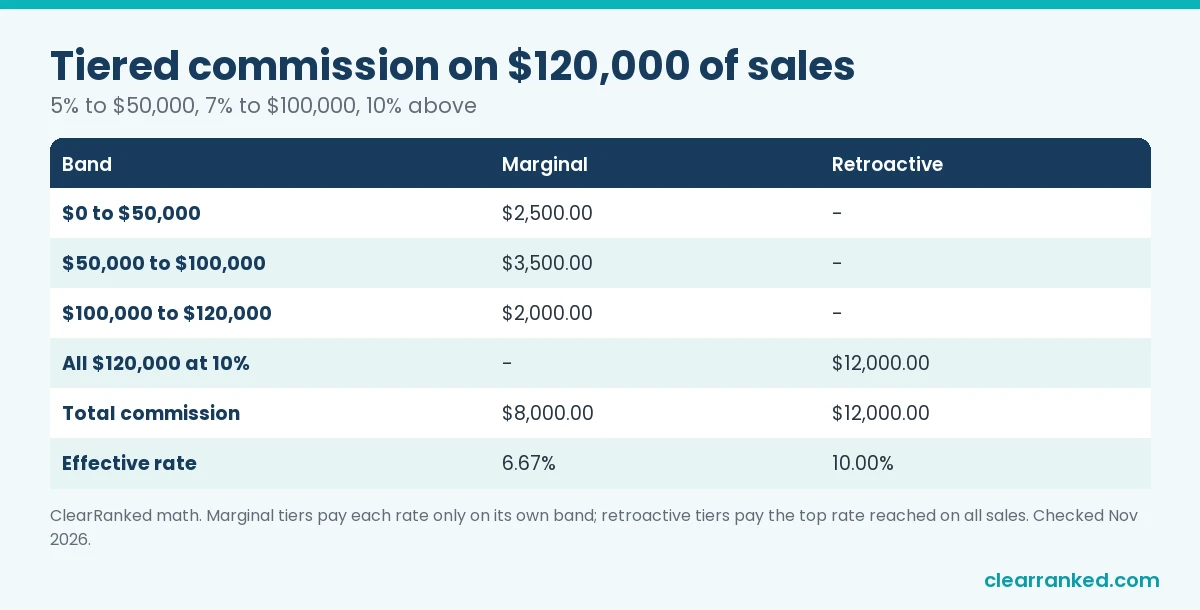
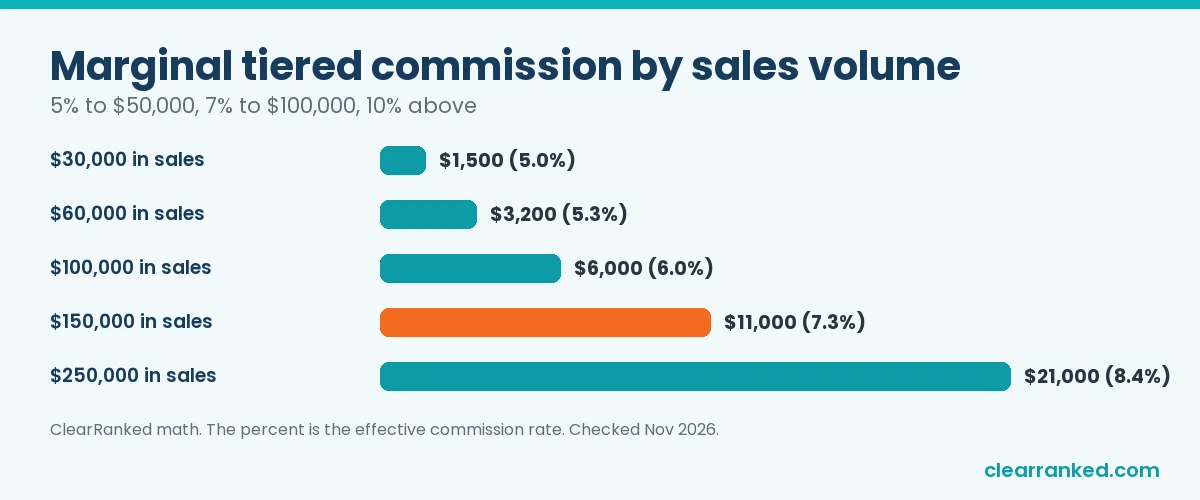
Now look at the cliff. Under the retroactive version, $100,000 of sales pays $7,000.00, but one more cent pays $10,000.00. That $3,000 jump gives reps a strong reason to pull deals into the period or push them out, which is why many companies prefer marginal tiers. Marginal plans still reward volume, just smoothly, as the effective rate below shows.
How do base plus commission and draws work?
A base plus commission plan pays a fixed salary plus commission on sales, so total pay = base + commission. A draw against commission is an advance paid when commission is low. If the draw is recoverable, the shortfall is paid back from future commission. If it's non-recoverable, the rep keeps it and the balance resets.
Here's a recoverable draw over two months. Jordan has a $2,500 monthly draw and earns 10% commission. In month one, sales are $20,000, so commission is $2,000. Jordan is paid the $2,500 draw, and $500 carries forward. In month two, sales are $60,000 and commission is $6,000. The $500 is recovered first, so Jordan is paid $5,500.00 and the balance returns to $0.
- Month 1: commission $2,000, paid $2,500.00, deficit $500.00
- Month 2: commission $6,000, minus $500 recovered, paid $5,500.00, deficit $0.00
If Jordan quit after month one, whether the company can collect that $500 depends on the written plan and state law, so get the terms in writing. Also, federal minimum wage still applies to nonexempt commissioned staff, and a draw is one way employers make sure each period clears it.
How are commissions taxed and treated for overtime?
Commissions are wages. They're subject to Social Security, Medicare and income tax withholding, and when paid separately from regular pay, an employer may withhold federal income tax at the 22% supplemental rate for 2026. For nonexempt employees, commission also has to be added to the regular rate when overtime is figured.
For example, a $3,200.00 commission check withheld at the flat rate has $704 of federal income tax, $198.40 of Social Security and $46.40 of Medicare taken out before any state tax. Your actual tax is settled on your return, so a flat 22% may be too much or too little. To see the reverse, our gross up calculator shows what gross commission leaves a given net amount, and the bonus tax calculator works the same way for bonuses.
On overtime, a nonexempt rep who earns commission and works more than 40 hours is owed extra half-time on a regular rate that includes the commission, spread over the hours in the period it was earned. Our overtime calculator handles the basic case. Not legal or tax advice, so check unusual plans with a CPA or employment lawyer.
Related calculators
- All ClearRanked calculators
- Gross up calculator
- Bonus tax calculator
- Paycheck calculator
- Profit margin calculator
FAQ
Multiply total sales by the commission rate. For example, $40,000 of sales at 8% is $3,200. If you also get a base salary, add the base for the period to get total pay.
Marginal tiers pay each rate only on the sales inside its band. Retroactive tiers pay the highest rate you reach on all of your sales. With tiers of 5%, 7% and 10%, $120,000 of sales pays $8,000 under marginal tiers and $12,000 under retroactive tiers.
A draw is an advance paid when commission is lower than the draw. With a recoverable draw, the shortfall carries forward and is taken from future commission. With a non-recoverable draw, the rep keeps the advance and nothing is owed back.
It depends on the product, the sales cycle and whether there's a base salary. Compare plans by effective rate and total pay at realistic sales levels, not by the headline percentage, since tiers and draws change the result.
Federal withholding on separately paid commissions can be a flat 22% under the 2026 supplemental wage rules, or 37% above $1 million of supplemental pay. That's withholding, not your final tax, which is settled on your return.
Yes, for nonexempt employees. Federal rules say commissions are pay for hours worked and must be included in the regular rate used to calculate overtime.
About the author
I'm Ali Hassan, the founder of ClearRanked. Also, I run small businesses myself, and I know how much time goes into payroll, sales pay plans and commission math. ClearRanked is where I share plain-English guides and honest comparisons, so small business owners can make decisions with confidence instead of guesswork.
How we work: this guide is research-based, and every source in it was checked in November 2026. We don't take payment for rankings, and we update guides when laws or prices change. Finally, read more on our About page.