Employer Payroll Tax Calculator: 2026 FICA, FUTA and SUTA Costs
This employer payroll tax calculator shows what your business owes on top of wages in 2026: 6.2% Social Security on pay up to $184,500, 1.45% Medicare on all pay, FUTA at 0.6% of the first $7,000, and your state unemployment (SUTA) rate. Enter one salary or a full staff list and get the cost per employee, per payroll and per year.
Employer payroll tax calculator (2026)
Wages in, the employer’s share of Social Security, Medicare, FUTA and state unemployment tax out, per employee and for the whole payroll.
An estimate, not tax advice. SUTA rate and wage base defaults are placeholders: use the numbers on your state’s rate notice. Credit reduction: 2025 rates were 1.2% in California and 4.5% in the U.S. Virgin Islands; check Schedule A (Form 940) for the 2026 list. Employee withholding is not included because it comes out of the worker’s pay.
Payroll taxes are the part of hiring that never shows up in the job ad. If you offer someone $48,000, your real tax bill is closer to $51,900 before you even think about workers comp or health coverage. So when you price a new hire, a raise or a seasonal crew, this is the number that belongs in the budget.
How we researched this: Social Security and Medicare rates and the 2026 wage base come from IRS Publication 15 (2026). FUTA rules come from IRS Topic 759 and the 2025 Schedule A (Form 940), which lists the credit reduction states. We checked them in November 2026.
Key takeaways
- Employer FICA is 7.65% of wages: 6.2% Social Security up to $184,500 in 2026, plus 1.45% Medicare with no cap.
- FUTA is 0.6% of the first $7,000 per worker for most employers, so it tops out at $42 a head.
- SUTA depends on your state's wage base and the rate on your yearly notice.
- Employers never pay the 0.9% Additional Medicare Tax; it's an employee-only withholding.
- For most staff, total employer payroll tax lands between 7.5% and 8.6% of wages.
How do you use the employer payroll tax calculator?
Pick whether everyone earns the same or list each person's yearly pay, then enter your SUTA rate and your state's wage base. Add a credit reduction only if your state is on the IRS list. The result splits the bill into the four taxes, per employee and for the whole payroll.
- Same pay mode is fastest for a crew at one wage. Type the yearly gross per person and the head count.
- List mode handles a real staff. Put one yearly wage per line; commas and dollar signs are fine. The caps are applied person by person, which matters a lot for high earners and part-timers.
- SUTA rate and base come from your state's rate notice. The 2.7% on $7,000 default is only a placeholder.
- Credit reduction stays at 0 unless your state owes the federal loan fund.
- Payrolls per year spreads the yearly total across your pay runs and shows which check fills the FUTA and Social Security caps.
How are employer payroll taxes calculated?
Each tax has its own rate and its own cap, so you figure them one at a time per employee. Social Security stops at $184,500 of wages, Medicare never stops, FUTA stops at $7,000 and SUTA stops at your state's base. Add the four, then add up all employees.
- Social Security = 6.2% x the smaller of wages or $184,500
- Medicare = 1.45% x all wages
- FUTA = (0.6% + any credit reduction) x the smaller of wages or $7,000
- SUTA = your rate x the smaller of wages or your state wage base
- Employer tax % = total employer tax / gross wages
Worked example: a cleaning company with eight staff
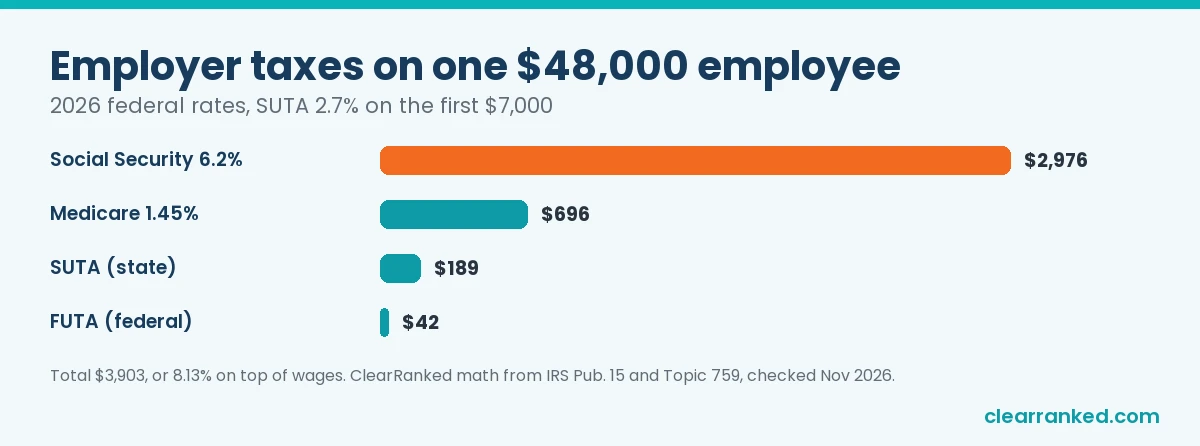
Dana runs a commercial cleaning business with eight employees, each earning $48,000. Her state sent a 2.7% SUTA rate on a $7,000 base, and she pays biweekly. Per employee, the math works out like this:
- Social Security: $48,000 x 6.2% = $2,976
- Medicare: $48,000 x 1.45% = $696
- FUTA: $7,000 x 0.6% = $42
- SUTA: $7,000 x 2.7% = $189
- Total: $3,903 per employee, or 8.13% of pay
Across eight people that's $31,224 a year, or about $1,200.92 per biweekly payroll on average. However, the cash doesn't leave evenly. Each person earns about $1,846 a check, so the $7,000 FUTA and SUTA bases fill up on the fourth payroll of the year. After that, Dana's tax per run drops to the 7.65% FICA share alone.
What is the employer FICA tax rate in 2026?
The employer pays 7.65% of wages: 6.2% for Social Security and 1.45% for Medicare, matching what's withheld from the employee. In 2026 the Social Security part applies to the first $184,500 of each person's wages, so the most you'll pay for one worker is $11,439 plus Medicare.
High earners change the percentage. Take a manager on $200,000. Social Security is 6.2% of $184,500, or $11,439, and Medicare is 1.45% of $200,000, or $2,900. Add FUTA and the 2.7% SUTA example and the total is $14,570, which is only 7.29% of pay. On a biweekly schedule, Social Security stops on the 24th check.
One thing that trips people up: the extra 0.9% Medicare tax on wages over $200,000 is not an employer cost. You withhold it from the employee's pay, but you don't match it, as Publication 15 explains. So this calculator leaves it out.
How do FUTA and SUTA work for employers?
FUTA is the federal unemployment tax: 6.0% of the first $7,000 per employee, cut to 0.6% when you pay your state unemployment tax in full and on time. SUTA is the state tax that funds benefits, with a rate and wage base your state sets for you each year.
FUTA is small but easy to get wrong. The $42 cap per worker only holds if you get the full 5.4% credit. If your state borrowed from the federal fund and hasn't paid it back, the credit shrinks. In 2025, California employers lost 1.2 points, so FUTA on a $48,000 worker was 1.8% of $7,000, or $126 instead of $42. You report that on Schedule A with your Form 940, and the extra is due with the fourth-quarter deposit.
SUTA varies far more. New employers usually start on a set rate, then move to an experience rate based on how many former workers drew benefits. State wage bases also differ a lot, so a $7,000 base and a base of $50,000 or more give very different bills. For state-specific rules, see our guides to Texas unemployment and New York unemployment.
| Tax | 2026 rate | Wage cap per employee | Max per employee |
|---|---|---|---|
| Social Security (employer) | 6.2% | $184,500 | $11,439 |
| Medicare (employer) | 1.45% | None | No max |
| FUTA, full credit | 0.6% | $7,000 | $42 |
| FUTA, 1.2% credit reduction | 1.8% | $7,000 | $126 |
| SUTA | Set by your state | Set by your state | Rate x base |
How much do employer payroll taxes add per employee?
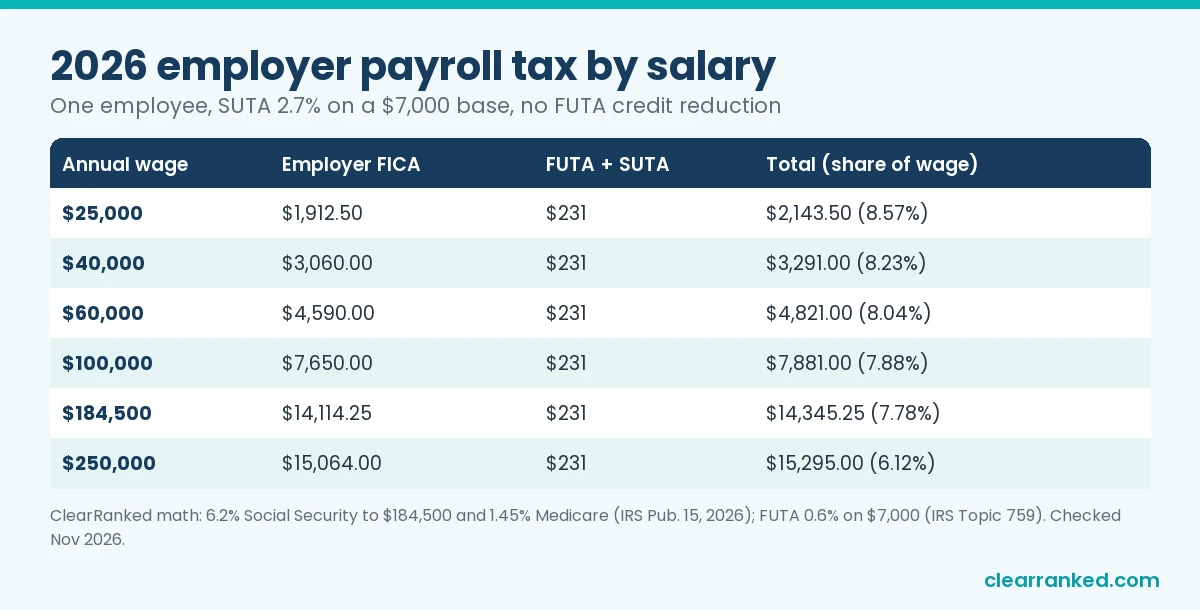
For a typical worker earning $25,000 to $184,500, employer payroll taxes add about 7.8% to 8.6% of wages. The share is highest on low wages, because the fixed unemployment taxes weigh more, and lowest above the Social Security cap, where only Medicare keeps growing.
Here's why list mode is worth the extra minute. Say your staff is $52,000, $38,000, $31,500, $96,000 and a summer helper at $6,200. Total wages are $223,700 and the employer tax comes to $18,241.65, or 8.15%. The helper never reaches the $7,000 base, so their FUTA is only $37.20 and their SUTA is $167.40. A same-pay estimate would miss that.
Payroll tax is only part of the cost of an employee. Workers comp, health coverage, PTO and retirement matches often add more. Our labor burden calculator rolls all of that into one hourly figure, and the workers comp cost calculator handles the insurance side. If you're paying your first employee, start with how to set up payroll.
| Situation | What changes in the math |
|---|---|
| Part-time or seasonal worker under $7,000 | FUTA and SUTA apply to every dollar they earn |
| Employee earns over $184,500 | Social Security stops; Medicare continues |
| Employee earns over $200,000 | You withhold 0.9% extra from them but pay no extra |
| FUTA owed passes $500 in a quarter | Deposit it electronically; under $500 carries forward |
| Pre-tax health premiums (Section 125) | Usually lower the wages subject to FICA and FUTA |
The calculator works on gross wages, so if your team pays health premiums through a cafeteria plan, enter wages after those premiums for a closer result. Check with a CPA for your situation, especially with workers in more than one state.
Can employers deduct payroll taxes?
Yes. The IRS lets employers deduct the Social Security, Medicare and FUTA taxes they pay out of their own funds, plus payments to state unemployment, state paid family leave and state disability funds, as business expenses.
That rule is in IRS Publication 334. It covers only the employer's share. The 7.65% you withhold from an employee's check comes out of their pay, so it isn't a second deduction for you.
Using the example above, a $48,000 employee costs about $3,903 a year in employer payroll taxes. You deduct the $48,000 in wages and the $3,903 in taxes, so the real after-tax cost is lower than the sticker price. Federal income tax itself is never deductible. If you're self-employed, the rule differs: you deduct half of your self-employment tax instead. Our guides on small business tax deductions and self-employment tax cover both. Check with a CPA for your situation.
Related calculators
- All ClearRanked calculators
- Labor burden calculator for the full cost of an hour of work
- Workers comp cost calculator
- Paycheck calculator for the employee side of the same check
- Self-employment tax calculator for owners and contractors
FAQ
Most employers pay 7.65% of each worker's wages for Social Security and Medicare, plus FUTA of up to $42 per worker and state unemployment tax. On a $48,000 employee that's about $3,903 a year in 2026, or 8.13% on top of wages, before workers comp or benefits.
It's 7.65%: 6.2% Social Security on wages up to $184,500 and 1.45% Medicare on all wages. The employer does not pay the extra 0.9% Additional Medicare Tax; that one is withheld only from the employee once their wages pass $200,000.
FUTA is 6.0% of the first $7,000 of each employee's wages, minus a credit of up to 5.4% for state unemployment tax paid on time. Most employers end up at 0.6%, which is $42 per employee per year. Credit reduction states add more.
It's a state that owes the federal unemployment trust fund money and hasn't repaid the loan. Employers there get a smaller FUTA credit, so they pay more. For 2025, California was 1.2% and the U.S. Virgin Islands 4.5%, settled on Schedule A (Form 940).
No. Each state sets its own wage base and assigns each employer a rate, often a fixed new-employer rate at first and then an experience rate based on past layoffs. Your state sends a yearly rate notice; that number goes into this calculator.
No. Independent contractors pay their own self-employment tax, so you don't pay FICA, FUTA or SUTA on their invoices. Misclassifying an employee as a contractor can lead to back taxes and penalties, so check the worker test first.
About the author
I'm Ali Hassan, the founder of ClearRanked. Also, I run small businesses myself, and I know how much time goes into payroll, payroll taxes and hiring costs. ClearRanked is where I share plain-English guides and honest comparisons, so small business owners can make decisions with confidence instead of guesswork.
How we work: this guide is research-based, and every source in it was checked in November 2026. We don't take payment for rankings, and we update guides when laws or prices change. Finally, read more on our About page.