WA Paid Family Leave 2026 and 2027: Premiums, Benefits, Rules
WA paid family leave, officially Washington Paid Family and Medical Leave, is a state insurance program that pays most workers up to 90% of their weekly pay while they’re on leave, capped at $1,647 a week in 2026. It’s funded by a premium of 1.13% of wages in 2026, rising to 1.2% on January 1, 2027.
If you run a small business in Washington, two numbers change your payroll on January 1: the new rate and the new split. Employees can now be charged up to 70.7% of the premium, down from 71.43%, so your share edges up a little even if you have just three people.
This guide covers the premium math, who qualifies for benefits, how long leave lasts, the job protection rules that changed in 2026, and the grants available to smaller employers.
How we researched this: all figures come from the Employment Security Department’s program site, including its 2027 premium update, the benefits and eligibility page, and the small business page. Our check was done in October 2026. It isn’t legal or tax advice, so confirm anything specific with ESD.
Key takeaways
- The total premium is 1.13% of gross wages in 2026 and 1.2% starting January 1, 2027.
- In 2027, you may withhold up to 70.7% of the premium from employees. Employers with 50 or more workers pay at least 29.3%.
- Businesses averaging fewer than 50 employees don’t pay the employer share, but they still collect and remit the employee share.
- Workers need 820 hours in their qualifying period. Benefits run up to 12 weeks, or 16 to 18 weeks in some combined cases.
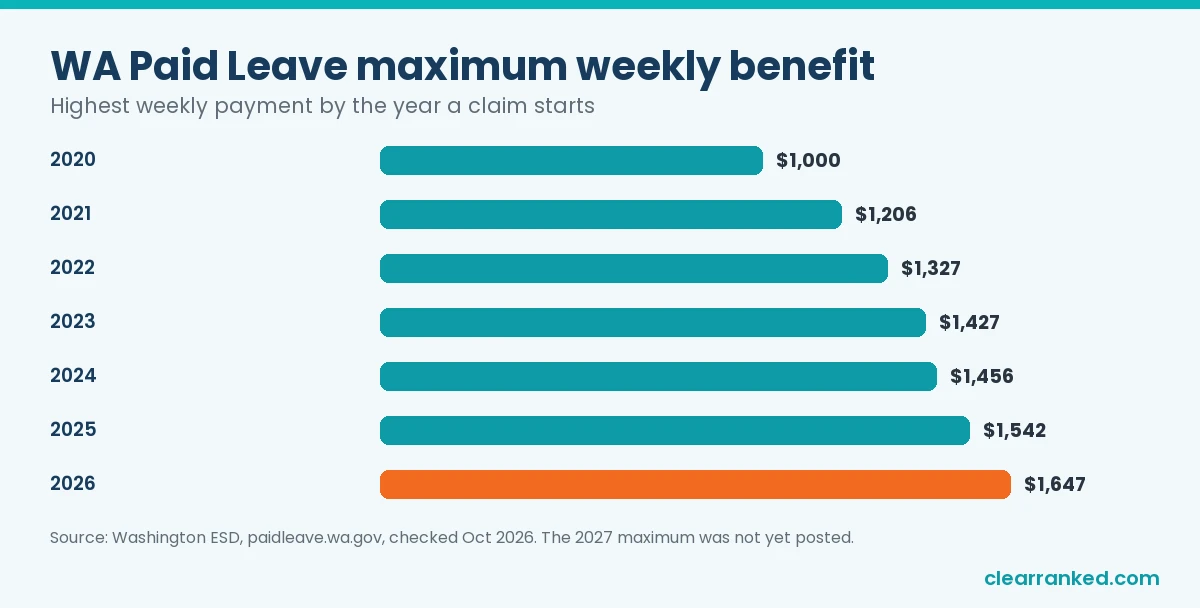
- The maximum weekly benefit is $1,647 for claims in 2026. ESD hadn’t posted the 2027 maximum when we checked.
How much is the WA paid family leave premium in 2027?
The WA paid family leave premium is 1.2% of each employee’s gross wages starting January 1, 2027, up from 1.13% in 2026. Employers may deduct up to 70.7% of that from paychecks. The remaining 29.3% is the employer’s share, unless the business has fewer than 50 employees.
ESD resets the rate every year around October 20, based on how much the fund took in and paid out. The rate has gone up as more people use the program, and ESD reports more than 221,000 people claimed benefits in the first nine months of 2026.
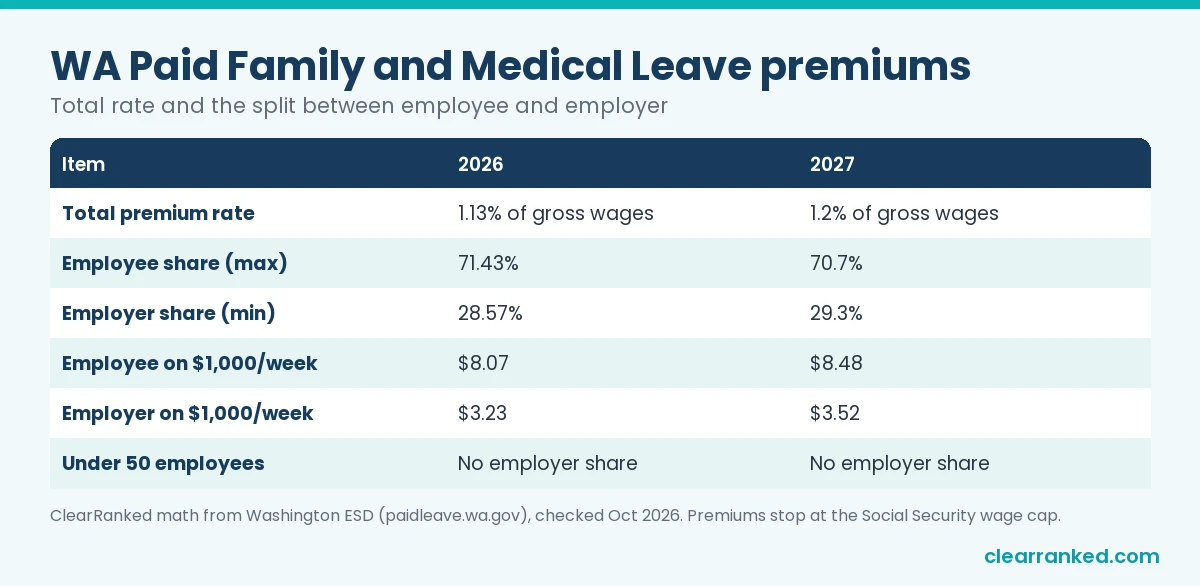
Here’s the two-step math ESD uses. First, multiply gross wages by the rate. Then split the result.
| Example | 2026 (1.13%) | 2027 (1.2%) |
|---|---|---|
| $60,000 salary: total premium | $678.00 | $720.00 |
| Employee share | $484.30 (71.43%) | $509.04 (70.7%) |
| Employer share (50+ staff) | $193.70 (28.57%) | $210.96 (29.3%) |
| $35,000 part-timer: total | $395.50 | $420.00 |
| Employee share | $282.51 | $296.94 |
| Employer share (50+ staff) | $112.99 | $123.06 |
Tips aren’t part of the wage base. Also, you stop collecting once an employee’s wages for the year hit the Social Security cap, which is $184,500 for 2026. You still report their wages after that point, though.
One rule trips people up. If you forget to withhold the employee share in a pay period, you can’t take it back later. ESD is clear that missed premiums can’t be clawed back from future checks, so you’d end up paying it yourself.
Do small businesses have to pay WA paid family leave?
Yes, every Washington employer must report wages and send in premiums. But a business averaging fewer than 50 employees doesn’t owe the employer share. It still has to withhold the employee share, or cover it as a perk, and remit it to ESD each quarter.
ESD sizes your business each September 30 by averaging headcount over the last four quarters of wage reports. It counts people, not full-time equivalents, so a café with 30 part-timers and a few full-timers is sized by the head. If your size changes, ESD mails a letter in October.
Take a five-person landscaping company with a $250,000 payroll in 2027. Total premium is $3,000. The owner can withhold up to 70.7%, which is $2,121, and owes no employer share because the company is under 50 employees. Many small owners choose to pay the whole employee share as a benefit. It’s cheap goodwill.
Premiums and wage reports are due quarterly. For the first quarter of 2027, they’re due by the end of April 2027. Since August 1, 2026, ESD charges penalties on late reports and interest on overdue balances, so don’t let them slide.
Who qualifies for Washington paid family and medical leave?
A worker qualifies after logging 820 hours of work in Washington during their qualifying period. That’s a 12-month window of calendar quarters that usually starts about 15 months before they apply. Full-time, part-time, temporary and seasonal hours all count, and the worker doesn’t need to be employed at the moment they apply.
Leave can be used for the worker’s own serious health condition, to care for a family member with one, to bond with a new child, and for certain military family events. Washington’s definition of family is broad. It covers siblings, grandparents, and even someone who expects to rely on the worker for care.
Some workers aren’t covered automatically. Those include federal employees, staff of tribally owned businesses on tribal land, self-employed people who haven’t opted in, and employees covered by an approved voluntary employer plan.
How long can you take WA paid family leave?
Most workers can take up to 12 weeks of family or medical leave in a claim year. If they have more than one qualifying event, they can combine up to 16 weeks. A pregnancy complication that causes incapacity can push the combined total to 18 weeks.
Leave doesn’t have to come in one block. A worker could, say, take Fridays off to sit with a spouse during chemo. Since 2026, the weekly minimum to claim is four straight hours, down from eight.
There’s normally an unpaid waiting week at the start. It doesn’t apply to bonding leave, leave in the postnatal period, or military exigency leave. Workers should give you 30 days’ notice when leave is foreseeable, and ESD’s processing time is about three to four weeks.
How much does WA paid family leave pay?
Benefits replace up to 90% of a worker’s weekly pay, with a maximum of $1,647 a week for claims that start in 2026. The weekly maximum is locked in when the claim starts, even if the leave runs into the next year.
Real-world example: a bakery shift lead earning $900 a week will get a share of that, not the full $900. ESD’s online estimator gives the exact amount from the wages you’ve reported. I’d send employees there rather than guess for them, since a wrong promise from the boss is hard to walk back.
Benefits come from the state, not from your payroll. So if an employee wants to top up with accrued PTO, check what your written policy allows. Our guides on writing a small business PTO policy and tracking PTO help you set that up cleanly.
Does WA paid family leave protect your job?
Since January 1, 2026, job protection applies at employers with 25 or more employees in Washington, for workers who’ve been there at least 180 days. The employer can refuse to restore the job only in narrow cases, such as the top 10% of salaried earners nearby, or a job that wouldn’t have existed anyway.
Federal FMLA is separate. It only covers employers with 50 or more employees and offers unpaid leave. When an absence qualifies for both, the two usually run at the same time, and using FMLA doesn’t shrink the state benefit.
If you have 25 or more people, the 2026 changes also clarified when you must keep health insurance going during job-protected leave. Update your handbook and leave forms now, and consider a leave management system once requests become regular.
What grants can small employers get?
Employers with 150 or fewer employees can apply for small business assistance grants of up to $3,000 when an employee takes approved paid leave. You can file up to 10 grants a year, one per worker on leave, within 12 months of the leave start date.
For businesses with 50 to 150 employees, there are two types: up to $3,000 if you hired a temporary replacement, or up to $1,000 for other wage-related costs like overtime for coworkers. Businesses under 50 can get up to $3,000 for either situation.
There’s a catch for the under-50 group. If you take a grant, you must pay the employer share of premiums for all employees for the next three years. On a $250,000 payroll in 2027, that’s about $880 a year ($3,000 total premium x 29.3%). For a one-off leave that cost you $3,000, it can still be worth it. Run the numbers first.
Not legal advice: rules change every year. Check paidleave.wa.gov or call ESD at (833) 717-2273 before you change payroll settings.
Related guides
- Washington paycheck calculator
- PTO policy for small business
- How to track PTO
- HR leave management system
- Employee handbook guide
- How to set up payroll
FAQ
It’s 1.2% of gross wages starting January 1, 2027. Employees can be charged up to 70.7% of that, and employers with 50 or more workers pay at least 29.3%.
It was 1.13% of gross wages, with employees paying up to 71.43% and employers paying at least 28.57%.
It’s $1,647 a week for claims that start in 2026. ESD hadn’t posted the 2027 maximum when we checked in October 2026.
You need 820 hours of work in Washington during your qualifying period, a 12-month window that usually starts about 15 months before you apply.
They don’t pay the employer share. They still must withhold or pay the employee share and send it to ESD each quarter.
Since 2026, yes for workers at employers with 25 or more employees who have worked there at least 180 days, with a few exceptions.
Up to 12 weeks for a single reason, up to 16 weeks combined, or up to 18 weeks with a pregnancy complication that causes incapacity.
About the author
I’m Ali Hassan, the founder of ClearRanked. Also, I run small businesses myself, and I know how much time goes into payroll, leave rules and HR paperwork. ClearRanked is where I share plain-English guides and honest comparisons, so small business owners can make decisions with confidence instead of guesswork.
How we work: this guide is research-based, and every source in it was checked in October 2026. We don’t take payment for rankings, and we update guides when laws or prices change. Finally, read more on our About page.