Employee Drug Testing: 2026 Laws, Panels and Policy Steps
Employee drug testing is legal for most private U.S. employers, but federal law rarely requires it. The big exception is the Department of Transportation, which mandates testing for safety-sensitive transport jobs under 49 CFR Part 40. Everyone else sets their own policy, within state limits that increasingly protect off-duty cannabis use.
So should your business test? It depends on what your people do all day. A trucking outfit has no choice. A 7-person marketing agency probably gains little and risks a lot of awkwardness. A roofing contractor sits somewhere in between, and that’s where most small-business owners get stuck.
Below you’ll find the federal rules, two state examples that show where cannabis law is heading, the actual DOT lab cutoffs, and a step-by-step way to write a pre-employment drug test policy that holds up.
How we researched this: we read the drug testing provision of the ADA at 42 U.S.C. 12114, the DOT lab rule at 49 CFR 40.85, California Government Code 12954, and New York Labor Law 201-d. Our review of each source took place in October 2026.
Key takeaways
- No federal law makes most private employers drug test. DOT-regulated safety jobs are the main exception.
- Under the ADA, a test for illegal drug use isn’t a medical exam, so you can test applicants before a job offer.
- California generally bars penalizing workers for off-duty cannabis use or for tests that only find non-psychoactive metabolites.
- New York protects legal off-duty cannabis use but lets you act on clear signs of impairment at work.
- Write the policy down, apply it the same way to everyone in a role, and use a certified lab.
Is employee drug testing legal?
Yes, in most cases. Federal law allows private employers to test applicants and employees, and the ADA states that a test for illegal drugs isn’t a medical examination. However, state laws control how, when and for what you can test, and some states sharply limit cannabis testing.
The ADA language is neutral on purpose. It says nothing in that law should be read to encourage or forbid testing. That leaves the real decisions to you and your state legislature.
The ADA’s main employment rules apply once you have 15 or more employees, according to the EEOC. Smaller employers still face state disability laws, which often cover fewer workers, so don’t assume a 10-person shop is exempt from everything.
One detail is easy to miss. The ADA carve-out names illegal drugs only. Alcohol isn’t in it, so a breath or blood alcohol test before a job offer carries more risk. If you want one, talk to an employment lawyer first.
Which employers are required to drug test?
Employers covered by DOT rules must test workers in safety-sensitive jobs. The DOT agencies involved include FMCSA (trucking), FAA (aviation), FRA (rail), FTA (transit) and PHMSA (pipelines). The process and lab standards come from 49 CFR Part 40. Most other private employers aren’t required to test at all.
Contracts can create duties too. Some government contracts and grants, and plenty of large commercial customers, write drug-free workplace terms into the deal. Read those clauses closely, because that’s where your obligation would come from.
Say you run a 14-truck delivery company with CDL drivers. You’re in the DOT world, so your program for those drivers has to follow Part 40 and FMCSA’s rules to the letter. Your office staff, though, sit outside that program unless you choose to include them under a separate company policy.
What does a pre-employment drug test look for?
A standard panel screens urine for marijuana, cocaine, opioids, amphetamines and PCP. DOT’s version adds specific opioids like oxycodone and hydrocodone and MDMA. Labs first run a screen, then confirm any result at or above the cutoff with a second, more precise test before calling it positive.
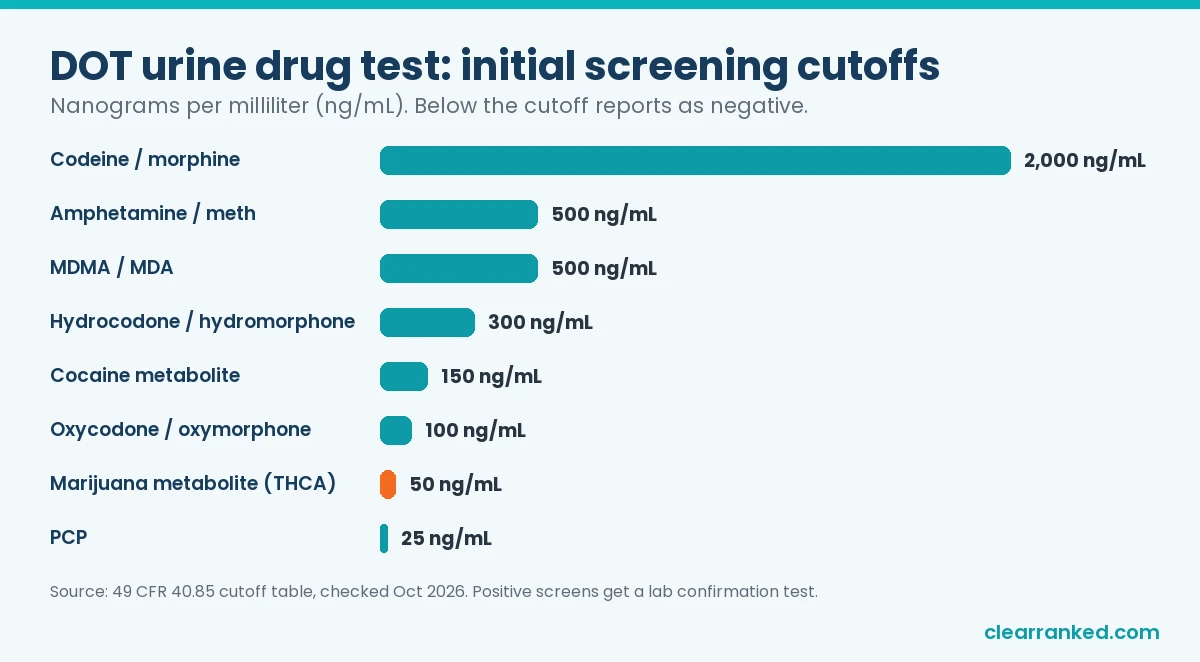
These are the initial screening cutoffs from 49 CFR 40.85. The confirmation cutoffs are lower. For marijuana, the confirmation level is 15 ng/mL, and for the cocaine metabolite it’s 100 ng/mL. A result under the cutoff gets reported as negative, even if a trace was present.
| Drug class (DOT) | Initial cutoff | Confirmation cutoff |
|---|---|---|
| Marijuana metabolite (THCA) | 50 ng/mL | 15 ng/mL |
| Cocaine metabolite | 150 ng/mL | 100 ng/mL |
| Amphetamine or methamphetamine | 500 ng/mL | 250 ng/mL each |
| MDMA or MDA | 500 ng/mL | 250 ng/mL each |
| Codeine or morphine | 2,000 ng/mL | 2,000 ng/mL each |
| Hydrocodone or hydromorphone | 300 ng/mL | 100 ng/mL each |
| Oxycodone or oxymorphone | 100 ng/mL | 100 ng/mL each |
| 6-acetylmorphine (heroin) | 10 ng/mL | 10 ng/mL |
| PCP | 25 ng/mL | 25 ng/mL |
Non-DOT employers aren’t bound by these numbers, but many use them because labs already run them. If you test outside DOT, ask your lab which panel and cutoffs it uses and put that in writing.
What are the workplace drug testing laws on marijuana?
They vary by state, and the trend is toward protecting off-duty use. California bars most employers from penalizing workers for off-the-job cannabis use or for tests that detect only non-psychoactive metabolites. New York protects legal off-duty cannabis use but allows action when an employee shows specific signs of impairment at work.
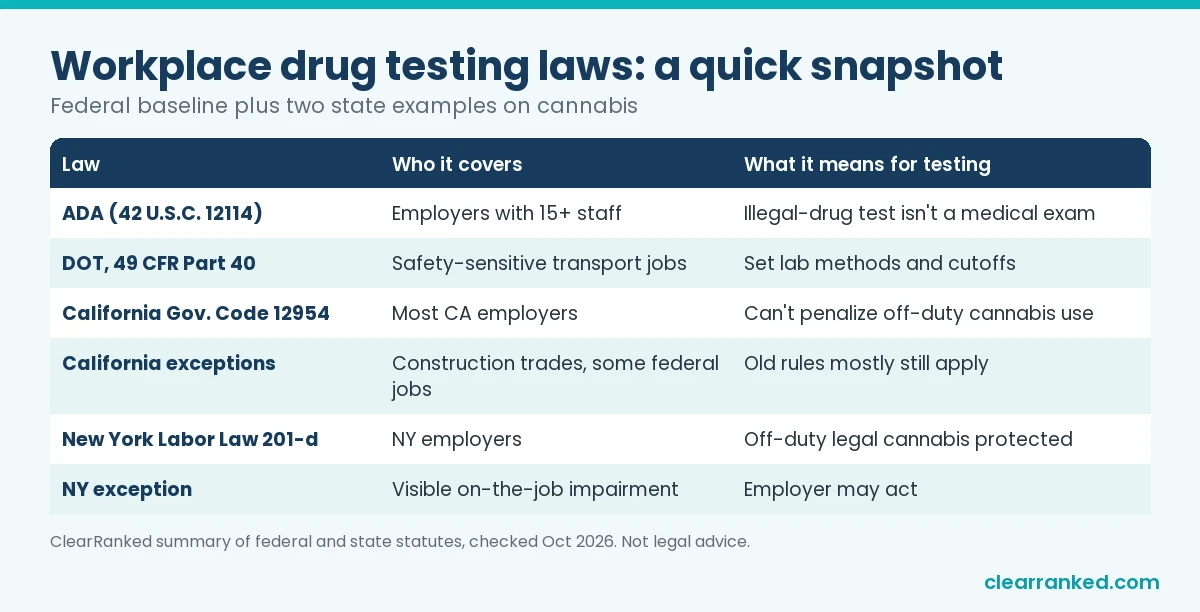
California’s rule, in Government Code 12954, has carve-outs worth knowing. It doesn’t cover employees in the building and construction trades, roles that need a federal background check or security clearance, or testing that federal or state law requires. It also doesn’t let anyone use or be impaired by cannabis on the job.
New York’s Labor Law 201-d takes a different angle. You can act if the law requires it, or if the employee shows specific, describable symptoms while working that reduce their performance or safety. A positive test alone isn’t enough there.
What should a multi-state employer do? Honestly, the simplest path for most small businesses is to drop routine THC screening for non-safety roles and focus on impairment at work. You’ll lose fewer good candidates, and you’ll stay clear of the strictest state rules.
When can employers test current employees?
Common times are after an accident, when a supervisor has reasonable suspicion, at random for safety-sensitive roles, and before returning someone to duty after a violation. Whichever you choose, write the triggers into your policy and apply them the same way to every employee in the same kind of job.
- Post-accident: after an incident that hurts someone or damages property. Set a time window in the policy.
- Reasonable suspicion: based on things a trained supervisor saw, like slurred speech or the smell of alcohol. Document it on a form, right away.
- Random: best kept to safety-sensitive positions. Use a neutral selection method.
- Return-to-duty and follow-up: after a violation, if you allow people to come back.
A practical example: a 25-person roofing crew tests after any fall or equipment accident and when a foreman documents signs of impairment. They don’t run random tests on the office staff. That’s a defensible, easy-to-explain policy.
If you work in construction, pair your testing policy with the right coverage. Our guide to contractor insurance explains how safety programs can affect what you pay.
How do you write a drug testing policy?
Put it in writing, say who gets tested and when, name the substances and the lab process, explain what happens after a positive result, and describe how you protect privacy. Then share it before testing begins, collect signed acknowledgments, and check it against your state’s law every year.
- Decide the purpose. Safety? Insurance? A customer contract? Your answer shapes everything else.
- List covered roles and the testing occasions for each.
- Choose a certified lab and a medical review officer to review positive results.
- Spell out consequences, such as a rescinded offer or a referral to treatment.
- Keep results confidential and separate from personnel files.
- Add the policy to your employee handbook and get signatures.
- Review each state where you hire, especially on cannabis.
Cost and setup vary by lab and region, so get two or three quotes. Some HR platforms can schedule tests and store consent forms, which our HR automation software roundup touches on.
Reminder: this page explains general rules and isn’t legal advice. A local employment attorney should sign off on your final policy, especially if you hire in more than one state.
How does drug testing work for federal employees?
Federal agencies drug test under Executive Order 12564, signed in 1986, which makes staying off illegal drugs a condition of federal employment. Agencies must randomly test workers in sensitive “testing designated positions,” and they can test job applicants too. Marijuana stays on the federal panel even where state law allows it.
The order lists the situations where an agency can test, per the National Archives text:
- Employees in sensitive positions chosen by the agency, usually on a random basis
- Any employee who volunteers
- Reasonable suspicion of illegal drug use
- After an accident or unsafe practice
- Follow-up after counseling or rehab through an employee assistance program
- Applicants for jobs
HHS sets the lab and collection rules in its Mandatory Guidelines. The newest urine guidelines, published in the Federal Register on October 29, 2026, say pre-employment tests apply to everyone applying for a testing designated position, current federal staff included. These rules cover federal civilian workers and programs like DOT that are required to use them. A private employer can copy the model, but it isn’t bound by it.
What do workplace drug testing statistics show for 2026?
About 4.3% of urine drug tests from the general U.S. workforce came back positive in 2025, down slightly from 4.4% in 2024, according to Quest Diagnostics’ 2026 Drug Testing Index. Hair tests ran far higher, at 19.1%. Hair catches use over a longer window, so the two rates aren’t directly comparable.
A few other numbers from the Quest report are useful when you set a policy. Healthcare had the highest overall positivity of any industry, at 5.8%. Fentanyl positives fell by nearly half, from 0.55% to 0.28%. And marijuana remained the drug behind most positive results. If you’re weighing whether to test at all, compare those rates with your own hiring volume: at 4.3%, about 4 of every 100 applicants tested would screen positive.
Related guides
- Employee handbook template and requirements
- Contractor insurance
- How to start a construction business
- Small business HR solutions
- HR automation software
FAQ
In many states, yes, especially for applicants, as long as the policy is written and applied evenly. Some states restrict random or suspicionless testing, so check local law first.
No. The ADA says a test for illegal drug use isn’t a medical examination, so you can test applicants before making an offer. Alcohol tests are treated differently.
Marijuana, cocaine, opioids (codeine, morphine, the heroin marker 6-acetylmorphine, hydrocodone, hydromorphone, oxycodone and oxymorphone), amphetamines, methamphetamine, MDMA, MDA and PCP.
The initial urine screen cutoff is 50 ng/mL, and the confirmation test cutoff is 15 ng/mL under 49 CFR 40.85.
Most can’t penalize workers for off-duty cannabis use or for tests that only show non-psychoactive metabolites. There are exceptions for construction trades, some federal jobs and legally required testing.
Only if you test. If you do, a written policy that names who gets tested, when, and what happens after a positive result protects both you and your employees.
About the author
I’m Ali Hassan, the founder of ClearRanked. Also, I run small businesses myself, and I know how much time goes into hiring, safety and HR rules. ClearRanked is where I share plain-English guides and honest comparisons, so small business owners can make decisions with confidence instead of guesswork.
How we work: this guide is research-based, and every source in it was checked in October 2026. We don’t take payment for rankings, and we update guides when laws or prices change. Finally, read more on our About page.