
Construction Signs: OSHA Colors, Required Site Signage and Work Zone Rules (2026)
Construction signs follow two rulebooks. On site, OSHA’s 29 CFR 1926.200 sets the colors: red danger signs for immediate hazards, yellow caution signs for potential ones, and green safety instruction signs. Anything that faces traffic must follow Part 6 of the federal MUTCD, which uses orange diamond warning signs and spaces them from 100 feet apart on slow city streets to over 2,000 feet on freeways.
Signs look like a small line item. However, the wrong color or a missing sign shows up fast in an OSHA inspection or a crash report. And a sign that stays up after the hazard is gone trains people to ignore the next one.
This guide sorts out which construction signs you need, what each color means, and how to lay out a basic work zone next to a road. The examples use real spacing numbers so you can sanity-check a traffic control plan.
How we researched this: we read OSHA’s sign rules in 29 CFR 1926 Subpart G and related sections on eCFR, plus the FHWA’s MUTCD 11th Edition, Revision 1, which FHWA lists as the current edition, dated December 2025. We checked both in October 2026.
Key takeaways
- Use red danger signs only for immediate hazards. Use yellow caution signs for potential hazards.
- Signs must stay visible during work and come down or be covered once the hazard is gone.
- Work zone signs that face road users must follow MUTCD Part 6. Warning signs there are diamond-shaped, black on orange.
- On urban streets, place the nearest warning sign 4 to 8 times the speed limit (in feet) ahead of the work.
- Cones must be at least 18 inches tall on low-speed roads in daylight, and 28 inches on freeways or at night.
- Post the OSHA workplace rights notice, and No Smoking or Open Flame signs near fire hazards.
What do the colors on construction signs mean?
Under OSHA’s construction rule, red marks danger, yellow marks caution, green marks safety instructions, and black-and-white panels give directions. Danger signs have a red upper panel, black border and white lower panel. Caution signs are mostly yellow with a black top panel. The rule ties these designs to ANSI Z535.2-2011 or the older ANSI Z35.1-1968.
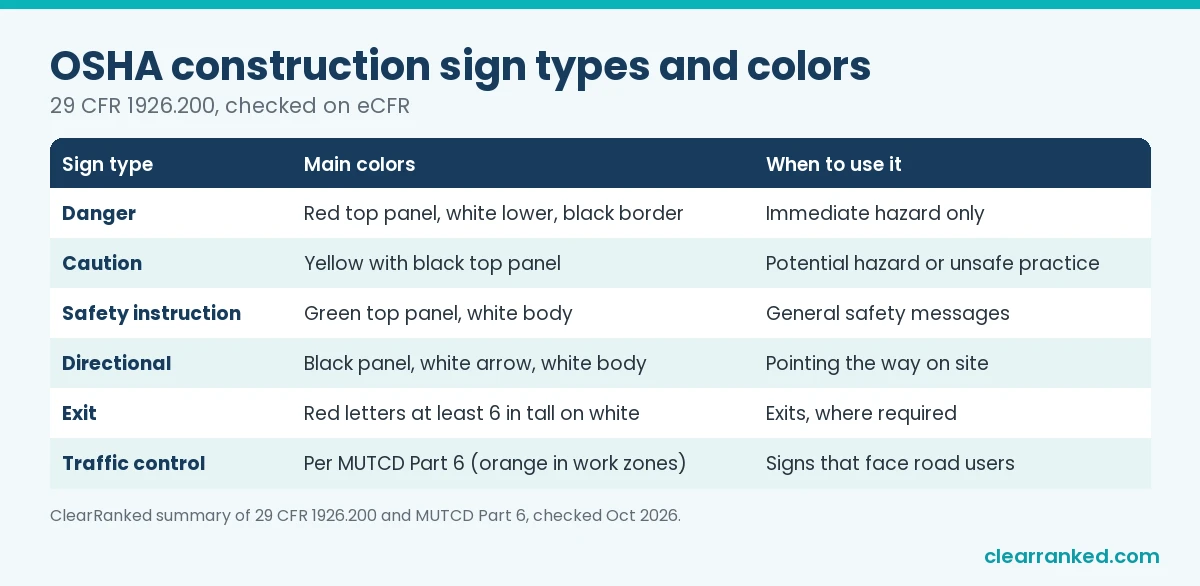
The key is picking the right level. A danger sign belongs at an unguarded floor opening or live electrical panel, where someone could be hurt right now. A caution sign fits a hazard that could hurt someone, like a slippery ramp or noise above a set level.
Overusing danger signs is a real problem. If every gate and fence panel screams DANGER, workers stop reading them. So save red for the places that truly need it.
Accident prevention tags are a separate tool. They’re for temporary warnings, like a tag on a defective saw or a locked-out breaker. However, OSHA says tags can’t replace a sign where a sign is required.
Which construction signs are required on a job site?
There’s no single federal list, but several OSHA rules require specific signs: hazard signs at points of danger, No Smoking or Open Flame signs near fire hazards, signs on nonpotable water outlets, swing-zone markings around cranes, and traffic control signs where the work meets the road. You must also post OSHA’s workplace rights notice, and your permit may require its own signs.
| Sign or notice | Where it goes | Rule behind it |
|---|---|---|
| OSHA rights notice (or state plan poster) | Where workers normally see notices | 29 CFR 1903.2 |
| No Smoking or Open Flame | Near fuel, flammable storage and other fire hazards | 29 CFR 1926.151 |
| Nonpotable water | On outlets not safe for drinking or washing | 29 CFR 1926.51 |
| Danger or caution signs | At each hazard, removed when it’s gone | 29 CFR 1926.200 |
| Swing or crush zone warnings | Around crane swing radius if barriers aren’t feasible | 29 CFR 1926.1424 |
| Work zone traffic signs | Facing road users near the work | MUTCD Part 6 |
| Permit placard and contractor info | Usually at the entrance | Local permit conditions |
Local rules vary a lot. Some cities want the permit card posted where an inspector can read it from the street, and some want an emergency contact sign on the fence. So check the permit conditions before your first inspection.
Signs are also part of keeping the public out, along with fencing, lighting and locked gates. If you hire out the dig, our guide to excavation contractors covers what to ask a sub about traffic control and site safety.
What rules apply to construction signs near roads?
Any sign, barricade, cone or other device used to protect workers from traffic must follow Part 6 of the Manual on Uniform Traffic Control Devices (MUTCD). That’s a direct OSHA requirement. Part 6 covers temporary traffic control, including sign colors, sizes, spacing, channelizing devices and flaggers. Many states adopt the MUTCD with their own supplements, so check your state DOT too.
The MUTCD breaks a work zone into four parts. The advance warning area tells drivers what’s coming. The transition area moves them out of their normal path. The activity area is where the work, and your crew, actually is. The termination area returns traffic to normal.
Most temporary warning signs in a work zone are diamond-shaped with a black legend on an orange background. There are exceptions, such as the grade crossing advance warning sign, which keeps its yellow background. Signs used for incident management may use fluorescent pink.
The 11th Edition also covers apparel. Flaggers and other workers exposed to traffic should wear high-visibility gear that meets ANSI/ISEA 107-2015 Performance Class 2 or 3, and Class 3 is recommended for flaggers at night.
How far apart should work zone signs be?
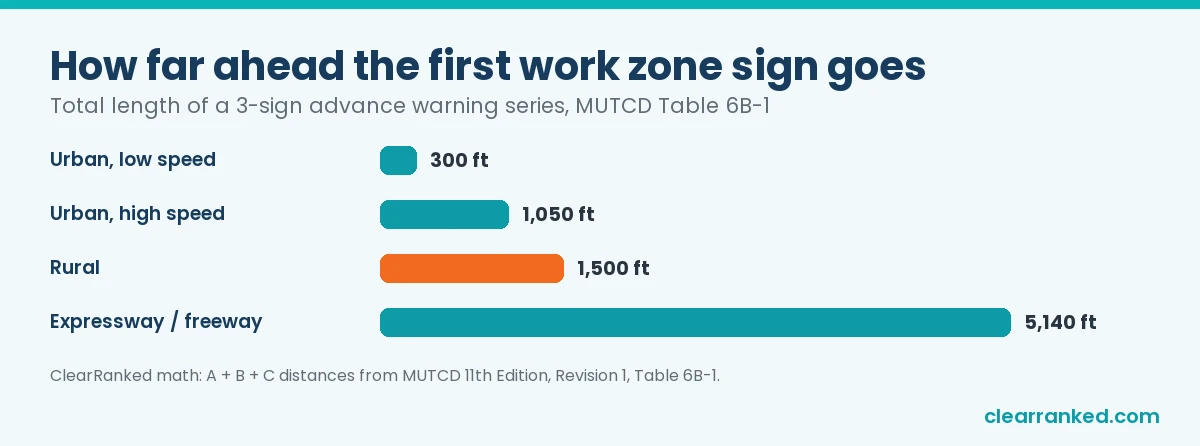
The MUTCD’s Table 6B-1 recommends spacing between each sign in a three-sign series of 100 feet on low-speed urban streets, 350 feet on high-speed urban streets, 500 feet on rural roads, and 1,000, 1,500 and 2,640 feet on expressways and freeways. These are guidance values, so adjust them with engineering judgment for hills, curves and sight lines.
The table uses three letters. A is the distance from the start of the restriction to the first sign drivers reach closest to the work. B is between the first and second signs. C is between the second and third. Here’s what that adds up to:
| Road type | A | B | C | Total (A + B + C) |
|---|---|---|---|---|
| Urban, low speed | 100 ft | 100 ft | 100 ft | 300 ft |
| Urban, high speed | 350 ft | 350 ft | 350 ft | 1,050 ft |
| Rural | 500 ft | 500 ft | 500 ft | 1,500 ft |
| Expressway / freeway | 1,000 ft | 1,500 ft | 2,640 ft | 5,140 ft |
There’s also a quick rule for city streets. The MUTCD says the nearest warning sign should sit 4 to 8 times the speed limit, in feet, ahead of the work. For a 35 mph street: 35 x 4 = 140 feet and 35 x 8 = 280 feet. So the closest sign goes 140 to 280 feet back, using the high end when speeds run fast.
On rural highways, the multiplier rises to 8 to 12 times the speed limit. At 55 mph that’s 55 x 8 = 440 feet to 55 x 12 = 660 feet for the first sign, and the whole warning area should reach 1,500 feet or more.
What size should construction cones and barricades be?
The MUTCD says cones must be mostly orange and at least 18 inches tall for daytime use on low-speed roads, and at least 28 inches tall on freeways, other high-speed roads, or anywhere at night. Drums must be at least 36 inches tall. Type 1 and Type 2 barricades must be at least 24 inches long, and Type 3 barricades at least 48 inches long.
- Cones used at night need retroreflective bands or lights. On 28 to 36 inch cones, that’s a 6-inch white band near the top plus a 4-inch band below it.
- Drums need alternating orange and white retroreflective stripes, at least two of each, with orange on top. Metal drums aren’t allowed.
- Barricade rails are 8 to 12 inches wide with orange and white stripes sloping down toward the side traffic should pass.
- Don’t put ballast on top of a drum, and keep sandbags low on barricades so they don’t become missiles when hit.
Cones and barricades also protect people on foot. If your work closes a sidewalk, the MUTCD expects you to keep a usable path where practical. Our excavation guide covers barricades at trench edges.
How do you keep construction signs compliant day to day?
Check signs every morning and after storms. Make sure each one is still visible, clean, upright, readable at night and placed where the plan says. Cover or remove signs once the hazard is gone, because a stale ROAD WORK AHEAD sign with no work teaches drivers to ignore the real ones. Replace faded or damaged signs promptly.
A simple daily routine works for most small contractors. Assign one person, give them a printed copy of the traffic control layout, and have them sign a short checklist. It takes ten minutes, and it gives you a record if something goes wrong.
Also, mount signs so they’re crashworthy. The MUTCD says large signs over 50 square feet on several breakaway posts need at least 7 feet of clearance from the ground. Smaller portable stands should be weighted at the base, not on top.
Finally, build sign costs into your bid. Our guides to planning a construction project and quantity takeoff show where temporary traffic control belongs in the estimate.
What do common work zone signs mean?
Each work zone sign tells drivers one specific thing. ROAD WORK AHEAD is the general first warning, ONE LANE ROAD means both directions will share a single lane, the flagger symbol means a person is directing traffic ahead, and END ROAD WORK marks where the zone ends.
| Sign (MUTCD code) | What it tells drivers | Where it goes |
|---|---|---|
| ROAD WORK AHEAD (W20-1) | Obstructions or restrictions ahead | First advance warning sign drivers meet |
| ROAD CLOSED (W20-3) | Closed to all traffic, or all but local traffic | Before the closure point |
| ONE LANE ROAD (W20-4) | Both directions must use one lane | Only ahead of that shared lane |
| Flagger symbol (W20-7) | A flagger is controlling traffic | Ahead of any flagger station, often with BE PREPARED TO STOP (W3-4) |
| Workers symbol (W21-1) | Workers in or near the roadway | When crews are in the road |
| END ROAD WORK (G20-2) | The work zone is over | Near the downstream end of the zone |
In the MUTCD Part 6, most placements are guidance, so ROAD WORK AHEAD “should” be the first sign drivers see. ONE LANE ROAD is a standard, though: it shall be used only ahead of a point where traffic in both directions must use one lane. If your crew isn’t running one-lane, two-way traffic, that sign doesn’t belong on the stand.
A few swaps are allowed. A FLAGGER word sign (W20-7a) with a distance can replace the flagger symbol, and a WORKERS word sign (W21-1a) can replace the workers symbol.
Related guides
- Construction debris removal
- How to excavate a construction site
- Excavation contractors
- How to plan a construction project
- Contractor insurance
FAQ
Danger signs, with a red upper panel, are only for immediate hazards that could cause serious injury right away. Caution signs, mostly yellow with a black top panel, warn about potential hazards or unsafe practices.
Under the MUTCD, temporary warning signs in work zones are usually diamond-shaped with a black legend and border on an orange background. Some exceptions keep yellow, and incident signs may use fluorescent pink.
Yes in practice. Employers must post OSHA’s workplace rights notice or an approved state plan poster, and specific OSHA rules require signs at hazards, near fire risks and on nonpotable water outlets.
On urban streets, the MUTCD suggests placing the nearest warning sign 4 to 8 times the speed limit in feet ahead of the work. On rural roads, use 8 to 12 times, with the warning area reaching 1,500 feet or more.
At least 18 inches for daytime use on low-speed roads, and at least 28 inches on freeways, other high-speed roads, or at night on any road, per the MUTCD.
FHWA lists the 11th Edition with Revision 1, dated December 2025, as the current version. States may adopt it with their own supplements, so check your state DOT.
About the author
I’m Ali Hassan, the founder of ClearRanked. Also, I run small businesses myself, and I know how much time goes into job site safety, signage and construction rules. ClearRanked is where I share plain-English guides and honest comparisons, so small business owners can make decisions with confidence instead of guesswork.
How we work: this guide is research-based, and every source in it was checked in October 2026. We don’t take payment for rankings, and we update guides when laws or prices change. Finally, read more on our About page.