
Places That Hire at 14: Child Labor Laws, Hour Limits and Allowed Jobs (2026)
Places that hire at 14 are mostly grocery stores, restaurants and fast-food spots, retail shops, movie theaters, offices, car washes and family businesses, in roles like bagging, cashiering, cleaning and serving. Federal law lets 14- and 15-year-olds work up to 3 hours on a school day and 18 hours in a school week, between 7 a.m. and 7 p.m. (9 p.m. from June 1 to Labor Day).
That’s the short version for teens and parents. For employers, the details matter more, because a single schedule mistake can lead to a federal penalty of up to $16,035 for that one worker.
This guide covers the kinds of businesses that can hire 14-year-olds, exactly what the hour limits are, which tasks are banned, how rules change at 16 and 17, and how state laws stack on top. Not legal advice; your state may add rules such as work permits.
How we researched this: we read the federal child labor rules directly in the eCFR, including 29 CFR 570.2 (minimum ages), 570.33 and 570.34 (banned and allowed jobs), 570.35 (hours) and 579.1 (penalties). The Department of Labor child labor page blocked us, so we checked an archived copy. Everything was reviewed in October 2026.
Key takeaways
- 14 is the youngest age for most non-farm jobs under federal law. 16 is the general minimum for everything else.
- School weeks: at most 3 hours a day and 18 hours a week. Summer and breaks: 8 hours a day and 40 a week.
- Work must fall between 7 a.m. and 7 p.m., or until 9 p.m. from June 1 through Labor Day.
- 14- and 15-year-olds can’t use power-driven machinery, climb ladders, bake, or do most cooking.
- At 16 and 17 there are no federal hour limits, but hazardous jobs stay off-limits until 18.
- Penalties reach $16,035 per minor, and $72,876 if a violation causes death or serious injury.
What places hire at 14?
Under federal rules, 14-year-olds can work in retail, food service, grocery, office and some service jobs, as long as the tasks are on the allowed list. Common employers include grocery stores, restaurants and fast-food places, ice cream shops, movie theaters, retail stores, car washes, and family-run businesses. Fifteen-year-olds can also work as certified lifeguards.
| Type of business | Jobs a 14-year-old can usually do | Watch out for |
|---|---|---|
| Grocery store | Bagging, carrying out orders, shelving, price tags, cashier | No meat prep or power equipment |
| Restaurant or fast food | Serving, bussing, dishes, cleaning, limited cooking | No open-flame cooking or slicers |
| Retail store or theater | Cashier, sales floor, stocking | No ladders or forklifts |
| Office | Filing, data entry, phones, office machines | Few limits beyond hours |
| Car wash or gas station | Car cleaning, pumping gas, courtesy service | No hoists or repair work |
| Pool or water park (age 15) | Lifeguard with certification | Not at the top of water slides |
| Family business | Wider range if owned by a parent | Not mining, manufacturing or hazardous work |
Those categories come straight from the allowed-jobs list in 29 CFR 570.34, which covers cashiering, bagging, shelving, office work, kitchen work, car cleaning and gas dispensing. Whether a particular store hires at 14 is its own policy choice, and many prefer 16. So call or ask in person; it’s faster than searching online.
For teens, a few tips help. Bring a parent’s contact info, know your available hours, and ask if a work permit is needed in your state. Smaller local businesses are often more open to younger workers than big chains.
How many hours can a 14-year-old work?
During the school year, 14- and 15-year-olds can work no more than 3 hours on a school day, including Fridays, and no more than 18 hours in a school week. When school is out, the limits rise to 8 hours a day and 40 hours a week. All work must be outside school hours and between 7 a.m. and 7 p.m.
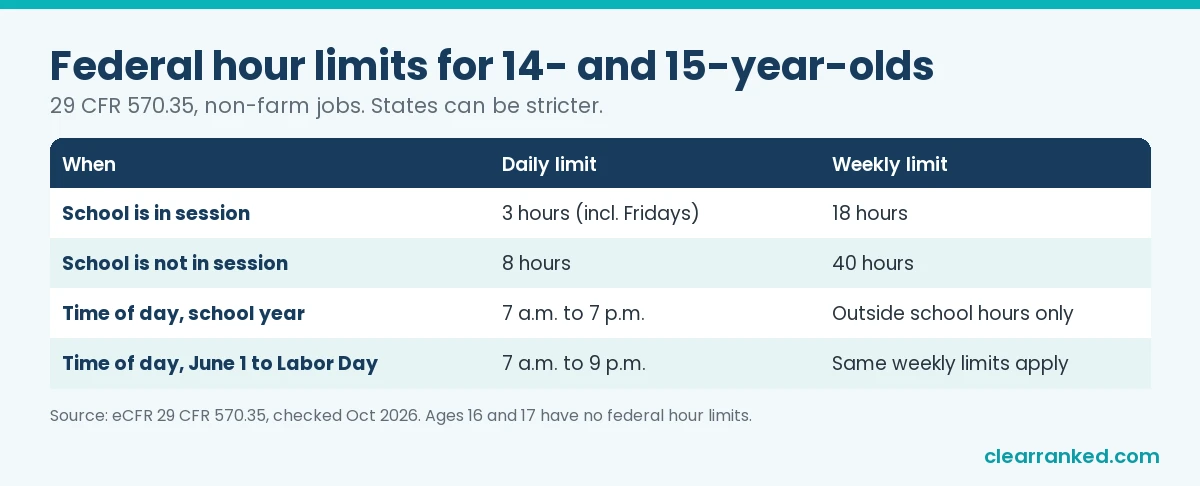
The evening limit stretches to 9 p.m. from June 1 through Labor Day, per 29 CFR 570.35. Notice that the summer exception is about the clock, not the totals. A 15-year-old can work later in July, but still no more than 8 hours in a day.
Here’s a quick employer check. Say a 14-year-old works Monday to Thursday after school, 3:30 to 6:30 p.m. That’s 3 hours x 4 days = 12 hours. Adding a 6-hour Saturday shift makes 18 hours, which is the weekly cap. Adding even one Friday shift on top breaks the rule.
Track these hours in your timekeeping system with an age flag, so managers can’t schedule over the limit by accident. Our hours worked calculator and employee scheduling software guide can help.
What jobs can’t 14- and 15-year-olds do?
They can’t run power-driven machinery, including lawn mowers, slicers, mixers and food processors. They can’t climb ladders or scaffolds, bake, cook over an open flame, work in freezers or meat coolers except briefly, drive or ride on vehicles for work, do door-to-door sales, or work in manufacturing, mining or boiler rooms.
That list comes from 29 CFR 570.33, which also bans all jobs that are off-limits for 16- and 17-year-olds. Cooking is a gray area people get wrong. A 14-year-old may cook on electric or gas grills without an open flame, and use deep fryers that lower and raise the baskets automatically. Manual fryers, broilers and rotisseries are out.
- Allowed: cashier, bagging, shelving, cleaning with vacuums and floor waxers, dishes, serving food.
- Allowed with limits: cooking on non-open-flame grills and auto-lift fryers.
- Not allowed: mowers, weed eaters, meat slicers, dough mixers, ladders, baking.
- Not allowed: delivery by car, door-to-door sales, work in freezers beyond quick trips.
What are the rules for 16- and 17-year-olds?
At 16 and 17, federal law sets no limit on hours or times of day. However, teens under 18 still can’t do jobs the Department of Labor has declared hazardous, such as most on-the-job driving, forklifts and other power-driven hoists, woodworking machines, and power-driven meat-processing or bakery machines. States often add their own hour limits for this age group, especially on school nights.
The age ladder is in 29 CFR 570.2: 14 for approved jobs, 16 as the general minimum, and 18 for hazardous occupations. Driving is a common trip-up. A 17-year-old may drive on the job only in narrow cases, with a valid state license, a completed driver education course and no moving violations at hire, among other conditions.
There’s also a parent exception. A parent can employ their own child at younger ages in their business, but not in mining, manufacturing or jobs declared hazardous for under-18s.
What are the penalties for breaking child labor laws?
Under 29 CFR 579.1, an employer can face a civil penalty of up to $16,035 for each minor employed in violation of the child labor rules. If a violation causes the death or serious injury of a worker under 18, the maximum is $72,876, and that can be doubled for repeated or willful violations.
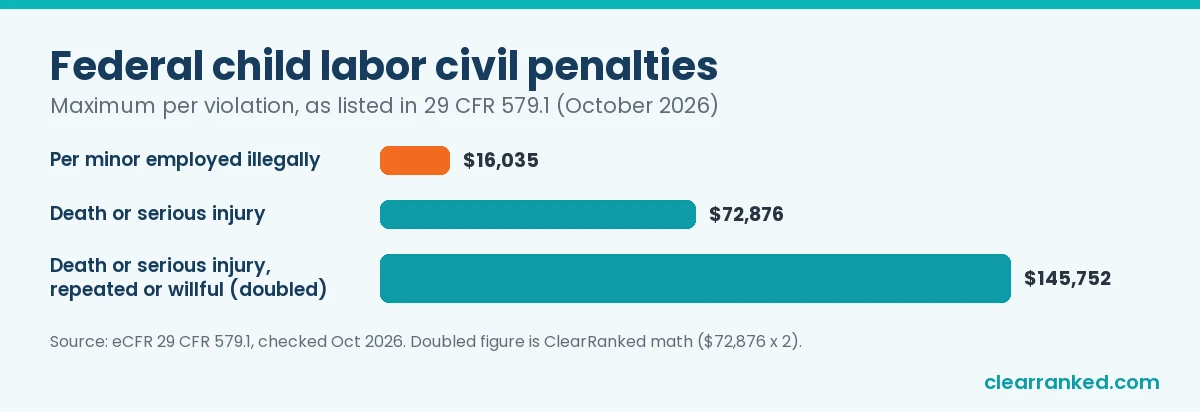
These are per-person caps, so they stack. Three teens scheduled past the 18-hour weekly limit could mean three penalties, as 29 CFR 579.1 lists them. The agency also considers business size and how serious the violation was when it sets the actual amount.
| Violation | Maximum civil penalty |
|---|---|
| Each minor employed in violation | $16,035 |
| Violation causing death or serious injury of a minor | $72,876 |
| Same, repeated or willful | Up to double ($145,752) |
If you’ve found a problem in your own schedules, fix it right away and get advice. Our employment law attorney guide explains when outside counsel makes sense.
Do state child labor laws change the rules?
Often, yes. Many states require work permits or age certificates, set tighter school-night hours for 16- and 17-year-olds, or require meal breaks for minors. Employers have to follow both the federal and the state rules, which in practice means meeting the stricter one. Check your state labor department before you hire anyone under 18.
For example, a state might cap 16-year-olds at a certain number of hours on a school night even though federal law doesn’t. Or it may require the teen to bring a permit signed by a school official before day one. Those steps are easy to handle once you know them.
Pay rules apply to teens too. Minors are generally owed the same minimum wage and overtime rules as adults, unless a specific exception applies. Our overtime pay laws by state guide covers the overtime side, and a written employee handbook is a good place to set teen scheduling rules.
How much do 14-year-olds get paid?
Under federal law, a 14-year-old must earn at least the $7.25 federal minimum wage, but employers may pay workers under 20 a youth wage of $4.25 an hour for their first 90 consecutive calendar days on the job.
The youth wage comes from 29 U.S.C. 206(g) of the Fair Labor Standards Act. It is optional, not automatic, and it has limits:
- It lasts 90 calendar days in a row from the first day of work, not 90 days worked.
- It ends sooner if the worker turns 20.
- It applies to the first 90 days with each employer, so it doesn’t restart with the same employer.
- An employer may not cut the hours, wages or benefits of current staff, or let them go, to hire teens at the lower rate.
So a 14-year-old working 12 hours a week during the school year earns at least $51 a week at the youth rate ($4.25 x 12), and at least $87 a week ($7.25 x 12) once the 90 days are up. Many states set a minimum wage above $7.25, and some don’t allow a lower youth rate, so check your state labor department before you set a teen’s pay.
Related guides
- Employee scheduling software
- Hours worked calculator
- Overtime pay laws by state
- Employee handbook guide
- When to hire an employment law attorney
- Second shift hours explained
FAQ
Look at grocery stores, restaurants, fast-food spots, ice cream shops, movie theaters, retail stores, car washes and family businesses. Hiring at 14 is each employer’s choice, so ask in person.
Yes, outside school hours, for up to 3 hours on a school day, and only until 7 p.m. during the school year.
Until 9 p.m. from June 1 through Labor Day, with a limit of 8 hours a day and 40 hours a week.
Only in limited ways. They can use electric or gas grills without an open flame and deep fryers that raise and lower baskets automatically.
Not under federal law, but they still can’t do hazardous jobs, and many states set their own limits for 16- and 17-year-olds.
Up to $16,035 per minor under 29 CFR 579.1, and up to $72,876 when a violation causes death or serious injury, which can be doubled if repeated or willful.
About the author
I’m Ali Hassan, the founder of ClearRanked. Also, I run small businesses myself, and I know how much time goes into hiring, scheduling and staff rules. ClearRanked is where I share plain-English guides and honest comparisons, so small business owners can make decisions with confidence instead of guesswork.
How we work: this guide is research-based, and every source in it was checked in October 2026. We don’t take payment for rankings, and we update guides when laws or prices change. Finally, read more on our About page.