Break Even Calculator: Find Your Break-Even Point in Units and Sales

This break even calculator shows how many units, or how many dollars of sales, you need to cover your fixed and variable costs. It also returns your contribution margin and ratio, the sales needed for a target profit, your margin of safety and a profit table at six sales volumes.
Break-Even Calculator
Enter fixed costs, price and variable cost. Results update as you type.
Estimate only, not financial or tax advice. It assumes price and variable cost per unit stay the same at every volume and that fixed costs don’t step up.
Break-even is the first number a lender, landlord or new partner will ask about. It's also the most honest test of a pricing idea. If you need 3,000 sales a month and you've never sold more than 400, the plan has a problem no spreadsheet can fix.
Our method: the formulas below are standard cost-volume-profit math, the same approach the SBA break-even guide describes for business plans. Every worked number on this page was run through the calculator and checked by hand in November 2026.
Key takeaways
- Break-even units = fixed costs / (price - variable cost per unit).
- Break-even revenue = fixed costs / contribution margin ratio.
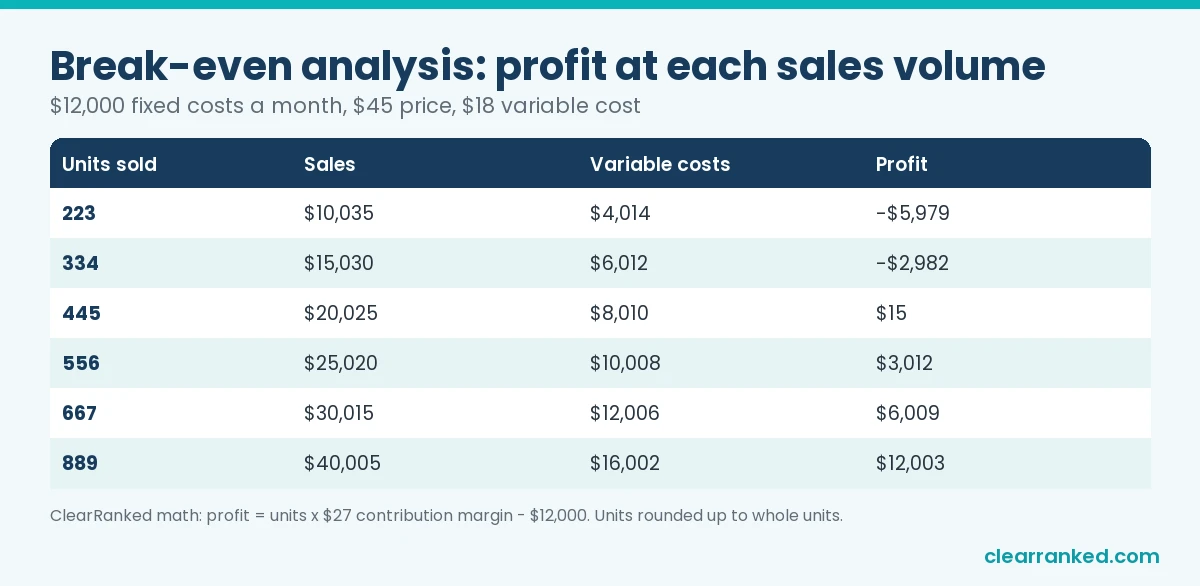
- With $12,000 of monthly fixed costs, a $45 price and $18 variable cost, you break even at 445 units, or $20,000 of sales.
- To earn a target profit, add it to fixed costs and run the same formula.
- If price is at or below variable cost, there's no break-even point at any volume.
How do you use the break even calculator?
Choose units if you sell products or billable hours with a set price, or sales dollars if you only know costs as a share of revenue. Enter fixed costs for one period, then price and variable cost per unit. Add a target profit and an expected volume to see how much room you have.
- Fixed costs. Costs that don't change with sales in the short run: rent, base salaries, insurance, loan payments, subscriptions. Keep the period consistent. Monthly costs give a monthly break-even.
- Price per unit. What the customer actually pays after typical discounts, not list price.
- Variable cost per unit. Everything that rises with each sale: materials, packaging, shipping you cover, card processing, sales commission.
- Target profit. Optional. It shows the units or sales you need to clear that amount for the period.
- Expected volume. Optional. Adds your profit at that level and the margin of safety.
What is the break even point formula?
The break even units formula is fixed costs divided by contribution margin per unit, where contribution margin is price minus variable cost. Multiply the units by price to get break-even revenue. Because you can't sell part of a unit, round the result up.
Take a small candle brand. It spends $12,000 a month on rent, two part-time wages and software. Each candle sells for $45 and costs $18 in wax, glass, labels and shipping.
- Contribution margin: $45 - $18 = $27 per candle
- Break-even units: $12,000 / $27 = 444.44, so 445 candles a month
- Contribution margin ratio: $27 / $45 = 60%
- Break-even revenue: $12,000 / 0.60 = $20,000
- At an expected 600 candles: 600 x $27 - $12,000 = $4,200 profit
The margin of safety here is (600 - 444.44) / 600 = 25.93%. In plain terms, sales could fall about a quarter before the month turns into a loss. That cushion is often more useful than the break-even number itself.
How do you find break-even revenue without unit prices?
Use the contribution margin ratio: one minus variable costs as a share of sales. Divide fixed costs by that ratio. A cleaning company with $8,000 of monthly fixed costs and variable costs of 35% of revenue has a 65% ratio, so it breaks even at $12,307.69 of monthly sales.
This mode suits service firms, restaurants and shops with hundreds of items, where a single unit price doesn't exist. Pull the variable share from last year's books: direct labor, supplies and merchant fees divided by revenue. For example, if those came to $70,000 on $200,000 of sales, use 35%.
Then add the profit goal. The same cleaning company wants $2,000 a month for the owner beyond salary. ($8,000 + $2,000) / 0.65 = $15,384.62 of monthly sales. If it expects $15,000, the margin of safety is 17.9% and profit is $1,750.00.
How many units do you need to hit a profit target?
Add the target profit to fixed costs, then divide by contribution margin per unit. For the candle example, a $5,000 monthly profit goal needs ($12,000 + $5,000) / $27 = 629.63, so 630 candles, or about $28,333 in sales.
Is the target pre-tax or after tax? The formula works on pre-tax profit. If you want $5,000 after a 25% combined tax rate, divide first: $5,000 / 0.75 = $6,667 of pre-tax profit, then run the formula with that.
Owners of pass-through businesses often think in take-home terms. In that case it helps to treat your own pay as a fixed cost and set the target at what the business should keep for growth. Our self employment tax calculator shows how much of that profit goes to SE tax.
What changes the break-even point most?
Price usually moves it most, because a price change goes straight into contribution margin. In the candle example, raising price 10% cuts break-even from 445 to 381 units, while cutting fixed costs 10% only gets it to 400. A 10% discount pushes it up to 534 units.
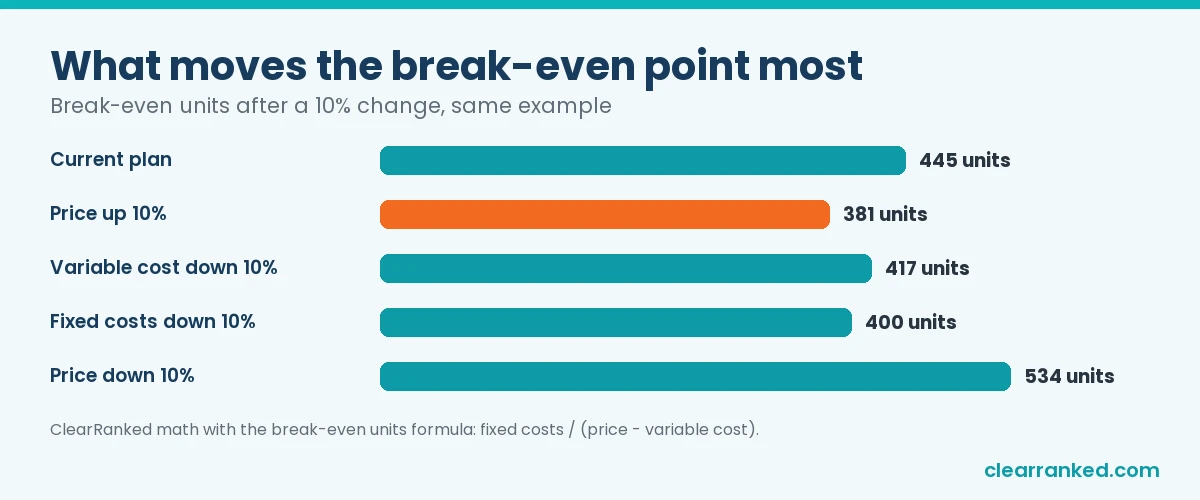
That last row is why blanket discounts hurt small sellers. A 10% price cut here drops margin from $27 to $22.50, so you need 20% more sales just to stand still. Before running a promotion, check the math with our discount calculator and then come back here.
What does a break even analysis table show?
It lists sales, variable costs and profit at several volumes around break-even, so you can see how fast losses shrink and profits grow. Below break-even each missing unit costs one contribution margin; above it each extra unit adds one. The calculator builds this table from your inputs.
| Term | Meaning | Candle example |
|---|---|---|
| Fixed costs | Costs that stay put as volume changes | $12,000 a month |
| Variable cost | Cost that rises with each unit | $18 per candle |
| Contribution margin | Price minus variable cost | $27 per candle |
| CM ratio | Contribution margin / price | 60% |
| Break-even point | Fixed costs / contribution margin | 445 units |
| Margin of safety | (Expected - break-even) / expected | 25.93% at 600 units |
A few things throw the analysis off. Mixed costs, like a phone plan with a base fee plus usage, need splitting into a fixed and a variable part. Step costs are another trap: a second delivery van makes fixed costs jump at a certain volume. If you sell several products, use a weighted average contribution margin based on your sales mix.
Finally, break-even ignores cash timing. You can be profitable on paper and still short on cash if customers pay in 60 days. Pair this with the profit margin calculator and, for pricing, the markup calculator.
Related calculators
- All ClearRanked calculators
- Profit margin calculator
- Markup calculator
- Discount calculator
- Free business plan template
FAQ
Divide fixed costs by contribution margin per unit, which is price minus variable cost per unit. For $12,000 of fixed costs, a $45 price and $18 variable cost, that's $12,000 / $27 = 444.44, so 445 units.
Break-even sales equal fixed costs divided by the contribution margin ratio. The ratio is contribution margin divided by price, or one minus variable costs as a share of sales.
There is no single rule, but many small businesses aim for 20% or more, meaning sales can drop a fifth before losses start. Seasonal or new businesses usually want a bigger cushion.
Yes, if you pay yourself a set amount. Treating it as fixed shows the volume needed to cover your pay as well as the bills, which is the honest break-even for most owner-run firms.
Your price is at or below your variable cost per unit, so each sale loses money or earns nothing toward fixed costs. Raise the price or cut per-unit costs before volume can help.
Work out a weighted average contribution margin using your expected sales mix, then divide fixed costs by it. Recheck it when the mix changes, since a shift toward low-margin items raises break-even.
About the author
I'm Ali Hassan, the founder of ClearRanked. Also, I run small businesses myself, and I know how much time goes into pricing, budgets and small business math. ClearRanked is where I share plain-English guides and honest comparisons, so small business owners can make decisions with confidence instead of guesswork.
How we work: this guide is research-based, and every source in it was checked in November 2026. We don't take payment for rankings, and we update guides when laws or prices change. Finally, read more on our About page.