Discount Calculator: Sale Price, Stacked Discounts and Margin Impact

This discount calculator gives you the sale price and the amount you save for any percent off or dollars off, including stacked deals and sales tax. Its business mode goes further: enter your unit cost and regular price to see the new margin and how many extra units you’d need to sell to earn the same gross profit.
Discount Calculator
Shopper mode finds the sale price. Business mode shows what the discount does to your margin.
Math only. Business mode looks at gross profit (price minus unit cost) and ignores fixed costs, card fees and shipping.
Shoppers mostly want the first tab. Owners should spend time on the second one before they run a promo, because a discount that looks small on the shelf can wipe out half the profit on each sale.
How we researched this: the math is standard percent arithmetic, and we tested the calculator code against a separate Python version on 13 cases, including a 100% discount, dollars-off larger than the price, and discounts that push the price below cost. The advertising rule comes from the FTC's Guides Against Deceptive Pricing, 16 CFR 233.1 on eCFR, checked in October 2026.
How do you use the discount calculator?
For a sale price, enter the original price and the discount as a percent or a dollar amount. Add a second percent for stacked deals and your sales tax rate if you want the checkout total. For business mode, enter unit cost, regular price, the discount and your normal unit sales.
- Original price: the regular price before any deal.
- Discount type and amount: pick percent off or dollars off, then type the number.
- Extra % off: for deals like 25% off plus another 10% at the register. Leave it at 0 for a single discount.
- Sales tax: optional. Type your combined state and local rate to see the total you'll actually pay.
- Business mode: switch tabs, then enter cost per unit, regular price, discount percent, and how many units you'd sell at full price over the same period.
What is the discount formula?
Sale price = original price x (1 - discount / 100). Savings = original price - sale price. For 25% off $120, the sale price is $120 x 0.75 = $90 and you save $30. For dollars off, just subtract: $49.99 - $10 = $39.99, which works out to about 20% off.
Multiplying by what you keep is faster than working out the discount and subtracting it. So 30% off means pay 70%, 15% off means pay 85%, and so on. It also avoids a rounding step, which helps when you're pricing dozens of items in a spreadsheet.
Worked example: a stacked deal with tax
A jacket is $120 with 25% off, and there's another 10% off at checkout. First, $120 x 0.75 = $90. Next, $90 x 0.90 = $81. So the total discount is $39, or 32.5%, not 35%. If your combined sales tax rate is 8.25%, the register total is $81 x 1.0825 = $87.68.
How do you calculate stacked discounts?
Multiply the keep-rates together. Two discounts of 20% give 0.8 x 0.8 = 0.64, so you pay 64% and save 36%. Stacked deals never add up to the sum of their percents, because each new discount is taken from a price that's already lower.
| Stacked deal | You pay | Real total discount |
|---|---|---|
| 20% + 20% | 64% | 36% |
| 25% + 10% | 67.5% | 32.5% |
| 30% + 10% | 63% | 37% |
| 50% + 20% | 40% | 60% |
| 40% + 25% | 45% | 55% |
Order doesn't matter for two percent discounts, since multiplication works either way. However, it does matter when one discount is in dollars. Taking $10 off first and then 20% gives a different result from 20% first and then $10 off. In the calculator, dollars-off always comes first.
How much does a discount cost your margin?
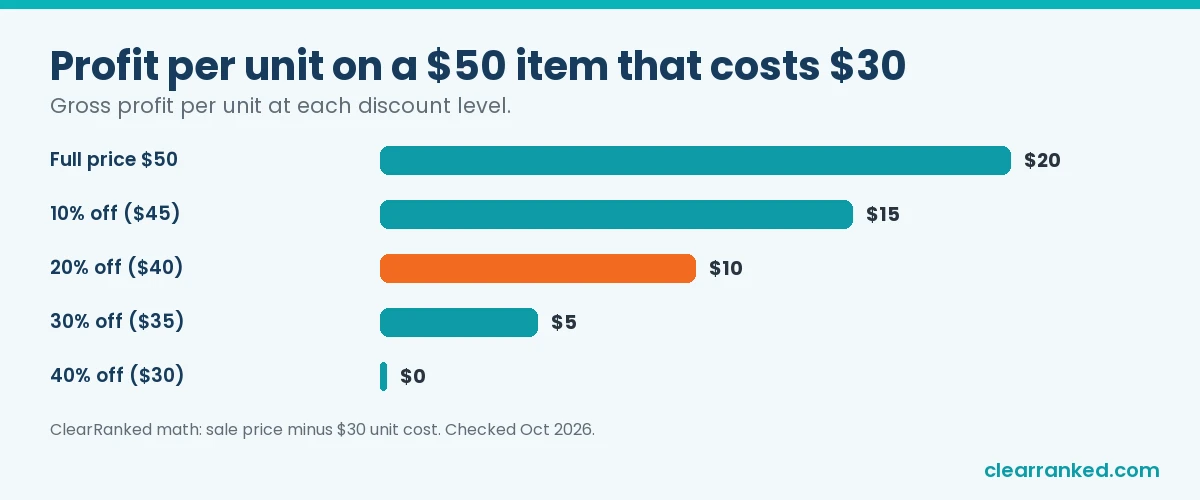
More than most owners expect. On a $50 item that costs you $30, the gross margin is 40%. A 20% discount drops the price to $40 and the margin to 25%, and gross profit per unit falls from $20 to $10. You'd need to sell twice as many units just to stand still.
Here's the math. At full price, 200 units x $20 = $4,000 of gross profit. On sale, each unit earns $10, so you need $4,000 / $10 = 400 units. That's a 100% sales lift. If the promo only brings in 300 units, you've moved more product and made $1,000 less.
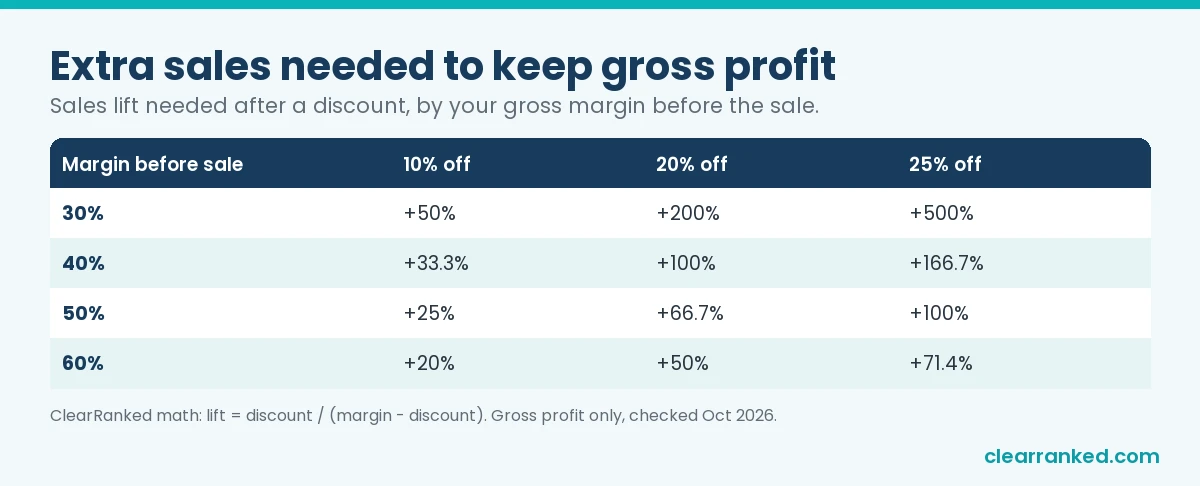
The quick formula is lift = D / (M - D), with D as the discount and M as your gross margin, both as percents of the regular price. So 20 / (40 - 20) = 1, or 100%. When the discount equals or passes the margin, you make nothing or lose money on every unit, and the calculator tells you so instead of showing a fake number.
Second example: a lower discount on a high-margin product
Say a product costs $6.50 and sells for $19.99, a 67.48% margin. You normally sell 340 a month. A 15% discount brings the price to $16.99, and gross profit per unit falls from $13.49 to about $10.49. To keep the same $4,586.60 of profit, you'd need 438 units, a lift of about 28.6%. That's a far more realistic target.
What discount mistakes do businesses make?
The big ones are confusing markup with margin, adding stacked discounts, working backward from the sale price the wrong way, and advertising a fake regular price. The last one is more than a math error, because it can break federal advertising rules.
- Markup is not margin. If you mark a $100 cost up 25% to $125 and then run 25% off, the price is $93.75, below your cost. Our markup calculator shows the difference.
- Adding stacked percents. As shown above, 20% plus 20% is 36% off, not 40%.
- Reversing a sale price. To find the original price from $90 after 25% off, divide by 0.75 to get $120. Adding 25% to $90 gives $112.50.
- Inflated reference prices. The FTC's 16 CFR 233.1 says a former price is a fair comparison when the item was openly offered at it, in good faith, for a reasonably substantial period. Raising a price for a few days just to cut it later makes the bargain a false one.
- Ignoring fixed costs. This calculator looks at gross profit. Card fees, shipping and ad spend for the promo come out of what's left.
When should a small business discount?
Discounts work best when they clear old stock, win back lapsed customers, fill slow periods or bring in buyers who'll come back at full price. They work poorly as a habit, because customers learn to wait for the sale and your regular price stops meaning anything.
Costs are still rising for many owners. The BLS reports consumer prices rose 3.7% over the 12 months ending September 2026, so a discount priced off last year's cost may be thinner than it looks. Re-check your unit cost before every promo.
Also, a promo has to clear your break-even point, not just look busy. The SBA's startup cost and break-even guide explains how to work that out. Then use the business tab here to set a sales target for the promo and compare it with what actually happened.
Quick reference: what you pay at common discounts
| Discount | You pay | On a $40 item | On a $250 item |
|---|---|---|---|
| 10% off | 90% | $36.00 | $225.00 |
| 15% off | 85% | $34.00 | $212.50 |
| 20% off | 80% | $32.00 | $200.00 |
| 25% off | 75% | $30.00 | $187.50 |
| 30% off | 70% | $28.00 | $175.00 |
| 40% off | 60% | $24.00 | $150.00 |
| 50% off | 50% | $20.00 | $125.00 |
FAQ
Multiply the price by the discount as a decimal, then subtract. For 25% off $120, that's $120 x 0.25 = $30 off, so you pay $90. A shortcut is to multiply by what you keep: $120 x 0.75 = $90.
No. The second discount applies to the already reduced price. $100 becomes $80, then $80 x 0.80 = $64, which is 36% off in total. Stacked discounts are always smaller than the two percents added together.
Divide the sale price by 1 minus the discount. If an item is $90 after 25% off, the original price was $90 / 0.75 = $120. Adding 25% to $90 gives $112.50, which is wrong.
It means you pay 70% of the original price. On a $40 item, that's $40 x 0.70 = $28, a saving of $12. On a $250 item, you'd pay $175 and save $75.
Use lift = discount / (margin - discount), with both as percents of the regular price. At a 40% margin, a 20% discount needs 20 / (40 - 20) = 100% more units just to earn the same gross profit.
Yes, if the regular price is genuine. FTC guidance says the former price should be one the item was openly offered at for a reasonably substantial period, not a number raised briefly to make the cut look bigger.
Related calculators
- All ClearRanked calculators
- Markup calculator to set prices from cost and target margin
- Bonus tax calculator if a good promo month turns into staff bonuses
- Overtime calculator for staffing a busy sale weekend
- Hours worked calculator
- Form 1099 guide for paying contractors who help run a promo
About the author
I'm Ali Hassan, the founder of ClearRanked. Also, I run small businesses myself, and I know how much time goes into pricing, payroll and small business math. ClearRanked is where I share plain-English guides and honest comparisons, so small business owners can make decisions with confidence instead of guesswork.
How we work: this guide is research-based, and every source in it was checked in October 2026. We don't take payment for rankings, and we update guides when laws or prices change. Finally, read more on our About page.