What Are Construction Site Barriers? Types, OSHA and MUTCD Rules, and When to Use Each
Construction site barriers are physical devices that keep people and vehicles away from hazards or out of the site. They include perimeter fences, guardrails at edges and openings, barricades, cones and drums for traffic, pedestrian channelizing devices, concrete or water-filled barriers, and swing-radius barriers around cranes. OSHA guardrails need a top edge of 42 inches, plus or minus 3.
Barrier is a loose word on most job sites. A string of caution tape, a chain-link panel and a concrete jersey barrier all get called barriers, yet they do very different jobs. Picking the wrong one is how a warning device ends up being asked to stop a car.
This guide explains the main types, what each one is for, and the size and strength rules that apply. It also answers the question owners ask most: what is the purpose of a construction site fence?
How we researched this: we read OSHA’s fall protection rules in 29 CFR 1926.502 and 1926.501, the sign and traffic device rule in 1926.200, plus the excavation and crane barrier rules, all on eCFR. Traffic device sizes come from the FHWA’s MUTCD 11th Edition, Revision 1. We checked them in October 2026.
Key takeaways
- Use barriers that match the hazard: warning devices guide, guardrails stop falls, and crash-tested barriers stop vehicles.
- OSHA guardrails need a 42-inch top edge (plus or minus 3 inches) and must hold a 200-pound force.
- Guardrails or other fall protection are required at unprotected edges 6 feet or more above a lower level.
- Any barricade or device that protects workers from traffic must follow MUTCD Part 6.
- MUTCD drums must be at least 36 inches tall, and Type 3 barricades at least 48 inches long.
- Sidewalk closures need pedestrian devices that cover the full width and that long-cane users can detect.
What are the main types of construction site barriers?
There are six common types: perimeter fencing that keeps the public out, guardrail systems that stop falls, traffic barricades and channelizing devices like cones and drums, pedestrian channelizing devices for sidewalks, temporary traffic barriers like concrete jersey barriers that protect a work space from vehicles, and control lines around hazards like crane swing zones.
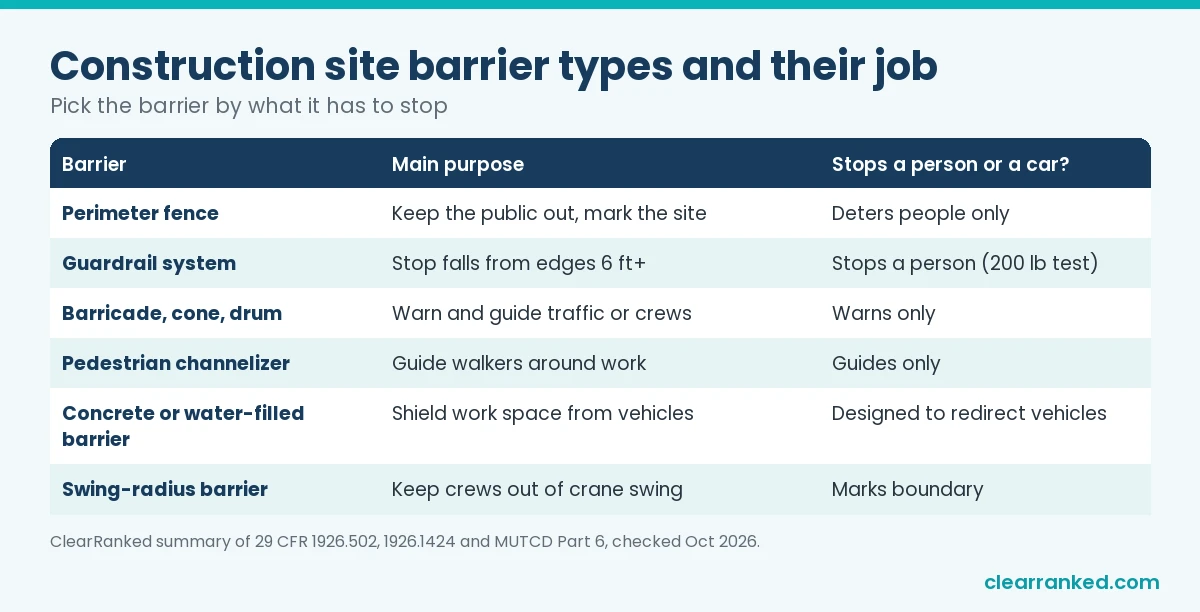
The key split is between barriers that warn and barriers that stop. Cones, tape and warning lines tell people where not to go. Guardrails and concrete barriers physically hold them back. So ask what happens if someone ignores or hits the barrier, and choose from there.
Barriers work with signs, not instead of them. Our guide to construction signs covers OSHA colors and MUTCD work zone sign spacing.
What is the purpose of a construction site fence?
A construction fence keeps the public, especially kids, out of a dangerous area, marks where the site begins, deters theft and vandalism, and can screen dust and debris. Many cities require fencing through permits, especially along sidewalks and streets. It also limits your liability, because it shows you took steps to keep unauthorized people away from hazards.
A fence is mostly a deterrent. It won’t stop a determined trespasser or a vehicle, so it doesn’t replace guardrails at edges or barricades at open holes inside the site. Treat it as the outer layer.
Check your permit for specific rules, such as minimum height, screening fabric, gate locations or how a sidewalk detour must be built. Local codes vary, and the inspector will look at the fence first.
For the security side, including gates, lighting and cameras, see our guide on how to secure a construction site.
What are OSHA’s rules for guardrail barriers?
OSHA requires the top edge of a guardrail to sit 42 inches above the walking surface, plus or minus 3 inches. It must withstand a 200-pound force in any outward or downward direction, and under that load the top edge can’t drop below 39 inches. Midrails go halfway up and must hold 150 pounds. Guardrails are required at edges 6 feet or more above a lower level.
| Guardrail part | OSHA requirement |
|---|---|
| Top edge height | 42 in, plus or minus 3 in |
| Top rail strength | 200 lb in any outward or downward direction |
| Deflection under load | Top edge stays at 39 in or higher |
| Midrail | Halfway between top edge and floor |
| Midrail or screen strength | 150 lb |
| Gaps between balusters | No more than 19 in apart |
| When midrails are needed | No wall or parapet at least 21 in high |
Here’s a quick worked example. If you build the top rail at 42 inches, it can sag up to 3 inches under the 200-pound test, since 42 – 39 = 3. But if you build it at the 39-inch minimum, it can’t sag at all under load, because 39 – 39 = 0. So building at 42 gives you a margin.
Midrail placement follows the same math. With a 42-inch top edge, the midrail goes at about 42 / 2 = 21 inches. Also, rails must be smooth enough not to cut hands or snag clothing, and if workers use stilts, the rail must rise by the stilt height.
What barriers are required around excavations and cranes?
Around excavations, OSHA requires a warning system such as barricades, hand signals or stop logs when equipment works near an edge the operator can’t see, guardrails on walkways 6 feet or more above the bottom, and protection from materials rolling in. Around cranes, you must mark swing hazard areas with control lines, warning lines, railings or similar barriers.
For cranes, the barrier marks the area where the rotating upper part could strike or crush someone. If barriers truly can’t be set up, OSHA allows warning signs and high-visibility markings on the crane instead, plus training so workers know what they mean.
Open holes and trenches are where public barriers matter most at night. Our guides on how to excavate a construction site and how cranes are assembled cover these hazards in detail.
What are the MUTCD rules for barricades, cones and drums?
When barriers face traffic, OSHA requires them to follow Part 6 of the MUTCD. Cones must be at least 18 inches tall on low-speed roads in daylight and 28 inches at night or on high-speed roads. Drums must be at least 36 inches tall. Type 1 and 2 barricades must be at least 24 inches long, Type 3 at least 48 inches, with rails 8 to 12 inches wide.

- Barricade rails carry orange and white retroreflective stripes, 6 inches wide, sloping down at 45 degrees toward the side traffic should pass.
- Barricades on freeways and other high-speed roads need at least 270 square inches of retroreflective area facing traffic.
- Drums must be made of lightweight, deformable material. Metal drums aren’t allowed.
- Don’t put ballast on top of drums, and don’t weight barricades so heavily that they become hazards when hit.
Temporary traffic barriers, like concrete jersey barriers, are a different category. The MUTCD says they aren’t traffic control devices by themselves, and they shouldn’t be used only to guide traffic. When they also act as a channelizing line, they need delineation or markings so drivers can see them day and night.
How do you protect pedestrians with barriers?
When work affects a sidewalk, the MUTCD calls for pedestrian channelizing devices to close it and to mark an alternate route. When used to close a sidewalk, the device must span its full width. Devices must be detectable to people using long canes and visible to people with low vision, and they must be crashworthy where they’re exposed to traffic.
The MUTCD’s example pedestrian device has a continuous top edge set between 32 and 38 inches high that people can trail with a hand, plus a detection plate low enough for a cane to find. A strip of caution tape fails both tests, which is why it shouldn’t be your sidewalk closure.
Keep the detour as wide as the original sidewalk where practical, and don’t let signs, materials or equipment narrow it. Also, check that the detour connects to curb ramps, so wheelchair users aren’t trapped at a corner.
How do you choose the right construction site barrier?
Start with the hazard and the worst case. If someone could fall 6 feet or more, use a guardrail or other fall protection. Where a vehicle could enter the work area at speed, use a crash-tested temporary barrier designed for it. If you only need to guide or warn, cones, drums, barricades and pedestrian devices do the job. Then add a perimeter fence around everything.
| Hazard | Best barrier | Not enough on its own |
|---|---|---|
| Open floor edge or deck | Guardrail system | Caution tape or a warning line alone |
| Lane next to a work zone | Temporary traffic barrier plus delineation | Cones at high speed |
| Closed sidewalk | Detectable pedestrian channelizing device | Tape or a single sign |
| Open trench at night | Fence or barricade with lights | A single cone |
| Crane swing area | Control lines or railings | Verbal warnings |
Barrier choices belong in your risk planning and your site layout. Our guides on soil erosion controls and hazardous materials cover other site setup decisions, and our project planning guide shows where to budget them. Check local codes and your permit for added rules.
Related guides
- Construction signs
- How to secure a construction site
- Excavating a construction site
- How cranes are assembled on construction sites
- Preventing soil erosion on a construction site
- How to plan a construction project
FAQ
They’re devices that keep people and vehicles away from hazards or out of the site, such as perimeter fences, guardrails, barricades, cones, drums, pedestrian channelizers, concrete jersey barriers and crane swing-zone barriers.
It keeps the public out, marks the site boundary, deters theft and vandalism, can screen dust and debris, and is often required by local permits. It doesn’t replace guardrails or barricades inside the site.
OSHA requires the top edge to be 42 inches above the walking surface, plus or minus 3 inches, and it must withstand 200 pounds without the top edge dropping below 39 inches.
OSHA requires guardrails, safety nets or personal fall arrest at unprotected sides and edges 6 feet or more above a lower level, and on walkways over excavations 6 feet or more above the bottom.
Cones are channelizing devices that warn and guide. They don’t stop vehicles. For a work space exposed to traffic at speed, a crash-tested temporary traffic barrier offers physical protection.
The MUTCD requires drums to be at least 36 inches tall and 18 inches wide, made of lightweight deformable material, with alternating orange and white retroreflective stripes.
About the author
I’m Ali Hassan, the founder of ClearRanked. Also, I run small businesses myself, and I know how much time goes into job site safety, layout and construction compliance. ClearRanked is where I share plain-English guides and honest comparisons, so small business owners can make decisions with confidence instead of guesswork.
How we work: this guide is research-based, and we checked every source in it in October 2026. We don’t take payment for rankings, and we update guides when laws or prices change. Finally, read more on our About page.