How to Set Up Utilities on a Construction Site: Temporary Power, Water, Toilets and Lighting
To set up utilities on a construction site, order temporary power early (a utility temp service or a generator), protect every 120-volt, 15- and 20-amp temporary outlet with a GFCI or an assured grounding program, light work areas to at least 5 foot-candles, supply drinking water, provide toilets at about one per 40 workers, add washing stations, and place 2A fire extinguishers so none is more than 100 feet away.
Utilities are easy to forget until the first morning on site. Then the crew is waiting on a generator, nobody can find drinking water, and the portable toilet company needs three days’ notice.
This guide gives you a setup order, the OSHA numbers for each utility, and worked examples for sizing toilets and extinguishers. It focuses on temporary site utilities, not the permanent services for the finished building.
How we researched this: we read OSHA’s construction standards on eCFR for electrical wiring and GFCIs (1926.404 and 1926.405), sanitation (1926.51), lighting (1926.56) and fire protection (1926.150). We also used call811.com for locate guidance. We checked everything in October 2026.
Key takeaways
- Request temporary power from the utility early, since temp service often needs a permit and inspection first.
- All 120-volt, single-phase, 15- and 20-amp temporary outlets in use need GFCIs, unless you run an assured equipment grounding conductor program.
- Small two-wire portable generators of 5 kW or less with insulated conductors are exempt from the GFCI rule.
- Toilets: 1 for 20 or fewer workers, then 1 seat and 1 urinal per 40 workers, and per 50 workers at 200 or more.
- Lighting: 5 foot-candles for general work areas, 3 for excavations and storage, 30 for offices and first aid.
- Fire: one 2A extinguisher per 3,000 square feet, with no more than 100 feet of travel to reach one.
What utilities does a construction site need?
Most sites need temporary power, lighting, drinking water, toilets, hand-washing, fire protection and some form of communication. Bigger sites may also need temporary heat, a site office with internet, and water for dust control and concrete work. OSHA sets minimums for power safety, lighting, water, toilets, washing and extinguishers, while your permit and local utility set the hookup rules.
| Utility | Common setup | Main OSHA rule |
|---|---|---|
| Temporary power | Utility temp pole or generator | GFCI or grounding program, temporary wiring rules |
| Lighting | Stringers, light towers | Table D-3 minimum foot-candles |
| Drinking water | Coolers, bottled water, temp tap | Potable, closed container with tap, no shared cup |
| Toilets | Portable units or building restrooms | Table D-1 counts by crew size |
| Washing | Hand-wash stations | Required where harmful contaminants are used |
| Fire protection | Extinguishers, hose lines | 2A per 3,000 sq ft, 100 ft max travel |
Put each one in your preconstruction checklist with an owner and an order date. Our guide on how to plan a construction project shows how to build that list into the schedule.
How do you get temporary power on a construction site?
Contact the local electric utility as early as possible to request temporary service. Typically, a licensed electrician sets a temporary pole or pedestal with a meter base and panel, the local building department inspects it, and then the utility connects the meter. Until power is live, or on sites without service, portable or towable generators fill the gap.
- Confirm the service size you’ll need for tools, lights, trailers and any temporary heat.
- Submit the temporary service request to the utility and pull the electrical permit.
- Call 811 before anyone digs for poles, pedestals or underground feeds.
- Have the electrician set the pole or pedestal, panel and GFCI-protected outlets.
- Pass the local inspection, then schedule the utility connection.
- Plan generator backup for early work or outages.
Every utility runs this a little differently, and lead times vary a lot by region and season. So ask your utility for its current timeline when you sign the contract, not when the crew shows up.
Underground feeds are digging, so locate rules apply. Our guide on how to excavate a construction site covers 811 requests and trench safety.
What are OSHA’s rules for temporary wiring and GFCIs?
OSHA lets you protect workers with either GFCIs or an assured equipment grounding conductor program. With GFCIs, every 120-volt, single-phase, 15- and 20-amp outlet that isn’t part of the building’s permanent wiring and is in use needs one. Temporary wiring must also be removed as soon as the work it serves is done.
- Feeders start at a distribution center, and branch circuits start at a power outlet or panel.
- Open conductors must be supported at intervals of no more than 10 feet, and branch-circuit conductors can’t lie on the floor.
- Receptacles must be the grounding type, with a grounding conductor in each branch circuit.
- Lamps used for general lighting need guards or another form of protection from contact and breakage.
- Temporary lights can’t hang by their cords unless designed for it.
- Each temporary circuit needs a way to disconnect all ungrounded conductors.
The assured grounding option is more work. It needs a written program kept at the site, a competent person to run it, and regular tests of cords and equipment with records. That’s why most small contractors simply use GFCIs.
One exemption matters for small crews. Receptacles on a two-wire, single-phase portable or vehicle-mounted generator rated 5 kW or less don’t need GFCIs, as long as the generator’s circuit conductors are insulated from its frame and other grounded surfaces. Check the generator’s manual before relying on it.
How much lighting does a construction site need?
OSHA’s Table D-3 sets minimum lighting while work is going on: 5 foot-candles for general construction areas, 3 for excavations, waste areas, accessways and active storage, 5 for indoor corridors and exitways, 10 for shops and mechanical rooms, and 30 for first aid stations and offices. Areas not listed follow the ANSI lighting practice the rule references.

A foot-candle is one lumen per square foot. You can check levels with an inexpensive light meter, and it’s worth doing at dusk in winter, when the problem shows up first. Also, light towers placed for work can often double as security lighting after hours.
Good lighting helps after hours too. See our guide on how to secure a construction site for lighting, fencing and camera tips.
How many toilets does a construction site need?
OSHA’s Table D-1 requires at least one toilet for 20 or fewer workers. For more than 20, provide one toilet seat and one urinal per 40 workers, and at 200 or more, one toilet seat and one urinal per 50 workers. Mobile crews with quick transportation to nearby facilities are exempt. Sites without sewer can use chemical, recirculating, combustion toilets or privies where allowed.
Here’s a worked example. Your peak crew is 45 workers. Divide by 40: 45 / 40 = 1.13. Round up, so you need 2 toilet seats and 2 urinals. At 250 workers, divide by 50: 250 / 50 = 5 toilet seats and 5 urinals.
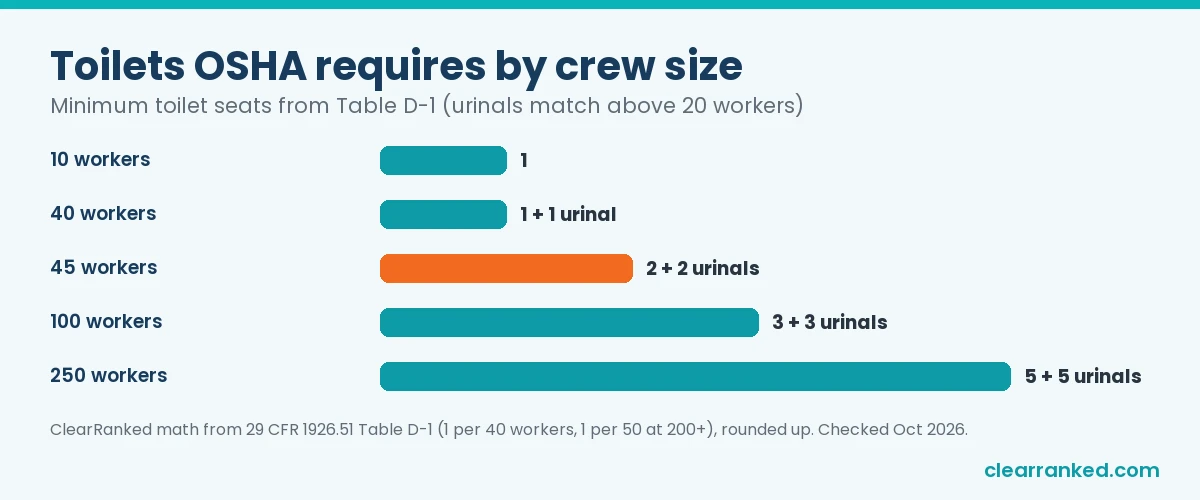
Plan for your peak headcount, not your average. Framing and MEP rough-in often overlap, and the crew size can double for a few weeks. Also, check whether your state or local code sets higher counts.
What water and washing facilities are required?
OSHA requires an adequate supply of drinking water that meets state, local or EPA drinking water standards. Portable containers must close tightly and have a tap, nobody can dip from them, and shared cups are banned. Lavatories with running water, soap and towels are required, and extra washing facilities are required where workers use paints, coatings, herbicides or other harmful substances.
- Label drinking water containers clearly and don’t use them for anything else.
- If you supply single-use cups, provide a clean holder for unused ones and a bin for used ones.
- Mark outlets for nonpotable water, such as firefighting or process water, with signs saying it’s unsafe to drink or wash with.
- Never cross-connect potable and nonpotable systems.
- Place wash stations near tasks that use harmful chemicals.
Heat makes water planning even more important. In summer, check water supply twice a day. Our guide on handling hazardous materials on a construction site explains when wash stations become a must.
How many fire extinguishers does a construction site need?
OSHA requires at least one fire extinguisher rated 2A for each 3,000 square feet of protected building area, or major fraction of it, placed so that travel distance to the nearest one is no more than 100 feet. A 55-gallon drum of water with two fire pails, or a qualifying garden hose line, can substitute for a 2A extinguisher.
Worked example: a 12,000 square foot building under construction. Divide by 3,000: 12,000 / 3,000 = 4 extinguishers rated at least 2A. Then check placement on the floor plan so no spot is more than 100 feet of walking distance from one. Long, narrow buildings often need an extra unit just to meet the distance rule.
Also add extinguishers suited to specific hazards, such as near fuel storage, welding and temporary heaters. Inspect them on a regular schedule, and recharge or replace any that get used.
Utilities also bring hazards of their own, like fuel for generators and heaters. So add them to your site risk assessment before setup day, and store fuel as our hazardous materials guide describes. Check local codes and your utility for requirements beyond OSHA.
Related guides
- How to excavate a construction site
- How to prevent soil erosion on a construction site
- Handling hazardous materials on a construction site
- How to secure a construction site
- How to plan a construction project
FAQ
Request temporary power from the utility early, set GFCI-protected temporary panels, add lighting, supply drinking water, rent toilets based on crew size, set up wash stations and place 2A fire extinguishers within 100 feet of travel.
Yes. OSHA requires GFCIs on all 120-volt, single-phase, 15- and 20-amp temporary outlets in use, unless the employer runs an assured equipment grounding conductor program instead.
Most do. However, two-wire, single-phase portable or vehicle-mounted generators rated 5 kW or less, with circuit conductors insulated from the frame, are exempt from the GFCI requirement.
One toilet for 20 or fewer workers, then one toilet seat and one urinal per 40 workers, and one per 50 workers once there are 200 or more workers on site.
OSHA requires at least 5 foot-candles for general construction areas, 3 for excavations and storage areas, 10 for shops and 30 for first aid stations and offices.
OSHA requires temporary wiring to be removed immediately once construction or the purpose it was installed for is complete.
About the author
I’m Ali Hassan, the founder of ClearRanked. Also, I run small businesses myself, and I know how much time goes into job site setup, crews and construction compliance. ClearRanked is where I share plain-English guides and honest comparisons, so small business owners can make decisions with confidence instead of guesswork.
How we work: this guide is research-based, and every source in it was checked in October 2026. We don’t take payment for rankings, and we update guides when laws or prices change. Finally, read more on our About page.