
Contractor Payroll Services: How to Pay 1099 Contractors (and What It Costs) in 2026
Contractor payroll services pay your independent contractors, collect their W-9s, track what you’ve paid each one and file the 1099-NEC forms at year-end. No taxes are withheld in the normal case. In October 2026, prices ran from $6 per contractor a month with Square to $49 per contractor a month for global platforms.
“Contractor payroll” is a slightly odd phrase, because contractors aren’t on payroll in the legal sense. You don’t withhold income tax, you don’t pay Social Security on their behalf, and they don’t get a W-2. What you do need is a clean way to pay them, the right forms on file, and a 1099-NEC for each one who crosses the reporting threshold.
That threshold changed this year, and it’s the first thing most guides online still get wrong. This one covers the 2026 rules, how to tell a contractor from an employee (the part that actually gets businesses fined), and what six services charge, from tools built into regular payroll to global platforms like Deel and Remote. It’s also part of our Payroll section.
How we researched this: no paid, hands-on testing. Tax rules come from IRS Publication 15 (2026) and IRS contractor pages, the classification guidance from the US Department of Labor, and prices from each provider’s own pricing page, all checked on October 19, 2026. Of course, this isn’t tax or legal advice.
Key takeaways
- For payments made in 2026, the 1099-NEC reporting threshold rose from $600 to $2,000, under P.L. 119-21. It will be adjusted for inflation after 2026.
- Get a Form W-9 before the first payment, and keep it for four years. If a contractor won’t give you a valid TIN, you must withhold 24% (backup withholding).
- The label on the contract doesn’t decide status. The IRS looks at behavioral control, financial control and the type of relationship.
- Prices we checked: Square charges $6 per contractor paid each month for contractor-only payroll; Gusto’s contractor-only plan is $35 a month plus $6 per contractor; Remote starts at $29 per contractor, Deel at $49.
- If you pay 10 or more information returns in a year, you must e-file them.
What are contractor payroll services?
Contractor payroll services are tools that onboard independent contractors, store their tax forms, pay their invoices by direct deposit or international transfer, keep a running total of payments, and prepare and file Form 1099-NEC. Global platforms add local contracts, currency conversion and, for a higher fee, misclassification protection.
They fall into three groups:
- Payroll software with contractor payments: Gusto, QuickBooks, Patriot and OnPay let you pay US contractors from the same account you use for employees.
- Global contractor platforms: Deel, Remote and Oyster handle contracts, invoices and payouts in other countries and currencies.
- Contractor of record (COR): the provider signs the contract with the contractor and takes on classification risk, for a much higher monthly fee.
If you only pay two or three US freelancers a year, you might not need any of this. Instead, a bank transfer and a 1099 filing service can be enough. The tools earn their keep when you’re paying several people every month, some of them abroad, and you want the paperwork to take care of itself.
Contractor or employee: how do you tell the difference?
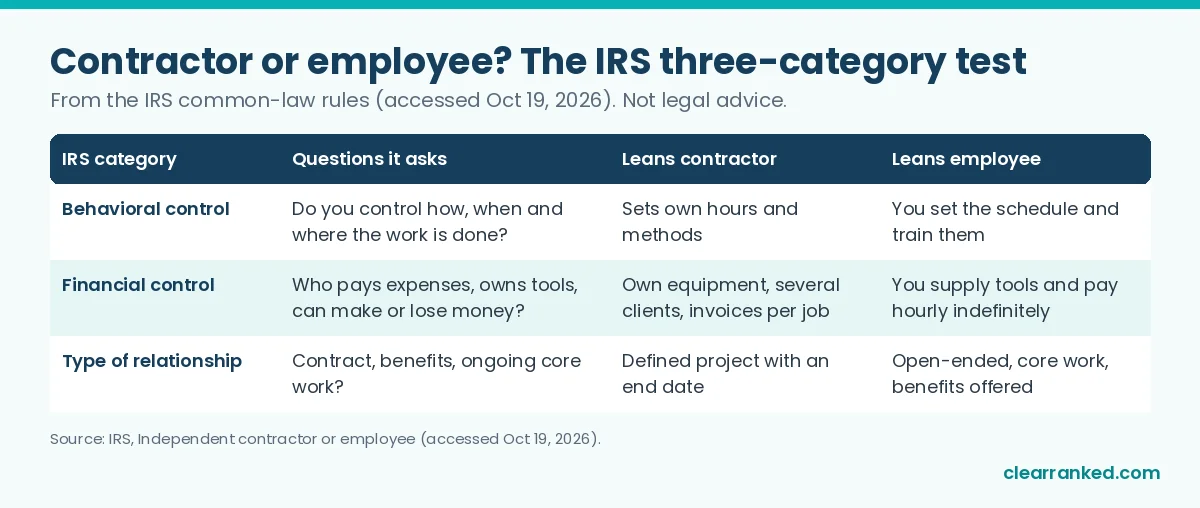
The IRS uses common-law rules that look at three areas: behavioral control (do you direct how the work is done?), financial control (who controls expenses, tools and profit or loss?), and the type of relationship (contracts, benefits, permanence). If you control what is done and how, the worker is usually an employee.
Getting this wrong is expensive, and no software can make the call for you. The IRS page on independent contractor vs employee (accessed Oct 19, 2026) groups the evidence like this:
| IRS category | Questions it asks | Leans contractor | Leans employee |
|---|---|---|---|
| Behavioral control | Do you control how, when and where the work is done? | Sets own hours and methods | You set the schedule and train them |
| Financial control | Who pays expenses, owns tools, can make or lose money? | Own equipment, several clients, invoices per job | You supply tools and pay by the hour indefinitely |
| Type of relationship | Is there a contract, benefits, ongoing work central to your business? | Defined project with an end date | Open-ended, core work, benefits offered |
Meanwhile, the US Department of Labor runs its own test for wage-and-hour law, and it’s in flux. The DOL’s 2024 rule took effect in March 2024, but under Field Assistance Bulletin 2025-1 (May 1, 2025) its investigators stopped applying it and returned to the older 2008 economic-reality factors. A replacement rule was proposed in February 2026 and sent for final White House review on September 28, 2026, according to Reginfo.gov (both accessed Oct 19, 2026). Until a new rule is final, the 2024 rule still applies in private lawsuits. Several states also use stricter tests of their own.
What happens if you get it wrong? IRS Publication 15 explains that you become liable for the employment taxes you didn’t withhold. Under section 3509, the reduced rates for an employer that did file the 1099s are 7.44% for Social Security, 1.74% for Medicare and 1.5% for income tax withholding, and they’re higher if you didn’t file. Here’s what that looks like on one misclassified worker paid $50,000, as our own estimate: about $5,340, before interest, penalties, state taxes and any back overtime. If you’re unsure, file Form SS-8 and the IRS will decide for you. Also, the Voluntary Classification Settlement Program lets you reclassify workers going forward.
What forms and taxes apply when you pay contractors?
Collect Form W-9 before the first payment. Pay the contractor without withholding unless backup withholding applies. For 2026 payments, file Form 1099-NEC for each contractor you paid $2,000 or more, send them a copy, and e-file if you have 10 or more returns. If you withhold backup tax, file Form 945.
Here’s the yearly paperwork, using IRS sources accessed Oct 19, 2026:
- Form W-9 at onboarding. The IRS page on forms for independent contractors says to keep it on file for four years.
- No withholding, in the usual case. The contractor pays their own self-employment tax.
- Backup withholding at 24% if the contractor doesn’t give you a correct TIN, or the IRS tells you it’s wrong. You then report it on Form 945.
- Form 1099-NEC for each contractor paid at least the threshold: $600 for payments made in 2025, and $2,000 for payments made in 2026, per IRS Publication 15.
- E-file if you have 10 or more information returns. The IRS is retiring its old FIRE system. So from the 2027 filing season (tax year 2026 returns), IRIS will be the only e-file route for these forms.

A quick tip on the threshold change. Yes, a $1,400 designer gig in 2026 no longer needs a 1099-NEC, so occasional freelancers mean less filing. But get a W-9 from every single person you pay anyway. In March you have no idea who crosses $2,000 by December, and a missing TIN still triggers backup withholding.
Paying foreign contractors
Foreign contractors, however, are different. You generally collect a Form W-8BEN rather than a W-9, and payments to nonresident aliens for US-source services can face 30% withholding unless a treaty lowers it. Work done entirely outside the US is often not US-source income, which is one reason global platforms exist. Ask your accountant before you pay someone abroad for the first time, and keep the form with your other contractor records, because you’ll need it again if the IRS ever asks why you didn’t withhold.
How much do contractor payroll services cost?
On October 19, 2026, Square charged $6 per contractor paid each month, Patriot’s Basic plan was $17 a month plus $4 per worker, Gusto’s contractor-only plan was $35 a month plus $6 per contractor, Remote and Oyster started at $29 per contractor and Deel at $49. Contractor-of-record plans started at $325.
| Provider | Best for | Published price (checked Oct 19, 2026) | Notes |
|---|---|---|---|
| Square Payroll | US contractors only, lowest cost | Contractor-only: $6 per person paid per month, no base fee | Files 1099-NEC; $3 a form if you want paper copies mailed |
| Patriot Software | US contractors, low cost | Basic Payroll $17/month + $4 per worker paid (page showed 50% off for 3 months) | “Pay contractors in payroll” included |
| Gusto | US teams with employees and contractors | Contractor-only $35/month + $6 per contractor, billed only in months with payments (per Gusto’s own contractor payroll guide; not shown on its main pricing page); Simple $49/month + $6 per person | Plus plan adds contractor invoice management |
| QuickBooks | Businesses already on QuickBooks | Workforce Payroll + Simple Start $88/month + $6.50 per employee | Unlimited 1099-MISC and 1099-NEC e-filing included |
| Remote | Global contractors | Contractor Management from $29 per contractor/month; Plus from $99; Contractor of Record from $325 | Plus includes $100,000 indemnity per contractor, up to $1M per company |
| Oyster | Global contractors | Global Contractors from USD 29/month (listed “per employee/month”) | Payments in 120+ currencies |
| Deel | Global contractors at scale | From $49 per contractor/month; Contractor of Record from $325 | Payments in 120+ currencies |
Gusto’s page also lists a separate global contractor payments option with no monthly per-contractor fee, just service and foreign exchange charges per payment. ADP and Paychex quote by sales call, so we couldn’t confirm their contractor pricing.
What would five US contractors cost in a month you pay all of them? Our estimate from those list prices: Square about $30 (5 × $6), Patriot Basic about $37 ($17 + 5 × $4), Gusto’s contractor-only plan about $65 ($35 + 5 × $6), Remote or Oyster about $145, and Deel about $245. Gusto’s contractor-only price comes from its own guide rather than its pricing page, so confirm it before you sign up.

Which payroll services for contractors should you choose?
If all your contractors are in the US and you also have employees, use the contractor feature in your payroll software. Only paying US freelancers? Then Square’s contractor-only plan was the cheapest one we found. If anyone works abroad, use Remote, Oyster or Deel. Pay for contractor-of-record coverage only when classification risk is real.
| Your situation | Look at first |
|---|---|
| Employees plus a few US contractors | Your existing payroll (Gusto, QuickBooks, OnPay) |
| Only US contractors, tight budget | Square Payroll (contractor-only) or Patriot Basic |
| One or two contractors abroad | Remote or Oyster Contractor Management |
| Many international contractors, need more HR tools | Deel |
| Long-term, full-time “contractors” you’re nervous about | Contractor of record, or convert them to employees |
Our take: people rarely go wrong by picking the wrong app. Instead, they go wrong by using a contractor app to dress up what’s really a job. Someone who works 40 hours a week for you, on your schedule, with your tools, doesn’t turn into a freelancer because the payment screen looks nice. Putting them on payroll costs more today and much less than a reclassification audit later. Hiring your first employee instead? See our guide to payroll services for one employee.
What about payroll for construction contractors?
In construction, “contractor payroll” often means something else: a general or specialty contractor running payroll for its own crews. That brings overtime, job costing, multiple pay rates and, on federally funded jobs, certified payroll. You need payroll software with time tracking by job, not a freelancer payment tool.
If that’s you, then the priorities shift. You’ll want job-level time tracking that feeds payroll, support for several pay rates per worker, and a way to split labor cost by project. Gusto’s Premium plan lists project-based rules and costing, and some time tracking apps built for crews connect directly to payroll. Our guide to construction employee scheduling software covers the crew side of that setup.
Subcontractors, meanwhile, are the other half. A drywall sub you hire for a job is usually a business, not an individual, but you still collect a W-9 and may owe a 1099-NEC. Keeping those documents in the same system as your crew payroll makes year-end much less painful. It’s also worth keeping your contractor records in the same place as the rest of your people data; most cloud-based HR systems can store W-9s and contracts next to employee files.
How do you pay contractors the right way?
First, put the classification call in writing. Then sign a contract about deliverables rather than hours, grab the W-9 or W-8BEN, pay against invoices and keep a running total for each person. Come December, see who needs a 1099, and give a hard second look to anybody whose gig has quietly become a job.
- Document the classification decision using the IRS three categories. One paragraph per contractor is enough.
- Use a contract with a defined scope and end date or deliverables.
- Collect the tax form before the first payment.
- Then pay against invoices, not timesheets, where you can.
- Track year-to-date totals so you know who needs a 1099-NEC.
- Review in December: who crossed $2,000, whose TIN is missing, and who now looks like an employee.
If you’re setting up payroll from scratch, our step-by-step guide on how to set up payroll covers the employee side, including EIN, state registration and deposit schedules.
Related guides
- How to Set Up Payroll: A Step-by-Step Guide
- Payroll Services for One Employee
- Construction Employee Scheduling Software
- HR Automation Software: What to Automate First
- All Payroll guides
FAQ
It’s software or a provider that pays independent contractors, collects their W-9 or W-8BEN forms, tracks year-to-date payments and files Form 1099-NEC. Unlike employee payroll, it normally doesn’t withhold income tax or pay Social Security and Medicare. Global versions add local contracts and currency conversion.
Usually not. Independent contractors pay their own income and self-employment taxes. The exception is backup withholding: you must withhold 24% if a contractor doesn’t provide a correct taxpayer identification number, or the IRS notifies you it’s wrong. You then report that withholding on Form 945.
For payments made in 2026, you file Form 1099-NEC for a contractor you paid $2,000 or more for services in the year. The threshold was $600 for payments made in 2025. P.L. 119-21 raised it, and the IRS says it will be adjusted for inflation after 2026.
At list prices checked on October 19, 2026, Square charged $6 per contractor paid each month, Patriot’s Basic plan was $17 a month plus $4 per worker, Gusto’s contractor-only plan was $35 a month plus $6 per contractor, Remote and Oyster started at $29 per contractor and Deel at $49.
A standard plan can’t. Classification depends on how the work is actually done, not on the software you use. Contractor-of-record plans, such as Remote’s or Deel’s from $325 a month, take on more of that risk by contracting with the worker themselves, but they don’t change the underlying facts.
About the author
I’m Ali Hassan, the founder of ClearRanked. I run small businesses myself, and I know how much time goes into picking the right HR, payroll and project tools. ClearRanked is where I share plain-English guides and honest comparisons, so small business owners can choose software with confidence instead of guesswork.
How we work: this guide is research-based, and every source in it was checked in October 2026. We don’t take payment for rankings, and we update guides when laws or prices change. Read more on our About page.