Form 1099 Guide for Small Businesses: NEC vs MISC, the New $2,000 Threshold and 2027 Deadlines
Form 1099 is the IRS information return a business files to report money it paid to someone who isn’t an employee, such as a freelancer, landlord or attorney. For payments made in 2026, the main reporting threshold rises from $600 to $2,000 per payee. Form 1099-NEC for 2026 payments is due to both the IRS and the worker by February 1, 2027.
Most small businesses only ever touch two versions. The 1099-NEC is for contractor pay. The 1099-MISC handles rent, prizes, royalties and a few odd payment types. Mix them up, or miss the new threshold, and you’ll spend February fixing forms instead of running your business.
Picture a roofing crew owner who used four subcontractors last year, rented a storage yard from a neighbor and paid a lawyer to review a contract. Which of those people get a form? By the end of this guide you’ll know, and you can run the same check on your own vendor list in about ten minutes.
How we researched this: we read the IRS 1099-MISC and 1099-NEC instructions (December 2026 revision), the IRS General Instructions for Certain Information Returns, and the IRS Form 1099-K page. Every figure was checked in October 2026.
Key takeaways
- For payments made in 2026, file Form 1099-NEC when you pay a non-employee $2,000 or more for services. For 2025 payments it was $600.
- The IRS says the $2,000 threshold may be adjusted for inflation beginning in 2027.
- Form 1099-NEC for 2026 is due February 1, 2027, because January 31 falls on a Sunday.
- Payments by credit card or apps like PayPal go on Form 1099-K from the processor, not on your 1099-NEC.
- Reach 10 information returns for the year, all types combined, and you have to e-file.
- Collect a Form W-9 before you pay. Without a valid TIN, you may have to withhold 24%.
What is Form 1099?
Form 1099 is a family of IRS information returns. A business uses them to tell the IRS, and the person paid, how much non-wage money changed hands during the year. Employees get a Form W-2 instead. The two forms most small businesses file are 1099-NEC for contractor pay and 1099-MISC for rents and other income.
There are many other 1099 forms. For example, banks send 1099-INT for interest, brokers send 1099-B, and payment processors send 1099-K. However, as a small business owner you normally file only the NEC and the MISC. The others come to you, not from you.
A 1099 doesn’t change what the contractor owes. It just gives the IRS a second record to compare with their return. When the two don’t match, letters go out, and sometimes to you.
1099-NEC vs 1099-MISC: which one do you need?
Use Form 1099-NEC for payments for services from people who aren’t your employees, such as freelancers, consultants and subcontractors. Use Form 1099-MISC for rents, royalties, prizes and awards, medical and health care payments, and gross proceeds paid to an attorney in a settlement. Pay for the attorney’s own legal services goes on the NEC.
| Payment | Form and box | Example |
|---|---|---|
| Fees for services by a non-employee | 1099-NEC, box 1 | A freelance designer you paid $3,500 |
| Attorney fees for legal services | 1099-NEC, box 1 | Your lawyer’s $2,400 invoice |
| Direct sales of $5,000+ of consumer products for resale | 1099-NEC box 2 or 1099-MISC box 7 | Products sold to a direct-sales rep |
| Rent for office or equipment | 1099-MISC, box 1 | $1,200 a month office rent to an individual landlord |
| Royalties | 1099-MISC, box 2 | Licensing fees to an author |
| Prizes, awards, other income | 1099-MISC, box 3 | A $2,500 contest prize |
| Attorney gross proceeds | 1099-MISC, box 10 | A settlement paid through a claimant’s attorney |
A quick rule: if the payment is for someone’s work, think NEC. If it’s for the use of property, or it’s a prize, royalty or settlement, think MISC. Also, the 2026 forms add new boxes for cash tips and overtime compensation, which the One Big Beautiful Bill Act (P.L. 119-21) now requires businesses to report.
What is the 1099 threshold for 2026?
For payments made in 2026, the threshold for most Form 1099-NEC and 1099-MISC payments is $2,000 per payee for the year. That replaces the old $600 rule, which still applies to payments made in 2025. Royalties keep a $10 threshold, and attorney gross proceeds on 1099-MISC box 10 still use $600.
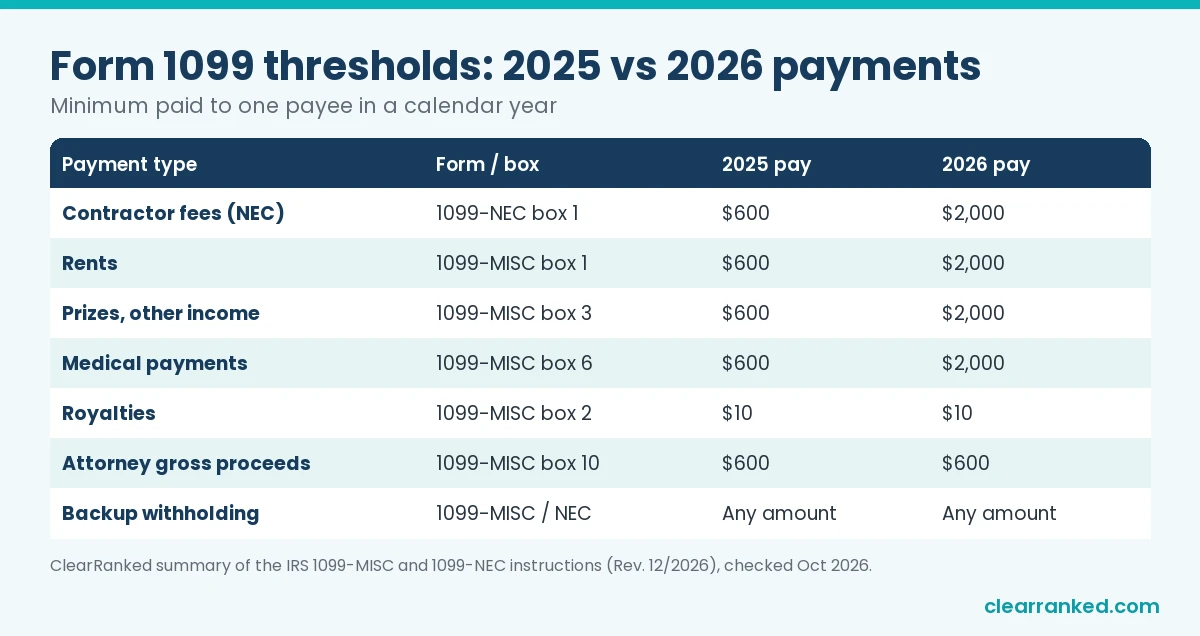
You’ll find the change in the “What’s New” notes of the 1099-MISC and 1099-NEC instructions. It covers 2026 and later years. The IRS also says the $2,000 figure could rise with inflation starting in 2027, so don’t assume it stays put forever.
So the year of payment decides the rule. For example, a contractor you paid $1,500 in 2025 needed a 1099-NEC in early 2026. However, the same $1,500 paid in 2026 doesn’t need a 1099-NEC in early 2027, because it’s under $2,000.
One exception catches people out. Did you hold back tax from a payee under backup withholding? Then the dollar threshold no longer matters, and that payee gets a form even for a small amount.
When is Form 1099 due in 2027?
Form 1099-NEC for 2026 payments is due to both the recipient and the IRS by February 1, 2027. The normal date is January 31, but that day is a Sunday, so it moves to the next business day. Form 1099-MISC copies go to recipients by February 1, 2027, and to the IRS by March 1 on paper or March 31 if you e-file.
| Form (2026 payments) | To recipient | To IRS (paper) | To IRS (e-file) |
|---|---|---|---|
| 1099-NEC | February 1, 2027 | February 1, 2027 | February 1, 2027 |
| 1099-MISC | February 1, 2027 | March 1, 2027 | March 31, 2027 |
The IRS rule behind those dates is simple. The 1099-NEC is due January 31, and the 1099-MISC is due February 28 on paper or March 31 electronically. If a due date lands on a Saturday, Sunday or legal holiday, it shifts to the next business day. In 2027, January 31 and February 28 are both Sundays.
Also, watch the e-file trigger. Once your business reaches 10 information returns for the year, all types combined, paper is off the table. The IRS runs a free portal called IRIS (Information Returns Intake System) for exactly this job.
Who gets a 1099, and who doesn’t?
You generally send a Form 1099-NEC to individuals, sole proprietors, partnerships and most LLCs that you paid $2,000 or more for services in 2026 in the course of your business. You usually don’t send one to corporations, to your employees, for personal payments, or for payments made by card or payment app.
- Corporations: most payments to C and S corporations are exempt. However, attorney fees and medical or health care payments are still reportable even to corporations.
- Employees: wages go on Form W-2, never on a 1099.
- Personal payments: paying a plumber to fix your own home isn’t a business payment.
- Card and app payments: paid by card or through an app like PayPal? Then it’s the processor’s job, not yours. Those payments land on a Form 1099-K, which the processor must file once a payee tops $20,000 across more than 200 transactions in the year (IRS).
- Goods only: buying inventory or supplies isn’t reportable on a 1099-NEC.
My advice is blunt: no W-9, no first check. The W-9 hands you the payee’s legal name, tax classification and TIN, which is everything the 1099 needs. And if a payee refuses to give a valid TIN, you may have to hold back 24% of reportable payments as backup withholding. Chasing that in January is miserable.
How do you file Form 1099 step by step?
To file Form 1099, collect a W-9 from each payee, total what you paid each one during the year, compare those totals to the $2,000 threshold, then fill out the right form. Send Copy B to the payee and file Copy A with the IRS by the deadline, electronically if you have 10 or more returns.
- Collect a Form W-9 from every contractor before the first payment.
- At year end, total payments to each payee by check, cash, ACH or bank transfer. Leave out card and app payments.
- Flag every payee at $2,000 or more for 2026 (or $10 or more for royalties).
- Fill in the payer and payee details, TINs and amounts in the right boxes.
- Send Copy B to each recipient by February 1, 2027.
- File Copy A with the IRS through IRIS or your payroll provider, or on official paper forms. The IRS scans paper Copy A, so it must be the official form or a substitute that meets Pub. 1179.
- Check whether your state wants its own copy. State filing rules vary, so look at your state revenue department’s site.
Many payroll tools file 1099s for you. For example, our guide to contractor payroll services compares tools that pay contractors and file the forms at year end. Also, if you’re setting up payroll for the first time, see how to set up payroll.
Worked example: which vendors need a 1099 for 2026?
Here is a small marketing agency’s 2026 vendor list with the decision for each one. The agency paid five vendors by check or bank transfer and one by credit card. Only payees at or above $2,000 who aren’t corporations, and who were not paid by card, get a Form 1099.
| Payee | Paid in 2026 | How paid | 1099? |
|---|---|---|---|
| Freelance copywriter (sole proprietor) | $6,400 | ACH | Yes, 1099-NEC $6,400 |
| Photographer (single-member LLC) | $1,850 | Check | No, under $2,000 |
| Web developer (S corporation) | $9,000 | ACH | No, corporation |
| Law firm (PC), legal services | $2,300 | Check | Yes, 1099-NEC $2,300 |
| Office landlord (individual) | $1,100 x 12 = $13,200 | Check | Yes, 1099-MISC $13,200 |
| Video editor | $4,000 | Credit card | No, processor files 1099-K |
Notice two things. First, the photographer at $1,850 would have needed a 1099-NEC under the old $600 rule, but not for 2026. Second, the law firm gets a form even though it’s a professional corporation, because attorney fees are an exception to the corporate exemption.
What are the penalties for late or missing 1099s?
The IRS charges a penalty for each information return you file late, file wrong or never file. In the General Instructions, the amounts are $60 per return if you file within 30 days, $130 if you file by August 1, and $340 after that or if you never file. Intentional disregard costs at least $680 per return.
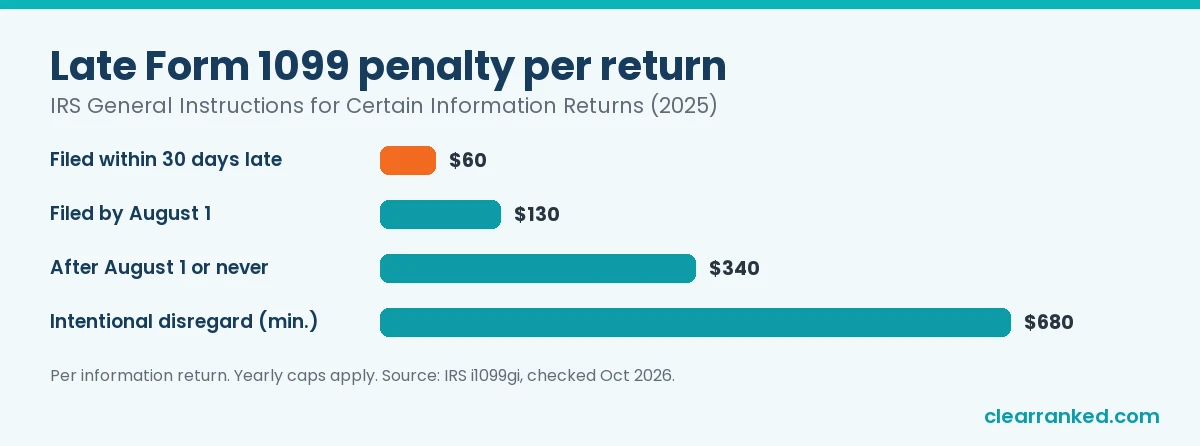
There’s a separate penalty for failing to give the recipient a correct copy, so one missed form can be charged twice. Small businesses get lower yearly caps. For example, the cap for filing within 30 days is $239,000 a year for a small business, compared with $683,000 for larger ones.
These amounts are inflation-adjusted, so check the current General Instructions before you estimate. The cheapest fix is boring: collect W-9s up front and file on time. A CPA can confirm the details for your own vendor list.
What is a 1099 employee?
“1099 employee” is everyday shorthand for an independent contractor: someone you pay for work who isn’t on your payroll, so you report the pay on Form 1099-NEC instead of a W-2. Legally they aren’t employees at all.
The IRS test turns on control. A worker is generally an independent contractor when you can direct only the result of the work, not what gets done and how. If you set the hours, train them and tell them how to do the job, they are likely an employee, whatever the contract says.
The label changes who handles taxes:
- You withhold no income tax or FICA, and you pay no employer payroll tax on their pay
- They pay self-employment tax of 15.3% on their net earnings and usually make quarterly estimated payments
- You send a 1099-NEC if you paid them $2,000 or more for services in 2026
Calling someone a 1099 worker when the facts say employee can leave you owing back payroll taxes and penalties. To compare the real cost of each setup, use our 1099 vs W-2 calculator.
Related guides
- Contractor payroll services that file 1099s
- How to set up payroll
- Exempt vs non-exempt employees
- Payroll services for one employee
- How many pay periods in a year
FAQ
For payments made in 2026, you generally file Form 1099-NEC or most 1099-MISC boxes when you pay one payee $2,000 or more in the year. The old $600 threshold applies to payments made in 2025. Royalties stay at $10.
Form 1099-NEC for 2026 payments is due to the IRS and the recipient by February 1, 2027. The usual January 31 date falls on a Sunday in 2027, so it moves to the next business day.
Form 1099-NEC reports pay for services from non-employees, such as contractors and freelancers. Form 1099-MISC reports rents, royalties, prizes, medical payments and gross proceeds paid to attorneys.
It depends on how the LLC is taxed. Send one to a single-member or partnership LLC you paid $2,000 or more for services in 2026. An LLC taxed as a corporation is usually exempt, except for attorney and medical payments. The W-9 tells you the tax classification.
No. Card and app payments show up on a Form 1099-K that the payment processor files, so leave them off your 1099-NEC.
Yes. The IRS runs a free portal called IRIS for e-filing 1099 forms. Once you reach 10 information returns in a year, all types combined, e-filing is required.
The IRS charges a penalty per return. The current General Instructions list $60 if filed within 30 days, $130 if filed by August 1, and $340 after that, with higher penalties for intentional disregard.
About the author
I’m Ali Hassan, the founder of ClearRanked. Also, I run small businesses myself, and I know how much time goes into payroll, contractor paperwork and HR rules. ClearRanked is where I share plain-English guides and honest comparisons, so small business owners can make decisions with confidence instead of guesswork.
How we work: this guide is research-based, and every source in it was checked in October 2026. We don’t take payment for rankings, and we update guides when laws or prices change. Finally, read more on our About page.