FTE Calculator: Full-Time Equivalent Hours and ACA 50-Employee Test

This FTE calculator converts part-time hours into full-time equivalents. In simple mode, it divides part-time hours by your full-time standard (40, 37.5, 35, 32 or 30 hours) and adds your full-time staff. In ACA mode, it counts FTEs the IRS way, capping each part-timer at 120 hours a month, and tells you how close you are to the 50-employee ALE line.
FTE calculator
Hours in, full-time equivalents out. Use the simple mode for budgeting and staffing, or the ACA mode to count FTEs the IRS way and check the 50-employee line.
An estimate, not legal or tax advice. ACA mode follows the IRS method: part-time hours capped at 120 per person, divided by 120. The real ALE test averages all 12 months of the prior year, and related companies are combined.
Headcount answers how many people work for you. FTE answers how much work they add up to, which is what budgets, grant applications, staffing plans and the Affordable Care Act care about. Ten people at 20 hours each are 10 heads but only 5 FTE on a 40-hour standard.
How we researched this: the ACA rules (30 hours a week or 130 a month for full-time, part-time hours capped at 120 and divided by 120, the 12-month average and the round-down step) come from the IRS page on determining if an employer is an applicable large employer. We checked it in November 2026.
Key takeaways
- FTE = full-time employees + (part-time hours / full-time hours for the same period).
- On a 40-hour week, 1 FTE is 40 hours a week, about 173.3 hours a month and 2,080 hours a year.
- For the ACA, full-time is 30 hours a week or 130 hours a month, and FTEs use a 120-hour monthly divisor.
- An employer with an average of 50 or more full-time employees plus FTEs in the prior year is an ALE.
- The 12-month ACA average is rounded down, so 49.99 counts as 49.
How do you use this FTE calculator?
Choose a mode first. For staffing or budgets, enter your full-time headcount, total part-time hours, your full-time standard and the period the hours cover. For the ACA, enter full-time employees for one month and each part-timer's hours that month.
- Simple mode works with weekly, biweekly, monthly or yearly hours. A month is 52 / 12 = 4.33 weeks of your standard.
- Full-time standard should match the report you're filling in. Many budgets use 40, some offices 37.5, and the ACA 30.
- ACA mode wants hours per person, so the 120-hour cap can be applied to each one. Anyone you list with 130 hours or more is moved to the full-time count automatically.
- The result shows the FTE total, the hours that were capped and, in ACA mode, how far you are from 50.
What is the FTE formula?
FTE = number of full-time employees + total part-time hours / full-time hours in the same period. Always match the periods: weekly part-time hours against a weekly standard, monthly hours against a monthly standard. The ACA version uses 120 hours a month as the divisor.
- Weekly: FTE = full-timers + part-time hours per week / 40
- Monthly: FTE = full-timers + part-time hours per month / (40 x 52 / 12 = 173.33)
- Yearly: FTE = full-timers + part-time hours per year / 2,080
- ACA monthly: FTE = employees with 130+ hours + sum of other employees' hours (max 120 each) / 120
Worked example: a bakery with mixed shifts
Marisol owns a bakery with 12 full-time bakers and drivers on 40 hours a week. Her counter staff are part-time: four people work 20, 18, 24 and 24 hours a week, which is 86 hours in total.
- Part-time FTE: 86 / 40 = 2.15
- Total FTE: 12 + 2.15 = 14.15
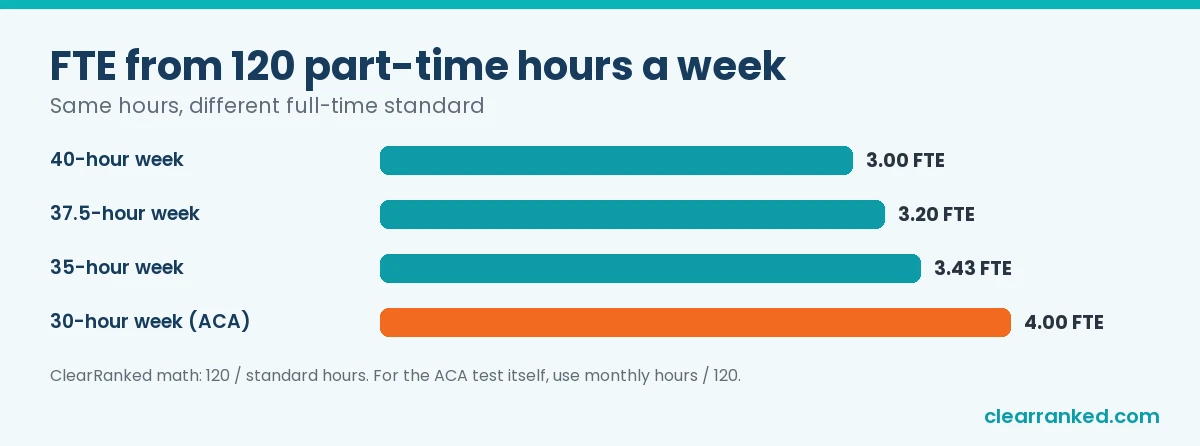
- Same team on a 37.5-hour standard: 12 + 86 / 37.5 = 14.29
- On the 30-hour ACA line: 12 + 86 / 30 = 14.87
So the same bakery reports 14.15 FTE in a budget but almost 14.9 on a 30-hour basis. Neither is wrong; they answer different questions. When a lender, grant or software vendor asks for FTE, check which standard they mean.
How do you calculate FTE for the ACA?
Each month, count employees with at least 130 hours of service as full-time. Then add the hours of everyone else, capping each person at 120, and divide by 120. Add the two figures. Do this for all 12 months, total them, divide by 12 and round down. If the result is 50 or more, you're an ALE next year.
Here's how the default ACA example works. A home health agency has 38 full-time aides and 13 other workers whose hours for the month are listed in the box. Two of them logged 130 and 140 hours, so they're full-time for that month, which makes 40 full-time employees. The other 11 worked 1,039 hours, none above the 120 cap, which is 8.66 FTEs. The month totals 48.66.
If every month looked like that, the yearly average would be 48.66, rounded down to 48. That's under 50, so the agency isn't an ALE. However, it's only 161 part-time hours a month away. One new part-timer at about 40 hours a week would push it over.

| ACA rule | What it means for your count |
|---|---|
| 130 hours in a month | That person is full-time for the month |
| 120-hour cap | A part-timer with 125 hours adds only 120 |
| Divide by 120 | Every 120 part-time hours = 1 FTE |
| Average 12 months, round down | 49.99 counts as 49 |
| Related companies | Commonly owned firms are combined |
| Seasonal exception | Over 50 for 120 days or less, due to seasonal staff, doesn't count |
Why does FTE matter for small businesses?
FTE decides more than ACA status. It feeds labor budgets, revenue per employee, staffing ratios, grant and loan applications, and benefit eligibility in some plans. Getting the standard right keeps those comparisons honest from one report to the next.
For the ACA, crossing 50 is the big one. As an ALE, you face the employer shared responsibility rules and must file Forms 1094-C and 1095-C. Under 50, you're not subject to those provisions, and you may qualify for the small business health care tax credit instead. Our guide to small business health insurance covers the options on both sides of the line.
FTE also turns into cost. Once you know the count, the labor burden calculator prices each hour, and the employer payroll tax calculator shows the tax side. For tracking the hours in the first place, a timesheet template or the hours worked calculator keeps the inputs clean.
A few edge cases to watch. A brand-new business uses the current year: it's an ALE if it reasonably expects to employ, and actually does employ, an average of at least 50. Employees with military coverage such as TRICARE or VA health care are left out of the 50 count for the months they have it. Check with a benefits advisor or CPA before you rely on a borderline result.
Related calculators
- All ClearRanked calculators
- Employee turnover rate calculator
- Hours worked calculator
- Prorated salary calculator for part-time pay
FAQ
Add the hours worked by part-time staff, divide by the hours of one full-time employee for the same period, and add your full-time headcount. With 12 full-timers and 86 part-time hours a week on a 40-hour standard, that's 12 + 2.15 = 14.15 FTE.
It depends on the standard your business uses. On a 40-hour week, 1 FTE is 40 hours a week or 2,080 hours a year. For the ACA, a full-time employee works 30 hours a week or 130 hours a month, and FTEs are counted in 120-hour blocks.
Each month, count employees with 130 or more hours as full-time. Add the other employees' hours, capping each person at 120, and divide by 120. Add both numbers for each month, total the 12 months, divide by 12 and round down.
Yes. For the employer mandate, an employee averaging at least 30 hours of service a week, or 130 hours in a month, is full-time. Your own PTO or benefits policy can use a different definition.
If you averaged at least 50 full-time employees, including FTEs, last year, you're an applicable large employer this year. That brings the employer shared responsibility rules and yearly 1094-C and 1095-C reporting.
They count, but there's an exception: if you were over 50 for 120 days or fewer in the year and the employees above 50 during that time were seasonal workers, you're not treated as an ALE.
About the author
I'm Ali Hassan, the founder of ClearRanked. Also, I run small businesses myself, and I know how much time goes into staffing, payroll and benefit rules. ClearRanked is where I share plain-English guides and honest comparisons, so small business owners can make decisions with confidence instead of guesswork.
How we work: this guide is research-based, and every source in it was checked in November 2026. We don't take payment for rankings, and we update guides when laws or prices change. Finally, read more on our About page.