How Do You Calculate Profit Margin? Formulas, Examples and Benchmarks
How do you calculate profit margin? Divide profit by revenue and multiply by 100. Gross margin uses revenue minus cost of goods sold; net margin uses what’s left after every expense, interest and tax. For example, $4,320 of net profit on $48,000 of sales is a 9% net profit margin.
That’s the whole formula. The hard part is picking the right profit number, because “margin” can mean three different things, and owners mix them up all the time. A 65% gross margin and a 9% net margin can describe the same healthy business.
So this guide shows each formula, works one small business through all three, explains the markup trap, and gives you real industry numbers to compare against.
How we researched this: the formulas are standard accounting math, and the industry benchmarks come from Professor Aswath Damodaran’s margin dataset at NYU Stern, with data as of January 2026. We checked it in October 2026. One caveat: that data covers public US companies, so treat it as a rough yardstick.
Key takeaways
- Profit margin = (profit / revenue) x 100. Change the profit figure and you get gross, operating or net margin.
- Gross margin only subtracts the direct cost of what you sold. Net margin subtracts everything.
- Markup is profit divided by cost; margin is profit divided by price. A 100% markup equals a 50% margin.
- To price for a target margin, divide cost by (1 minus the margin). A $30 item at a 40% margin sells for $50.
- Across non-financial public US companies, the average net margin was 8.56% in the January 2026 data.
How do you calculate profit margin step by step?
Take total revenue for a period, subtract the costs that belong to the margin you want, divide the result by revenue, then multiply by 100. Use the same period for every number. A month’s revenue divided into a year’s profit gives you nonsense, and it happens more than you’d think.
- Pick a period: one month, one quarter or one year.
- Pull total revenue (sales) for that period from your books, after returns and discounts.
- Subtract the costs for the margin you want. For gross margin, that’s cost of goods sold only.
- Divide the profit by revenue.
- Multiply by 100 to get a percentage.
Quick check: if your answer is above 100% or below -100%, a number is in the wrong place. Margin can’t exceed 100%, since profit can’t be larger than the sales that produced it.
What is the formula for gross, operating and net profit margin?
Gross margin = (revenue – cost of goods sold) / revenue. Operating margin = operating profit / revenue, where operating profit also subtracts rent, wages and other running costs. Net margin = net profit / revenue, after interest and taxes too. Each one answers a different question about the business.
| Margin | Formula | What it tells you |
|---|---|---|
| Gross profit margin | (Revenue – COGS) / Revenue x 100 | Are your prices high enough over direct costs? |
| Operating margin | Operating profit / Revenue x 100 | Does the business run at a profit day to day? |
| Net profit margin | Net profit / Revenue x 100 | What’s left for you after everything? |
Cost of goods sold means the direct cost of each sale. For a bakery, that’s flour, butter, boxes and maybe the hourly bakers. For a roofing crew, it’s shingles, underlayment, dumpster fees and crew labor on the job. Office rent and your bookkeeper don’t count there. They come out in the operating line.
Sole proprietors get a built-in checklist here. IRS Publication 334 explains the cost of goods sold section of Schedule C, lines 35 to 42: you start with opening inventory, add purchases, labor (never your own draw), materials and other direct costs, then subtract what’s still on the shelf at year end. Use that same number in your gross margin and your books will agree with your tax return.
The SBA’s guide to managing business finances is also worth ten minutes if you’re still sorting expenses into categories. Clean categories are what make these formulas trustworthy.
What does a worked profit margin example look like?
Take a 6-person bakery with $48,000 of monthly sales. Ingredients, packaging and baker wages cost $16,800, so gross margin is 65%. After $25,440 of rent, front staff and other overhead, operating margin is 12%. After $1,440 of interest and taxes, net margin is 9%.
Here’s the math, one line at a time:
- Gross profit: $48,000 – $16,800 = $31,200. Gross margin: $31,200 / $48,000 = 0.65, or 65%.
- Operating profit: $31,200 – $25,440 = $5,760. Operating margin: $5,760 / $48,000 = 0.12, or 12%.
- Net profit: $5,760 – $1,440 = $4,320. Net margin: $4,320 / $48,000 = 0.09, or 9%.
Look at what that tells the owner. The 65% gross margin says the pricing on each croissant is fine. The drop to 12% says overhead eats most of it. So raising prices by a dime won’t fix much; trimming a slow afternoon shift or renegotiating rent might.
That’s why we’d always calculate all three. One margin hides the story the other two tell.
What is the difference between markup and margin?
Markup measures profit against cost; margin measures profit against selling price. If something costs $40 and sells for $80, the markup is 100% but the margin is only 50%. To convert, margin = markup / (1 + markup), and markup = margin / (1 – margin).
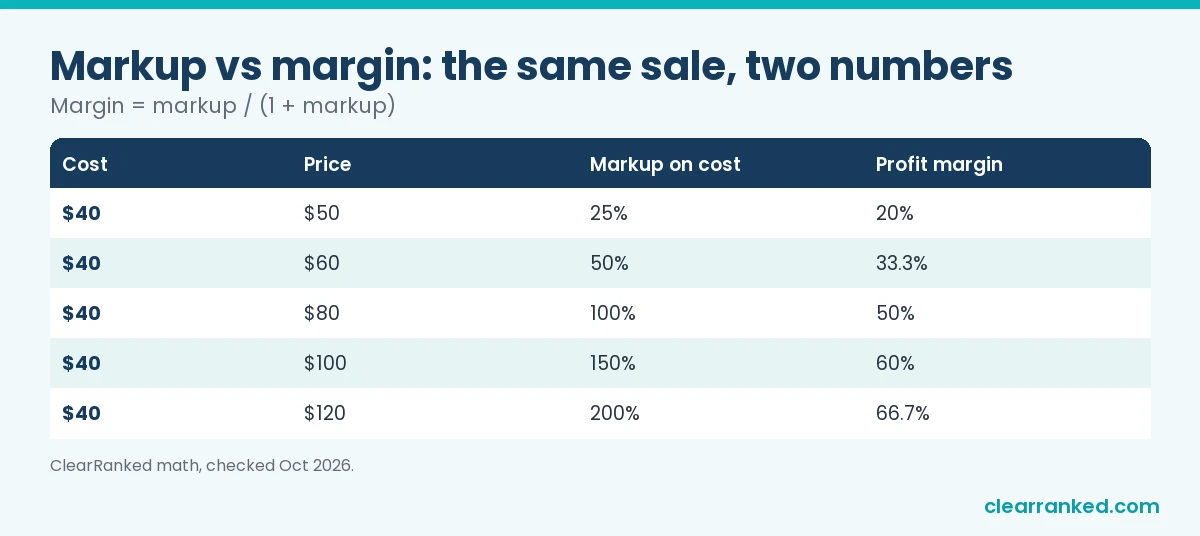
This is the most expensive mix-up in small business pricing. Say a contractor wants a 30% margin and tells the estimator to “add 30%.” A $10,000 job becomes $13,000. But $3,000 / $13,000 is a 23.1% margin, not 30%. On a year of $600,000 in jobs, that gap is real money.
The fix is simple. To hit a 30% margin, divide cost by 0.70: $10,000 / 0.70 = $14,286. Our markup calculator does the conversion both ways, so you don’t have to redo it by hand on every quote.
How do you price a product for a target margin?
Use price = cost / (1 – target margin). A product that costs you $30 with a 40% target margin should sell for $30 / 0.60 = $50. Check it: $20 of profit divided by the $50 price is 40%. Simply adding 40% to cost would give $42, which is only a 28.6% margin.
| Unit cost | Target margin | Price formula | Selling price |
|---|---|---|---|
| $30 | 30% | $30 / 0.70 | $42.86 |
| $30 | 40% | $30 / 0.60 | $50.00 |
| $30 | 50% | $30 / 0.50 | $60.00 |
| $30 | 60% | $30 / 0.40 | $75.00 |
Notice how fast price climbs at higher margins. Going from 50% to 60% adds $15 to a $30 item. That’s why high-margin products usually need a brand, a niche or a service attached. Otherwise, a competitor undercuts you.
Also, remember that labor cost moves with wages and overtime. If your margin depends on crew hours, check them against payroll every month, not once a year. Our overtime calculator helps you see what a busy week does to cost.
What is a good profit margin for a small business?
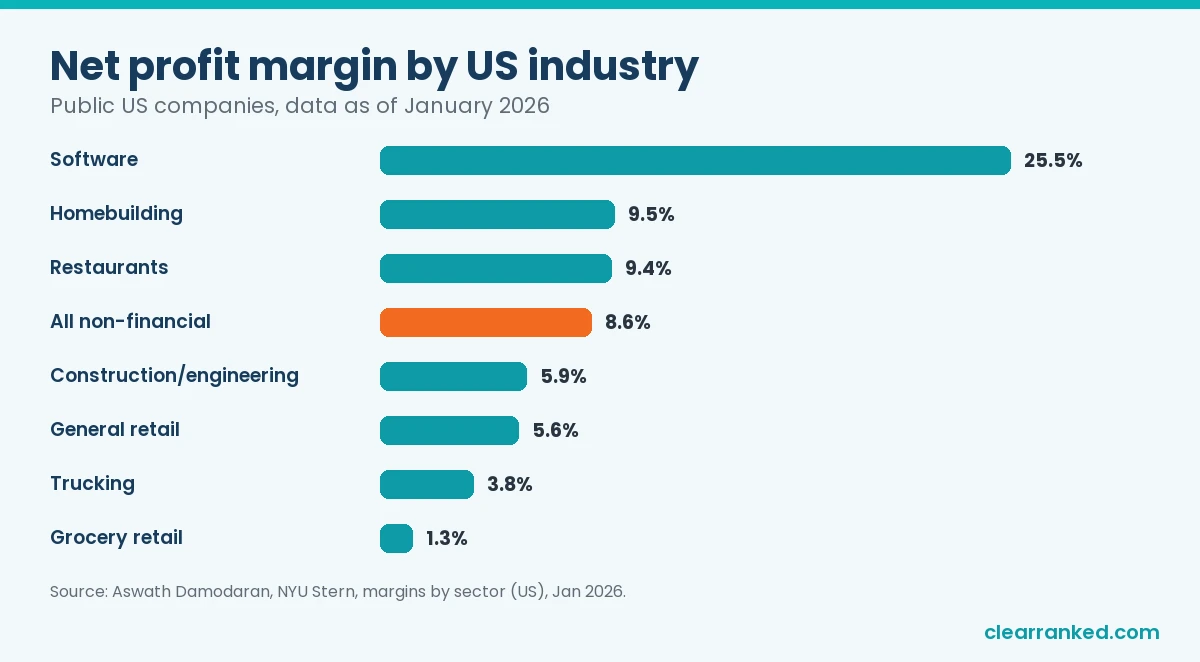
It depends heavily on the industry. In the January 2026 NYU Stern data, average net margins ran from 1.32% for grocery retail to 25.49% for software, with all non-financial public companies averaging 8.56%. Compare yourself with your own industry, and with your own last year, before anything else.
| Industry (public US firms) | Gross margin | Net margin |
|---|---|---|
| Restaurant/Dining | 32.24% | 9.37% |
| Engineering/Construction | 15.46% | 5.94% |
| Homebuilding | 22.70% | 9.47% |
| Retail (General) | 33.18% | 5.61% |
| Retail (Grocery and Food) | 26.31% | 1.32% |
| Trucking | 21.19% | 3.79% |
| Software (System and Application) | 71.72% | 25.49% |
| Total market, excluding financials | 34.39% | 8.56% |
A word of caution. These are big listed companies with buying power and scale, so gross margins can look different from a corner shop’s. Your own trend line matters more. A net margin that slides from 9% to 6% over two years is a warning, even if 6% looks normal on a chart.
Here’s our rule of thumb for owners: watch gross margin monthly, operating margin quarterly, and net margin yearly with your CPA. That rhythm catches pricing problems early and tax surprises before they’re due. Check with a CPA for how your industry defines cost of goods sold.
How can you improve your profit margin?
You can raise prices, lower direct costs, or cut overhead, and the best lever depends on which margin is weak. A low gross margin points to pricing or supplier costs. A healthy gross margin with a thin net margin points to overhead, debt, or labor scheduling.
- Reprice by margin, not habit. Run every product or service through the price formula above at least once a year.
- Cut waste in direct costs. For a bakery, unsold product. For a contractor, material overruns caught by a proper quantity takeoff.
- Schedule to demand. Paying four staff during a dead hour costs margin every single day.
- Drop low-margin work. Some customers cost more to serve than they bring in. It’s fine to let them go.
- Track it in one place. Good books make margins visible; the small business tax deductions guide also helps net profit after tax.
Related guides
- Markup calculator
- Tax deductions for small business
- How to start a construction business
- What is an LLC?
- All ClearRanked calculators
FAQ
Divide profit by revenue and multiply by 100. For example, $2,500 profit on $10,000 of sales is a 25% profit margin.
Profit margin equals profit divided by revenue, times 100. Use gross profit for gross margin, operating profit for operating margin, and net profit for net margin.
No. A 50% markup on a $40 cost gives a $60 price, which is a 33.3% margin. A 50% margin on the same cost needs an $80 price.
Divide the markup by one plus the markup. A 25% markup is 0.25 divided by 1.25, which is a 20% margin.
It depends on the industry. In January 2026 data on public US companies, net margins ranged from about 1.3% in grocery retail to about 25.5% in software, with 8.56% as the non-financial average.
Yes. If costs are higher than revenue, profit is negative, and so is the margin. A negative net margin means the business lost money for that period.
About the author
I’m Ali Hassan, the founder of ClearRanked. Also, I run small businesses myself, and I know how much time goes into pricing, pay math and keeping the books. ClearRanked is where I share plain-English guides and honest comparisons, so small business owners can make decisions with confidence instead of guesswork.
How we work: this guide is research-based, and every source in it was checked in October 2026. We don’t take payment for rankings, and we update guides when laws or prices change. Finally, read more on our About page.