Mechanical Contractors: What They Do, 2026 Costs and How to Hire One
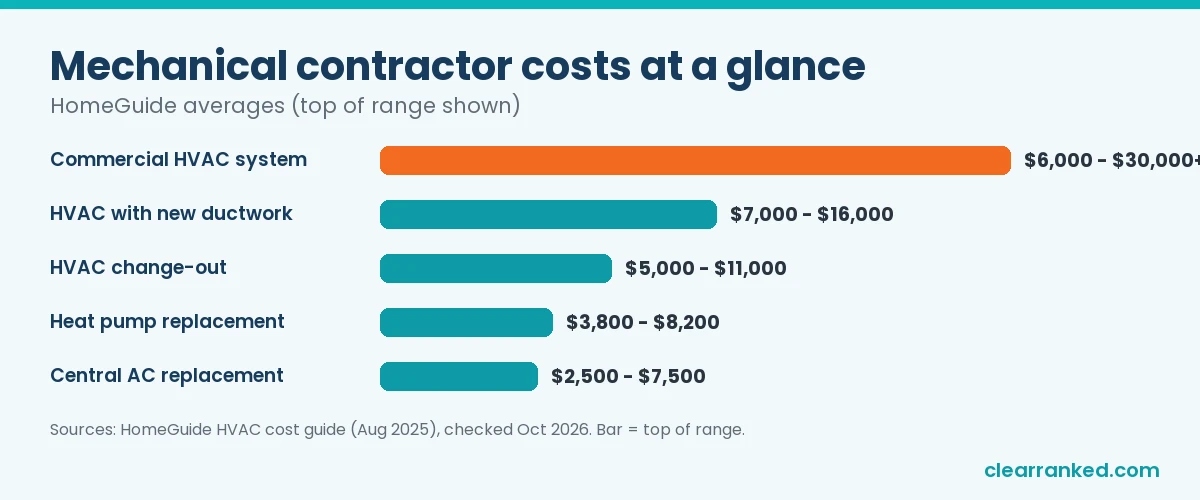
Mechanical contractors install and service the systems that heat, cool, ventilate and plumb a building: HVAC equipment, ductwork, piping, boilers and often refrigeration. On cost, HomeGuide puts a commercial HVAC system at $6,000 to $30,000 or more, or about $15 to $30 per square foot for office buildings. A home HVAC change-out runs $5,000 to $11,000.
The term confuses a lot of owners. You’ll see mechanical contractor on a bid next to electrical and general, and it isn’t obvious what’s included. In short, mechanical covers the air and water systems, while electrical covers power and lighting.
This guide explains the trade for business and property owners, then shows small HVAC and plumbing firms how mechanical work is usually priced. The numbers are sourced and dated so you can check them.
How we researched this: costs come from HomeGuide’s HVAC cost guide (August 2025) and its plumber cost guide (September 2023). Certification rules come from the EPA Section 608 program, license examples from California’s CSLB, and wages from the BLS OEWS survey for May 2025. We checked all sources in October 2026.
Key takeaways
- Mechanical contractors handle HVAC, ductwork, plumbing and piping, and often refrigeration.
- Commercial HVAC runs about $15 to $30 per square foot for offices, per HomeGuide.
- A residential HVAC change-out costs $5,000 to $11,000; adding new ductwork pushes it to $7,000 to $16,000.
- Commercial plumbers average about $85 an hour on HomeGuide’s data, versus about $70 for residential.
- Technicians handling ozone-depleting refrigerants must hold EPA Section 608 certification.
- HVAC mechanics earned a median $29.33 an hour and plumbers $30.67 in May 2025, per the BLS.
What does a mechanical contractor do?
A mechanical contractor designs, installs, maintains and repairs a building’s heating, ventilation, air conditioning, plumbing and process piping. On larger jobs, that includes rooftop units, ductwork, boilers, chillers, water heaters and gas lines. Many firms also handle refrigeration and building controls, while electrical wiring usually goes to a separate electrical contractor.
On a commercial project, the mechanical contractor is often one of the largest subcontractors, working under the general contractor. On a service call, they may work directly for the owner. Some firms do only HVAC, some only plumbing, and some do both under one roof.
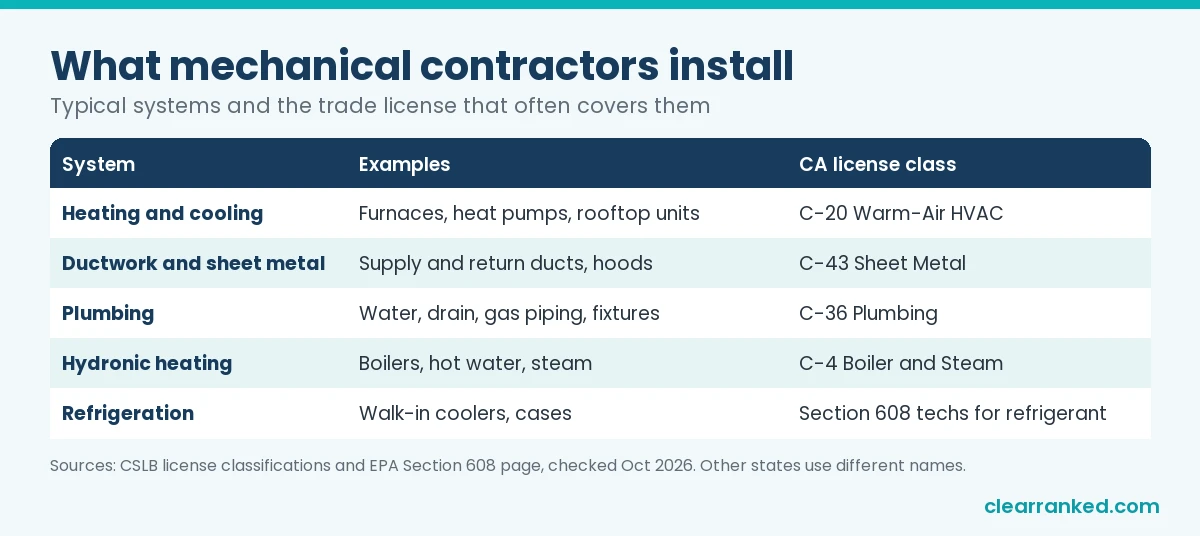
Licensing follows the systems. California’s CSLB list, for example, separates C-20 HVAC, C-36 Plumbing, C-43 Sheet Metal and C-4 Boiler and Steam Fitting. Other states use different names, and some issue a single mechanical license. So ask which license covers each part of your job.
How much do mechanical contractors charge?
Mechanical contractor costs depend on the system. HomeGuide lists commercial HVAC installs at $6,000 to $30,000 or more, or $15 to $30 per square foot for offices and $17 to $22 for recreational buildings. Plumbers charge $45 to $150 an hour, with commercial plumbers averaging about $85. Residential HVAC replacement averages $8,000.
For a quick commercial budget, use area x rate. A 5,000-square-foot office at $15 to $30 per square foot works out to 5,000 x $15 = $75,000 up to 5,000 x $30 = $150,000 for HVAC. That’s a planning number only; tonnage, zoning and ductwork layout decide the real price.
| Job | HomeGuide price | Typical time |
|---|---|---|
| HVAC change-out, existing ducts | $5,000 – $11,000 | About 1 day |
| HVAC with new ductwork | $7,000 – $16,000 | 3 – 5 days |
| HVAC with add-ons (zoning, humidifier) | $9,500 – $18,500 | 4 – 7 days |
| Heat pump replacement | $3,800 – $8,200 | Varies |
| Boiler replacement | $2,200 – $10,000 | Varies |
| Plumber, hourly | $45 – $150 | Plus service call $50 – $200 |
After-hours work costs more. HomeGuide notes emergency plumbing can be billed at double or triple time on nights, weekends and holidays. For a restaurant, a weekend repair may still be cheaper than closing for a day, but ask for the rate before the truck rolls.
What certifications should mechanical contractors have?
Mechanical contractors should hold the state or local licenses for each trade they perform, and their HVAC technicians who work with refrigerants should hold EPA Section 608 certification. Under 40 CFR Part 82, Subpart F, technicians who maintain, service, repair or dispose of equipment that could release ozone-depleting refrigerants must be certified.
The EPA Section 608 page lists four certification types: Core, Type I for small appliances, Type II for high-pressure systems and Type III for low-pressure systems. EPA doesn’t issue the cards itself; approved programs do. So it’s fair to ask a contractor for copies of their technicians’ cards.
Plumbers usually need a state or city license too, often with journeyman and master levels. Gas piping, backflow devices and medical gas may need extra endorsements in some places. This isn’t legal advice; your local building department can confirm what applies.
How do you choose mechanical contractors?
Choose mechanical contractors with the right trade licenses, EPA-certified technicians, liability and workers’ comp insurance, and experience with your building type. Ask for a load calculation rather than a guess on equipment size, a written scope listing equipment model numbers and ductwork, and a clear warranty and maintenance offer.
- Verify each trade license and ask who holds the qualifying license.
- Ask for a load calculation before accepting an equipment size.
- Get model numbers, efficiency ratings and warranty terms in writing.
- Confirm who handles permits, startup, testing and balancing.
- Ask about a service agreement and emergency response times.
Red flags: a contractor who sizes equipment by square footage alone with no calculation, a bid that leaves out ductwork changes, or technicians who can’t show refrigerant certification. Insurance should match the job; our contractor insurance guide lists the main policies to ask for.
Should you repair or replace a building’s HVAC system?
Replace an HVAC system when repairs keep coming back, the equipment is near the end of its life, or the ductwork needs work anyway. HomeGuide says ductwork lasts 10 to 20 years and often needs repair or replacement during an upgrade. If ducts are sound, a change-out at $5,000 to $11,000 avoids the higher ductwork price.
Look at how the bill splits. HomeGuide breaks a typical replacement into $4,000 to $8,000 for the equipment and $1,000 to $3,000 for installation labor. So the brand and efficiency you pick usually move the price more than the crew does.
For smaller buildings priced like homes, HomeGuide’s rule of thumb is $3 to $6 per square foot. A 2,000-square-foot space works out to 2,000 x $3 = $6,000 up to 2,000 x $6 = $12,000. Larger commercial spaces jump to the $15 to $30 range because of rooftop units, longer duct runs, controls and code requirements for ventilation.
One more tip: get the replacement quote before an emergency. A planned swap in spring or fall lets you compare two or three bids. A failed unit in July usually means taking whoever can come first, at whatever rate they quote.
How do mechanical contractors bid jobs?
Mechanical contractors bid by doing a takeoff of equipment, duct, pipe and fittings from the drawings, applying labor units for each item from past jobs, getting equipment quotes from distributors, then adding startup, testing, permits, supervision, overhead and profit. Labor is often the line that decides who wins, so accurate units matter.
Here’s a simplified labor check for a small commercial HVAC replacement:
- Scope: replace two rooftop units and modify ductwork; your labor units total 80 hours
- HVAC mechanic wages: 80 x $29.33 (BLS median) = $2,346.40 before payroll taxes and comp
- Plumbing for condensate and gas: 16 hours x $30.67 (BLS median for plumbers) = $490.72
- Equipment, crane, curbs and duct materials: from distributor and rental quotes
- Sanity check for a full system on a 5,000 sq ft office: $75,000 to $150,000 at $15 to $30 per sq ft
Notice how close the trades are on pay. The BLS medians for May 2025 were $29.33 for HVAC mechanics, $30.67 for plumbers and $30.38 for electricians. So the real differences between mechanical bids usually come from labor units, equipment pricing and how well each firm runs its jobs, not from wage rates.
Good estimating software speeds this up. Our guides to HVAC estimating software and plumbing estimating software compare tools built for these trades, and the quantity takeoff guide covers the basics. Then set your price with the markup calculator.
If you sub to general contractors, learn how they think about fees and schedules. Our guide to commercial electrical contractors shows how a sister trade prices commercial work, and construction scheduling software helps keep techs, cranes and inspections lined up.
Related guides
- HVAC estimating software
- Plumbing estimating software
- Commercial electrical contractors
- Spray foam insulation contractors
- Contractor insurance guide
FAQ
Mechanical contractors handle HVAC, ductwork, plumbing and piping. Electrical contractors handle power distribution, wiring, lighting and panels. Most commercial projects need both.
HomeGuide puts commercial HVAC systems at $6,000 to $30,000 or more, or about $15 to $30 per square foot for office buildings and $17 to $22 for recreational buildings.
Yes, if they work with ozone-depleting refrigerants. EPA Section 608 rules require technicians who maintain, service, repair or dispose of such equipment to be certified.
HomeGuide reports commercial plumbers average about $85 an hour, compared with about $70 for residential plumbers, with higher rates for emergency work.
HomeGuide says a straight change-out usually takes about a day, a system with new ductwork takes 3 to 5 days, and one with add-ons takes 4 to 7 days.
The BLS reported May 2025 median wages of $29.33 an hour for HVAC and refrigeration mechanics and $30.67 for plumbers, pipefitters and steamfitters.
About the author
I’m Ali Hassan, the founder of ClearRanked. Also, I run small businesses myself, and I know how much time goes into trade pricing, crews and contractor costs. ClearRanked is where I share plain-English guides and honest comparisons, so small business owners can make decisions with confidence instead of guesswork.
How we work: this guide is research-based, and every source in it was checked in October 2026. We don’t take payment for rankings, and we update guides when laws or prices change. Finally, read more on our About page.