How to Calculate PTO Accrual (Formulas + Examples)
For a PTO accrual calculation, divide the annual allowance by the number of accrual periods. Per pay period, that’s annual hours ÷ pay periods, so 120 hours paid semi-monthly accrues 5 hours per paycheck. Per hour worked, it’s annual hours ÷ 2,080, about 0.0577 hours for every hour worked. Then pro-rate part-timers and apply caps.
Accrual math isn’t hard, but there are several slightly different ways to do it, and each gives a different balance on any given day. When an employee and a manager disagree about a balance, they’re usually using two methods without realizing it. Below, each method is worked through with real numbers. For the software side, see the pillar guide, What Is PTO Tracking Software?
Key takeaways
- Per pay period: annual hours ÷ pay periods per year. Per hour worked: annual hours ÷ 2,080 (for a 40-hour full-time year).
- Front-loading gives the full allowance up front. Pro-rate it for mid-year hires.
- Pro-rate part-timers by FTE: scheduled hours ÷ full-time hours.
- A carryover cap limits what rolls into next year, and an accrual cap stops new accrual at a maximum balance. California allows caps but bans use-it-or-lose-it.
What is PTO accrual?
PTO accrual is the method of earning paid time off gradually, for example a few hours each pay period or a fraction of an hour for every hour worked, instead of receiving the whole year’s allowance at once. The accrual rate is the amount earned per period or per hour, and it’s the number your payroll system applies. Every PTO accrual calculation starts from that rate.
Definitions used in this guide:
- Annual allowance is the PTO a full-timer earns in a leave year, such as 80 or 120 hours.
- Accrual period is the unit you earn in: a pay period, a month or an hour worked.
- Front-loading is giving the whole allowance on day one.
- Carryover cap is the most unused PTO that can roll into the next leave year.
- Accrual cap (or ceiling) is the maximum balance. Once someone reaches it, they stop earning until they use some.
There’s no federal rule on any of this. The US Department of Labor (accessed Oct 2026) says the FLSA “does not require payment for time not worked, such as vacations.” States can add rules, especially for sick leave and payout.
This is general information, not legal advice. Check your state labor department or GOV.UK for your situation.
How does PTO accrual calculation work per pay period?
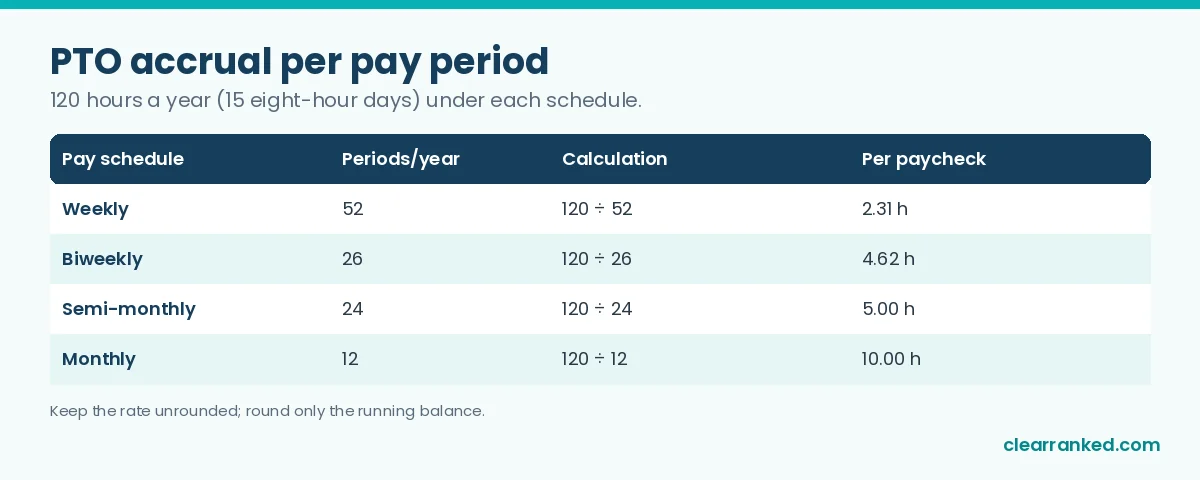
Divide the annual allowance in hours by the number of pay periods in a year: 52 for weekly, 26 for biweekly, 24 for semi-monthly or 12 for monthly. The result is the hours added to the balance each paycheck. For example, 120 hours a year paid biweekly is 120 ÷ 26 ≈ 4.62 hours per paycheck.
Formula: accrual per period = annual allowance (hours) ÷ pay periods per year
Here’s 120 hours a year (15 eight-hour days) under each pay schedule:
| Pay schedule | Periods per year | Calculation | Accrual per paycheck |
|---|---|---|---|
| Weekly | 52 | 120 ÷ 52 | 2.31 h |
| Biweekly | 26 | 120 ÷ 26 | 4.62 h |
| Semi-monthly | 24 | 120 ÷ 24 | 5.00 h |
| Monthly | 12 | 120 ÷ 12 | 10.00 h |
Worked example. Dana gets 120 hours a year, paid biweekly. After her 15th paycheck she has accrued 15 × 4.615 = 69.23 hours. Keep the unrounded rate (4.6154) and round only the balance; rounding the rate to 4.62 first gives 120.12 hours over 26 paychecks, not 120.
Choose per-pay-period accrual if your staff are salaried or work steady schedules. It’s the easiest method to explain.
PTO accrual calculation per hour worked
Divide the annual allowance by the hours in a full-time year, usually 2,080 (40 hours × 52 weeks), to get a per-hour rate. Then multiply that rate by the hours actually worked. For 120 hours a year, that’s 120 ÷ 2,080 ≈ 0.0577 hours of PTO for every hour worked.
Formula: accrual rate = annual allowance ÷ 2,080, and PTO earned = rate × hours worked
Worked example. Luis is hourly and works 35 hours one week: 35 × 0.0577 = 2.02 hours of PTO. If he works 1,500 hours over the year, he earns 1,500 × 0.05769 = 86.5 hours.
Some state sick-leave laws work this way. California’s minimum is 1 hour of paid sick leave for every 30 hours worked (accessed Oct 2026) (1 ÷ 30 ≈ 0.0333), and employers may cap use at 40 hours or 5 days a year and accrual at 80 hours or 10 days. A half-time employee working 1,040 hours accrues 1,040 ÷ 30 = 34.67 hours.
Choose hourly accrual if hours vary week to week, and write down whether overtime counts.
How does front-loaded PTO work?
Front-loading gives the full annual allowance on the first day of the leave year instead of building it up over time. For mid-year hires, pro-rate it by the share of the year left. Someone who starts on July 1 under an 80-hour policy gets 80 × 6 ÷ 12 = 40 hours for that first year.
Formula (monthly pro-rating): first-year allowance = annual allowance × months remaining ÷ 12
Formula (daily pro-rating): annual allowance × days remaining ÷ 365. Same July 1 hire: 80 × 184 ÷ 365 = 40.33 hours.
The catch: someone can use a whole year’s PTO in March and then leave. In California, the Labor Commissioner treats vacation taken before it’s earned as an advance on wages that can’t be deducted from the final paycheck. The same page pro-rates earned vacation daily at separation: on a 120-hour entitlement, someone who quits on day 219 has earned 219 ÷ 365 = 60%, or 72 hours, less any already used.
How do tenure tiers change the PTO accrual calculation?
Tenure tiers increase the annual allowance as service grows, for example 80 hours in years 1–2, 120 hours from year 3 and 160 hours from year 7. You redo the PTO accrual calculation whenever someone moves up a tier. The key policy choice is whether the step-up happens on the work anniversary or at the start of the next leave year.
For a benchmark, the Bureau of Labor Statistics (accessed Oct 2026) reports these averages for private-industry workers with paid vacation in March 2026:
| Years of service | Average paid vacation days (private industry) |
|---|---|
| After 1 year | 11 |
| After 5 years | 16 |
| After 10 years | 18 |
| After 20 years | 20 |
Worked example (anniversary step-up). Sam is paid biweekly and hits his 3-year anniversary halfway through the leave year, moving from the 80-hour to the 120-hour tier.
- First 13 paychecks: 13 × (80 ÷ 26) = 13 × 3.077 = 40.0 hours
- Last 13 paychecks: 13 × (120 ÷ 26) = 13 × 4.615 = 60.0 hours
- Year total: 100 hours
If the step-up waits for the next leave year, Sam earns 80 hours this year and 120 next. That’s easier to run in a spreadsheet, which is how our PTO tracking spreadsheet template works.
How do you pro-rate PTO for part-time employees?
Multiply the full-time allowance by the employee’s FTE, which is their scheduled weekly hours divided by full-time weekly hours. A 24-hour-a-week employee on a 40-hour standard is 0.6 FTE, so an 80-hour policy becomes 48 hours a year, or 1.85 hours per biweekly paycheck.
Formula: part-time allowance = full-time allowance × (scheduled hours ÷ full-time hours)
Hourly accrual pro-rates on its own; per-period accrual needs the FTE step.
Offering part-timers any paid vacation puts you ahead of most employers. BLS data for March 2026 shows 38% of part-time private-industry workers had access to paid vacation, against 93% of full-time workers. Whatever you choose, write it into your PTO policy so it’s applied the same way to everyone.
How do carryover caps and accrual caps work?
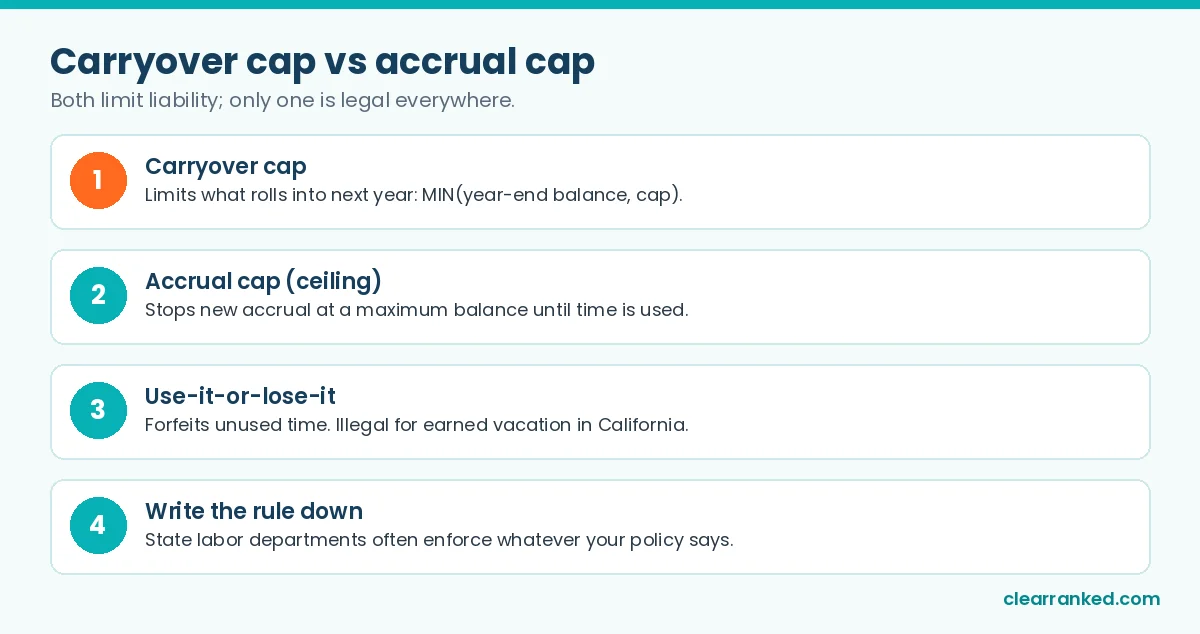
A carryover cap limits how much unused PTO moves into the next year: carryover = the lower of the year-end balance or the cap. An accrual cap stops new accrual once the balance reaches a maximum. California allows reasonable accrual caps but bans use-it-or-lose-it forfeiture of earned vacation.
Carryover formula: carryover = MIN(year-end balance, cap)
Worked example. Ending balance 70 hours, cap 40. Carryover = MIN(70, 40) = 40 hours. The other 30 hours depend on your policy and state: payout, extra carryover, or forfeiture where allowed.
Accrual cap formula (per period): hours added = MIN(accrual rate, MAX(0, cap − current balance))
Worked example. Cap 180, balance 178, rate 4.62. Hours added = MIN(4.62, 180 − 178) = 2 hours, then nothing until the balance drops.
California’s Labor Commissioner accepts a policy where accrual stops at 200 hours, but not forfeiting earned vacation. Other states differ; check your state labor department for payout and forfeiture rules.
One tax note: the IRS says vacation pay is subject to withholding (accessed Oct 2026) as if it were a regular wage payment, and a lump-sum payment for unused vacation is treated as a supplemental wage payment.
How is holiday accrual calculated in the UK?
Most UK workers are entitled to 5.6 weeks of paid holiday a year, which is 28 days for a five-day week. Part-timers on regular hours get 5.6 times their days per week. For irregular-hours and part-year workers, in leave years starting on or after 1 April 2024, holiday accrues at 12.07% of the hours worked in each pay period.
The rules come from GOV.UK (accessed Oct 2026):
- Regular full-time: 5.6 × 5 days = 28 days, the statutory cap even for a six-day week. Bank holidays can count toward it.
- Regular part-time: 3 days a week × 5.6 = 16.8 days.
- First-year accrual (regular hours): one-twelfth a month. After 3 months, 28 ÷ 12 × 3 = 7 days (GOV.UK).
- Irregular hours: 12.07% of hours worked each pay period, rounded up to the nearest hour if 0.5 or more. GOV.UK’s example: 30 hours × 12.07% = 3.621, which becomes 4 hours. The figure is 5.6 weeks of leave ÷ 46.4 working weeks (52 − 5.6).
- Carryover: someone who gets 28 days can carry over up to 8 days.
Check tricky cases with the GOV.UK holiday entitlement calculator.
Which PTO accrual calculation method should you use?
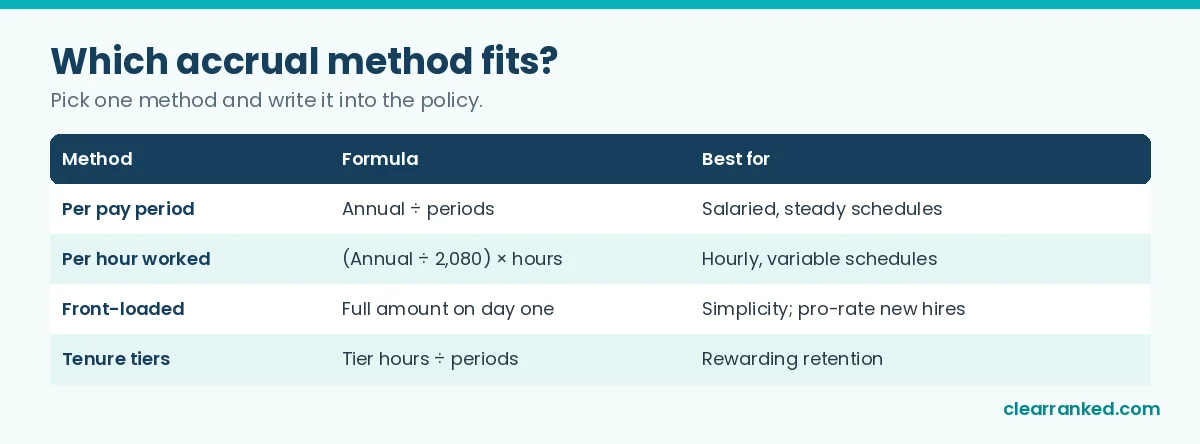
Use per-pay-period accrual for salaried staff and steady schedules, hourly accrual for variable-hour workers, and front-loading if you want simplicity and accept the risk of advances. Whichever you pick, apply it the same way to everyone and put the formula in your written policy.
| Method | Formula | Best for | Watch out for |
|---|---|---|---|
| Per pay period | Annual ÷ periods | Salaried, steady schedules | Rounding the rate too early |
| Per hour worked | (Annual ÷ 2,080) × hours | Hourly, variable schedules | Deciding whether overtime counts |
| Front-loaded | Full amount on day one; pro-rate new hires | Simplicity | Leave used before it’s earned |
| Tenure tiers | Tier hours ÷ periods | Rewarding retention | Mid-year step-up math |
Running several methods at once? See How to Track PTO for a Small Team for when a spreadsheet stops being enough.
How many days is 200 hours of PTO?
200 hours of PTO is 25 workdays if you work 8-hour days, or 20 days if you work 10-hour shifts. To convert any balance, divide the hours by the length of the workday you’d be taking off. That’s five full 40-hour weeks.
Use your scheduled shift, not a standard 8 hours. A nurse on 12-hour shifts uses 12 hours of PTO per day off, so 200 hours covers about 16.7 shifts. A part-timer on 6-hour days gets 33.3 days from the same balance.
| PTO hours | 8-hour days | 10-hour days | 40-hour weeks |
|---|---|---|---|
| 40 | 5 | 4 | 1 |
| 60 | 7.5 | 6 | 1.5 |
| 80 | 10 | 8 | 2 |
| 99 | 12.4 | 9.9 | 2.5 |
| 120 | 15 | 12 | 3 |
| 125 | 15.6 | 12.5 | 3.1 |
| 156 | 19.5 | 15.6 | 3.9 |
| 160 | 20 | 16 | 4 |
| 190 | 23.8 | 19 | 4.8 |
| 200 | 25 | 20 | 5 |
A fraction of a day is still usable. For example, 99 hours at 8 hours a day is 12 full days plus 3 hours, so you could take 12 days off and keep 3 hours for an appointment. Our PTO calculator does the accrual side if you want to see when you’ll reach a balance.
FAQ
Divide the annual PTO allowance in hours by the number of pay periods in a year. For example, 120 hours paid biweekly is 120 ÷ 26 ≈ 4.62 hours per paycheck, and paid semi-monthly it’s 120 ÷ 24 = 5 hours. Keep the rate unrounded and round only the balance.
Divide the annual allowance by 2,080 hours for a 40-hour full-time year. A 120-hour allowance gives about 0.0577 hours of PTO per hour worked, so a 35-hour week earns about 2.02 hours. California’s sick-leave minimum is 1 hour for every 30 hours worked.
A carryover cap is the maximum unused PTO that can roll into the next leave year. Carryover equals the lower of the year-end balance and the cap. What happens to the excess depends on your policy and state law. California, for example, bans forfeiting earned vacation.
According to BLS data for March 2026, private-industry workers with paid vacation averaged 11 days after 1 year of service, 16 after 5 years, 18 after 10 years and 20 after 20 years. Federal law doesn’t require any paid vacation.
For leave years starting on or after 1 April 2024, irregular-hours and part-year workers accrue holiday at 12.07% of the hours worked in each pay period, according to GOV.UK. For example, 30 hours worked gives 3.621 hours, which rounds up to 4 hours.
About the author
Ali Hassan is the owner and editor of ClearRanked, an independent business-software blog. He researches HR, payroll and PTO tools using vendor pricing pages, official government guidance and published data, and every source in this guide was checked in October 2026. I’m Ali Hassan, the founder of ClearRanked. I run small businesses myself, and I know how much time goes into picking the right HR, payroll and project tools. ClearRanked is where I share plain-English guides and honest comparisons, so small business owners can choose software with confidence instead of guesswork.
How we work: this guide is research-based. We don’t take payment for rankings, and we update guides when laws or prices change. Read more on our About page.