
Basement Finishing Contractors: Cost to Finish a Basement in 2026 and How to Hire
Basement finishing contractors usually charge $30 to $50 per square foot, which puts most projects between $15,000 and $75,000, according to HomeGuide’s February 2026 cost guide. An open-plan 1,000-square-foot basement runs about $30,000 to $40,000. Add bedrooms and a bathroom and the same space reaches $40,000 to $50,000 or more.
A basement is often the cheapest square footage you can add to a house. The foundation, roof and outer walls already exist. However, below-grade space brings its own problems: water, low ceilings, radon and the need for a legal way out in a fire.
This guide gives homeowners real 2026 numbers and a hiring checklist. It also shows remodelers how these jobs are usually priced, so you can sanity-check a bid from either side.
How we researched this: costs come from HomeGuide’s cost to finish a basement guide, updated February 2026. Radon guidance comes from the EPA’s radon health risk page, and trade wages come from the BLS OEWS survey for May 2025. We checked each source in October 2026.
Key takeaways
- Finishing a basement costs $30 to $50 per square foot, or about $15,000 to $75,000 for most homes.
- A partial finish, like one living room, runs $2,500 to $20,000.
- Adding a basement bathroom costs $10,000 to $25,000 and is often the single biggest upgrade.
- Labor typically makes up 20% to 40% of the total, or $6 to $20 per square foot.
- Permits run about $200 to $1,000, and a bedroom needs an egress window, which costs $2,000 to $5,000.
- The EPA says to fix a home with radon at 4 pCi/L or higher, so test before you finish.
What does it cost to finish a basement in 2026?
The cost to finish a basement in 2026 is about $30 to $50 per square foot, per HomeGuide. A 600-square-foot open basement costs $18,000 to $24,000, while a 1,500-square-foot basement split into three rooms costs $60,000 to $75,000. Open layouts save money on framing, drywall, doors and insulation.
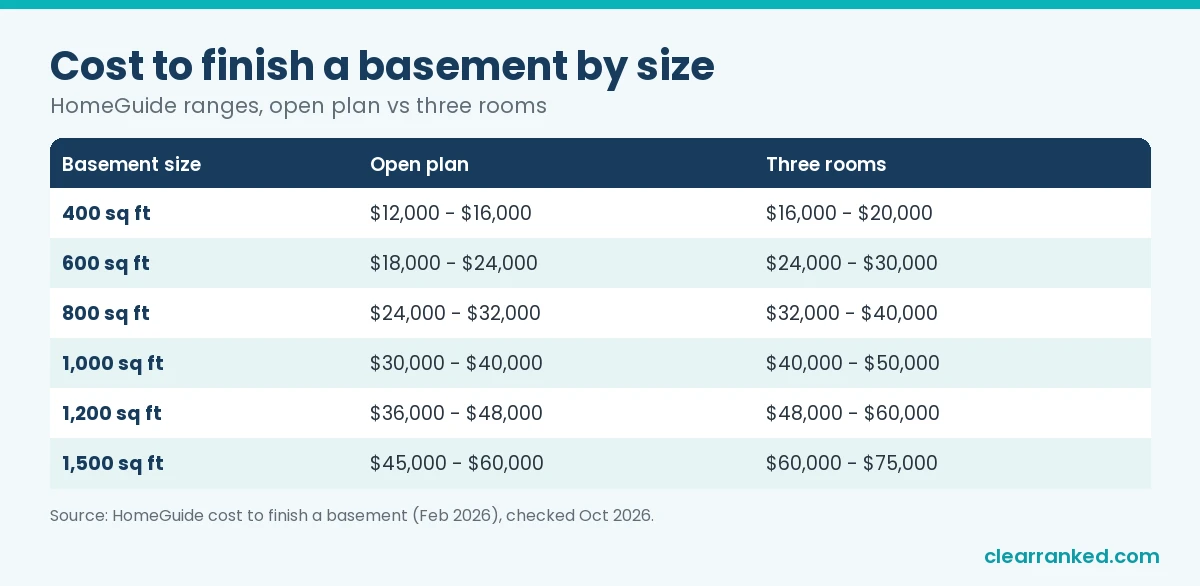
The math works like this: area x rate. For example, 800 square feet x $30 = $24,000 at the low end, and 800 x $50 = $40,000 at the high end. Your result lands lower with an open plan and builder-grade finishes, and higher with a bathroom, a kitchenette and tile floors.
If the budget is tight, a partial finish is a smart first phase. HomeGuide prices a basement living room at $6,000 to $16,000, a bedroom at $3,000 to $12,000 each, and a kitchenette at $5,000 to $20,000. You can rough in plumbing now and finish the bathroom later.
Which line items drive basement finishing costs?
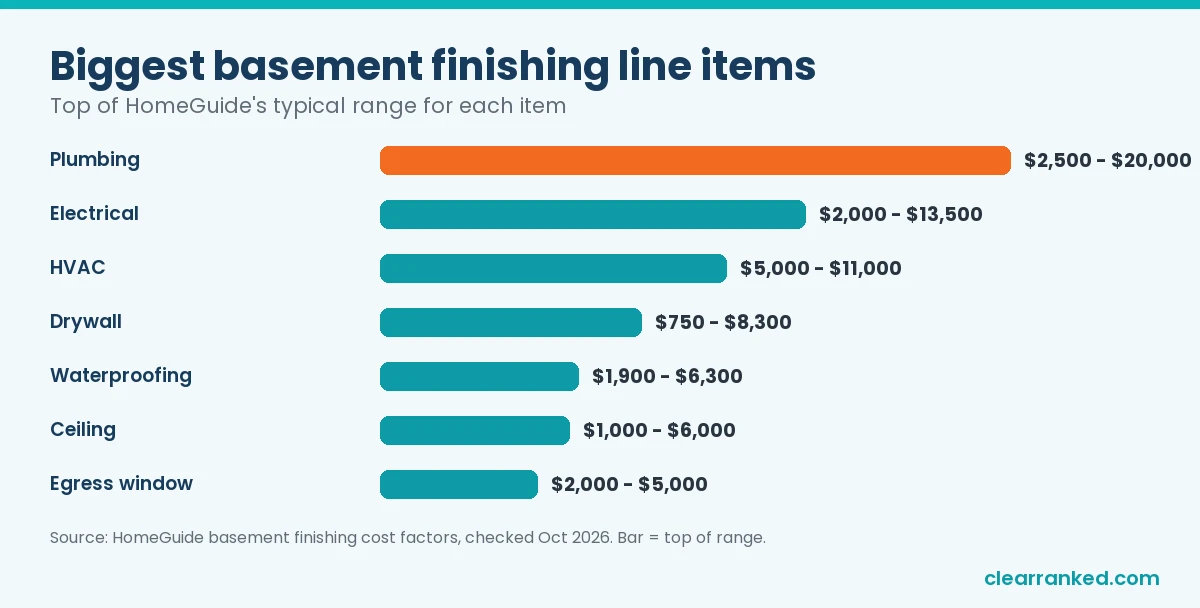
Plumbing, electrical and HVAC drive most of a basement’s cost. HomeGuide lists plumbing at $2,500 to $20,000, electrical at $2,000 to $13,500, and HVAC at $5,000 to $11,000. Drywall, waterproofing, ceilings and an egress window each add a few thousand more. Flooring can range from $1,000 to $36,000 depending on the material.
| Item | HomeGuide cost | What changes the price |
|---|---|---|
| Framing | $1,100 – $4,500 | Number of rooms and closets |
| Insulation | $600 – $4,600 | Foam board vs batts, wall area |
| Drywall | $750 – $8,300 | Rooms, ceiling height, texture |
| Ceiling | $1,000 – $6,000 | Drywall vs drop ceiling |
| Painting | $800 – $2,500 | Number of rooms |
| Flooring | $4 – $15 per sq ft | Carpet vs tile vs hardwood |
| Permit | $200 – $1,000 | City fees, about 1% to 2% of cost |
Water is the one cost you can’t skip. HomeGuide puts a full waterproofing job, including wall sealing plus a pump and drain, at $6,000 to $18,000, and a sump pump alone at $600 to $2,500. If your basement has ever had standing water, fix that first. Finishing over a wet wall just hides mold behind new drywall.
What permits and safety checks does a finished basement need?
Most cities require a building permit to finish a basement, usually with separate electrical and plumbing inspections. HomeGuide puts permit fees at $200 to $1,000. A basement bedroom needs an egress window or door, and HomeGuide notes ceilings generally need at least 7 feet of height. Also, test for radon before you close the walls.
Radon is the hidden one. The EPA describes it as a radioactive gas you can’t see or smell, and testing is the only way to know your level. On its health risk page, the EPA recommends fixing a home at 4 pCi/L or above and estimates radon causes about 21,000 lung cancer deaths a year. A finished basement is exactly where people start sleeping, so test first.
Code details like egress window size, stair rules and smoke alarms depend on the version of the building code your city has adopted. So ask your building department for its basement checklist before you design rooms. This isn’t legal advice, and local rules win.
How do you choose basement finishing contractors?
Choose basement finishing contractors who are licensed for remodeling in your state, carry liability and workers’ comp insurance, pull the permits themselves, and give a fixed-price bid with an itemized scope. Ask how they handle moisture and radon, and get references from at least two finished basements you can actually visit.
You’ll usually pick between a general contractor and a design-build basement company. HomeGuide notes general contractors charge 10% to 20% of construction costs to manage subs. A basement specialist may cost similar money but bring a set process for moisture control and egress.
- Verify the license number on your state contractor board’s website.
- Ask for a certificate of insurance sent from the insurer or agent.
- Make sure the bid names who pulls permits and who is on the permit.
- Ask what the price includes for plumbing rough-in, HVAC and egress.
- Tie payments to inspections passed, not just calendar dates.
Red flags: a contractor who suggests skipping the permit to save money, a bid with one lump-sum number and no detail, or a demand for half the money up front. Unpermitted basements can cause trouble at resale and with insurance claims.
How do remodelers price a basement finishing job?
Remodelers price a basement by measuring wall length and floor area, then pricing each trade: framing, insulation, electrical, plumbing, HVAC, drywall, ceiling, paint, flooring and trim. They add subcontractor quotes, permit fees and a contingency, then apply overhead and profit. HomeGuide puts labor at roughly 20% to 40% of the total.
Here’s a simplified estimate for an 800-square-foot open basement with one bedroom and no bathroom, using rounded HomeGuide midpoints where it gives a range:
- Framing $2,800 + insulation $2,600 + drywall $4,500 = $9,900
- Electrical $7,750 + ductwork extension $2,450 = $10,200
- Ceiling $3,500 + paint $1,650 = $5,150
- Flooring: 800 sq ft x $5 for laminate = $4,000
- Egress window $3,500 + permit $600 = $4,100
- Total: $9,900 + $10,200 + $5,150 + $4,000 + $4,100 = $33,350, or about $41.69 per sq ft
That result sits inside HomeGuide’s $30 to $50 band, which is a good sign the line items are realistic. For your labor side, the BLS reported median hourly wages of $29.12 for carpenters and $30.38 for electricians in May 2025. Those are national medians before taxes and insurance, so adjust for your area.
For bidding, a solid quantity takeoff saves you from guessing drywall sheets and studs. Then check your price with our markup calculator. If you run several basements at once, construction scheduling software keeps framers, electricians and inspectors in the right order.
Is finishing a basement worth the money?
Finishing a basement is usually worth it when you need more living space and the basement is dry, tall enough and easy to reach. It costs far less per square foot than building an addition because the structure already exists. However, a basement that leaks or has very low ceilings can cost more to fix than it’s worth.
Think about how you’ll use it. A family room and a guest bedroom are practical. A full kitchen, a theater and a wet bar push the budget toward $75,000 quickly. HomeGuide prices wet bars alone anywhere from $2,000 to $30,000.
Also, plan the money. If you’re a contractor offering this work, our guide to planning a construction project helps you set phases and payment milestones. Homeowners can use the same steps to keep the job on track. Check with a CPA or lender about financing options for your situation.
Related guides
- How to plan a construction project
- Construction cleaning services after a remodel
- Contractor insurance: coverage and costs
- Quantity takeoff in construction
- Plumbing estimating software
FAQ
HomeGuide puts a 1,000-square-foot basement at $30,000 to $40,000 with an open plan, or $40,000 to $50,000 if you divide it into three rooms.
HomeGuide lists a basement bathroom addition at $10,000 to $25,000, depending on size and how far the new fixtures are from existing drain lines.
In most US cities, yes. Finishing usually involves framing, electrical and sometimes plumbing work that needs inspection. HomeGuide estimates permits at $200 to $1,000.
Usually only if it has an egress window or door, a closet and a door, per HomeGuide, plus whatever your local code requires for ceiling height and smoke alarms.
Yes. The EPA says testing is the only way to know your radon level and recommends fixing homes at 4 pCi/L or higher. Test before the walls go up.
HomeGuide estimates labor at about 20% to 40% of the total, or roughly $6 to $20 per square foot. The rest is materials, subcontractor markups, permits and fixtures.
About the author
I’m Ali Hassan, the founder of ClearRanked. Also, I run small businesses myself, and I know how much time goes into remodel budgets, bids and crew scheduling. ClearRanked is where I share plain-English guides and honest comparisons, so small business owners can make decisions with confidence instead of guesswork.
How we work: this guide is research-based, and every source in it was checked in October 2026. We don’t take payment for rankings, and we update guides when laws or prices change. Finally, read more on our About page.