$21 an Hour Is How Much a Year? Weekly Pay, Taxes and Credits
$21 an hour is $43,680 a year before taxes for a full-time worker (40 hours a week x 52 weeks = 2,080 hours). Monthly, that’s $3,640, and a weekly paycheck is $840 gross. After 2026 federal income tax and FICA, a single person with no state income tax keeps about $37,277, close to $717 a week.
That’s the answer for a single worker. For parents, $21 an hour works out very differently, because the child tax credit and the earned income tax credit both kick in at this income. A single mom or dad with two kids can end the year with more than the gross wage.
Below, you’ll find the standard conversion, a line-by-line weekly paycheck, the 2026 credit math for families and a look at where $21 sits next to minimum wage. Every figure is shown with its math so you can rerun it for your own hours.
How we researched this: the 2026 brackets, standard deductions, child tax credit and EITC tables come from the IRS 2026 inflation release and Rev. Proc. 2025-32. Payroll tax rates come from Publication 15. Minimum wage figures come from federal law and Washington’s Department of Labor and Industries. All of it was checked in October 2026.
Key takeaways
- $21 an hour = $43,680 a year, $3,640 a month, $1,680 biweekly, $840 a week.
- Single take-home: about $37,277, or $3,106 a month.
- A single parent with two kids could receive about $5,559 in combined credits on this wage.
- $21 is $3.27 above Washington’s 2027 minimum of $17.73, and almost 3x the $7.25 federal floor.
- Each extra hour per week at $21 adds $1,092 a year before tax.
How much is $21 an hour a year, month and week?
$21 an hour is how much a year? $43,680 at 40 hours a week. Do $21 x 40 = $840 a week, then $840 x 52 = $43,680. A month averages $3,640, a biweekly check is $1,680, and a semi-monthly check is $1,820, all before taxes.
| Hours per week | Weekly gross | Yearly gross |
|---|---|---|
| 20 | $420 | $21,840 |
| 25 | $525 | $27,300 |
| 32 | $672 | $34,944 |
| 40 | $840 | $43,680 |
| 45 (5 hrs overtime at $31.50) | $997.50 | $51,870 |
The 45-hour row assumes you’re non-exempt, so hours past 40 pay time and a half under the FLSA. That’s $31.50 an hour at this rate, which adds $8,190 a year for five extra hours a week.
Many hourly jobs at this rate pay every week rather than every two weeks. If that’s you, our explainer on pay periods per year covers why 52 checks budget differently from 26, and our direct deposit guide explains when the money actually lands.
What does a $21-an-hour weekly paycheck look like after taxes?
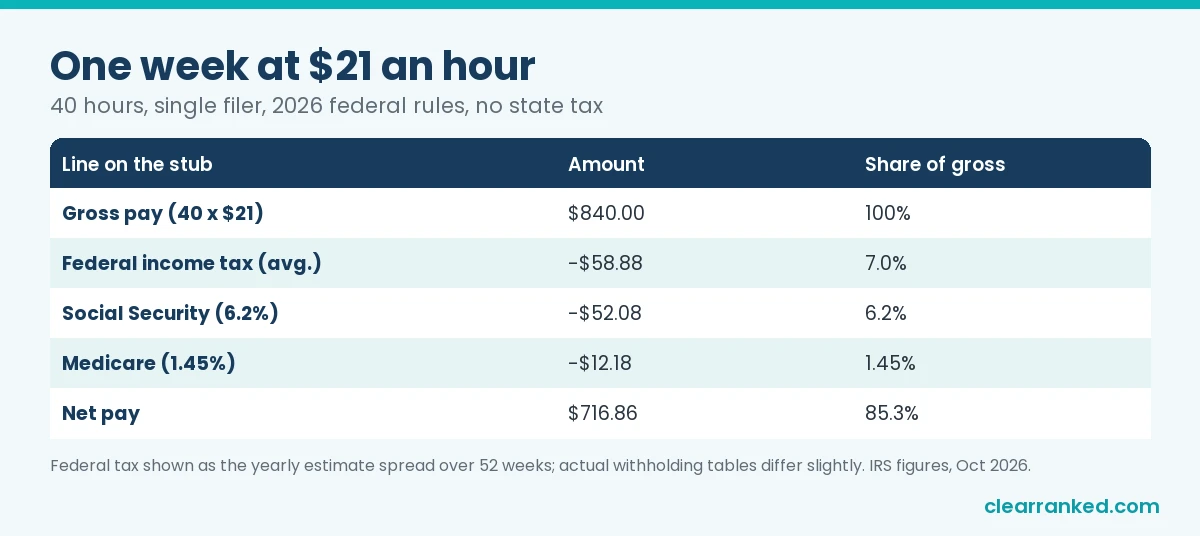
About $716.86 out of $840 for a single filer. Federal income tax averages about $58.88 a week, Social Security takes $52.08 and Medicare $12.18. Over a year, that’s $3,061.60 in income tax and $3,341.52 in FICA, leaving $37,276.88.
Here’s the yearly math. Take $43,680 and subtract the 2026 standard deduction of $16,100, which leaves $27,580 of taxable income. Tax the first $12,400 at 10% ($1,240) and the other $15,180 at 12% ($1,821.60). Total federal income tax: $3,061.60, or 7% of your gross pay.
Your real stub may differ by a few dollars, since payroll uses IRS withholding tables, not a flat yearly average. Pre-tax health premiums, a 401(k) or a state income tax will also change it. Not sure what each line means? Our pay stub guide decodes them, and a CPA can confirm your own numbers.
How do tax credits change $21 an hour for parents?
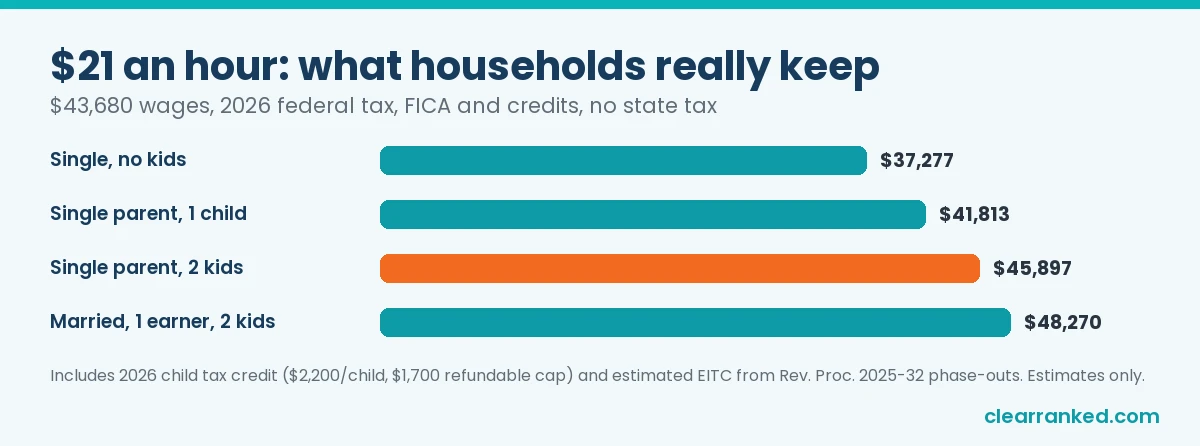
A lot. A single parent filing as head of household with one child would owe no federal income tax and could get roughly $1,475 back through the refundable child credit and EITC. With two children, the refund grows to about $5,559. That lifts yearly resources to around $45,897, above the $43,680 gross wage.
Two credits do the work. First, the child tax credit is $2,200 per qualifying child in 2026, and up to $1,700 per child of it can be refunded, per Rev. Proc. 2025-32. Second, the earned income tax credit pays the most to workers with children and lower wages, then shrinks as income rises.
For heads of household, the 2026 EITC starts phasing out at $23,890 and fully disappears at $51,593 with one child, $58,629 with two and $62,974 with three or more. At $43,680, you’re inside all three ranges, so part of the credit survives.
| Household (2026) | Federal income tax | Credits refunded | Yearly resources |
|---|---|---|---|
| Single, no kids | $3,061.60 | $0 | $37,276.88 |
| HoH, one child | $0 | about $1,475 | about $41,813 |
| HoH, two children | $0 | about $5,559 | about $45,897 |
| Married jointly, one earner, two kids | $0 | about $7,931 | about $48,270 |
How we got the one-child row: head of household tax is $1,989.60 after the $24,150 deduction. The $2,200 credit wipes that out, and the leftover $210.40 comes back as a refund. The EITC adds about $1,265, since the $4,427 maximum shrinks by roughly 16 cents for each dollar above $23,890.
The married row gets the biggest boost, because couples have a higher EITC phase-out start of $31,160. These are estimates. The real EITC comes from IRS lookup tables, and eligibility rules for the qualifying child, residency and investment income all apply. The IRS child tax credit page lists them.
A practical warning: these credits arrive as a lump sum at tax time, not in your weekly check. So budget on the $717 weekly figure and treat the refund as a once-a-year boost for savings or debt.
How does $21 an hour compare with minimum wage?
It’s well above it in most of the country. The federal minimum is still $7.25, so $21 is almost three times that. Even in Washington, which has one of the highest state minimums, $21 beats the 2026 rate of $17.13 by $3.87 and the 2027 rate of $17.73 by $3.27.
The federal floor of $7.25 comes straight from 29 U.S.C. 206, and it hasn’t moved since 2009. Washington’s Department of Labor and Industries has already announced the 2027 statewide minimum of $17.73, effective January 1.
Put another way, a full-time Washington minimum-wage worker earns $36,878 in 2027. You’d earn $6,802 more at $21. That’s a meaningful gap, but it’s narrowing every year as indexed state minimums climb. Some cities in Washington set even higher local rates, so check yours.
Hiring at $21 in a lower-minimum state? It can be a real recruiting edge. Our Oklahoma minimum wage guide shows how far apart state floors are, and the Virginia minimum wage page covers a state that indexes every year.
What does a $21-an-hour worker cost the employer?
More than $43,680. The employer matches your Social Security and Medicare, another $3,341.52 a year. Federal unemployment tax is 6.0% of the first $7,000 of wages, but with the usual 5.4% credit for paying state unemployment on time it drops to 0.6%, or $42, according to the IRS FUTA page. So the floor is about $47,064 before state unemployment tax, workers’ comp and any benefits. That’s roughly $22.63 per paid hour, and it’s worth knowing if you’re the one setting wages.
Is $21 an hour enough to live on?
For a single person in a lower-cost area, usually yes. You’d take home about $3,106 a month, so rent near $930 keeps housing at 30% of that. In high-cost metros, $21 gets tight fast, and a second earner or extra hours often fills the gap.
Some useful context: the BLS reported a $24.51 median hourly wage across all jobs in May 2025, so $21 sits about 14% below the national middle. Customer service representatives ($21.53) and medical assistants ($21.97) are two common jobs paid close to this rate, per the BLS wage survey.
Small changes add up at this wage. One extra hour a week is $1,092 a year. A $1 raise to $22 adds $2,080 gross and about $1,671 after tax. And if you’re paid weekly, moving even $25 a week into savings builds $1,300 by year-end without much pain.
Living somewhere without a state income tax helps too. Our guide to states with no income tax lists them, though property and sales taxes often run higher there.
Related guides
- $22 an hour: salary vs minimum wage
- $26 an hour: rent and filing status
- How to read a pay stub
- States with no income tax
- Oklahoma minimum wage
- Hourly to salary chart
FAQ
$43,680 before taxes, based on 40 hours a week for all 52 weeks.
About $37,277 a year for a single filer with no state income tax, using 2026 federal brackets and FICA. That’s roughly $717 a week or $3,106 a month.
$840 gross for 40 hours. After federal income tax, Social Security and Medicare, a single filer keeps about $716.86.
$1,680 gross every two weeks, or about $1,434 after federal taxes for a single filer.
Yes. In 2026 the EITC for heads of household phases out completely at $51,593 with one child and $58,629 with two, so a parent earning $43,680 still qualifies for part of it.
At 25 hours a week it’s $525 a week or $27,300 a year. At 32 hours it’s $672 a week or $34,944 a year.
About the author
I’m Ali Hassan, the founder of ClearRanked. Also, I run small businesses myself, and I know how much time goes into payroll, pay math and HR rules. ClearRanked is where I share plain-English guides and honest comparisons, so small business owners can make decisions with confidence instead of guesswork.
How we work: this guide is research-based, and every source in it was checked in October 2026. We don’t take payment for rankings, and we update guides when laws or prices change. Finally, read more on our About page.