Biweekly Pay Calculator: Gross and Take-Home Pay (2026)

This biweekly pay calculator turns an hourly wage or an annual salary into the gross amount of each paycheck when you’re paid every two weeks. It also estimates take-home pay with 2026 federal withholding, Social Security, Medicare and a state rate, and shows what a year with 27 paydays does to your checks.
Biweekly Pay Calculator
Turn an hourly rate or annual salary into biweekly gross pay, a take-home estimate with 2026 federal withholding, and yearly totals.
Estimate only, not tax advice. Federal withholding uses the 2026 IRS percentage method for a 2020 or later W-4 with no extra entries. State tax is a flat rate you enter. Local taxes are not included.
The core math is short. Hourly: rate x hours in two weeks, with overtime at 1.5x. Salary: annual pay / 26. At $25 an hour for 80 hours, that's $2,000 gross, and a single filer with no state tax keeps about $1,690.85. The rest of this page covers the details that trip people up, from biweekly versus semimonthly to the extra payday some years bring.
How we researched this: 2026 federal withholding follows the annual percentage method in IRS Publication 15-T, which treats a biweekly schedule as 26 pay periods. The 6.2% Social Security rate, the $184,500 wage base and the 1.45% Medicare rate come from Publication 15, and the brackets and standard deductions from Rev. Proc. 2025-32. We checked them in November 2026 and counted paydays with calendar math.
Key takeaways
- Biweekly gross for salary = annual salary / 26. For hourly pay, it's rate x hours worked in the two weeks.
- Biweekly to annual salary: multiply one check by 26. A $2,000 check is $52,000 a year.
- Biweekly means 26 checks a year, not 24. Two months each year have three paydays.
- Some years have 27 paydays. If your Friday payday cycle hits January 1, 2027, next year is one of them.
- Take-home depends on your W-4, so treat the net figure as an estimate.
How do you use the biweekly pay calculator?
Pick hourly or salary. For hourly, enter your rate, regular hours for the two weeks and any overtime hours. For salary, enter the annual amount. Then add your W-4 filing status, pre-tax deductions per check and a state tax rate to get an estimated net check, plus monthly and yearly totals.
- Overtime. Federal overtime is figured per workweek, so enter only hours over 40 in each week. Working 50 hours one week and 30 the next still has 10 overtime hours, even though the total is 80.
- Paydays this year. Leave it at 26 unless your calendar has 27. Not sure? Type any payday date and the calculator counts them for you.
- Pre-tax deductions. A 401(k) lowers income tax but not Social Security and Medicare. Section 125 health premiums lower both, so they're separate fields.
- State rate. A flat percentage is a reasonable estimate. Our state paycheck calculators, such as the Pennsylvania paycheck calculator, go further.
How do you calculate biweekly pay?
For an hourly worker, biweekly pay is the hourly rate times regular hours over two weeks, plus overtime hours times 1.5 times the rate. For a salaried worker, it's the annual salary divided by 26. To go the other way, from biweekly to annual salary, multiply one check by 26.
| Pay type | Formula | Example |
|---|---|---|
| Hourly, no overtime | Rate x hours in 2 weeks | $25 x 80 = $2,000.00 |
| Hourly with overtime | Rate x regular h + rate x 1.5 x OT h | $2,000 + $25 x 1.5 x 6 = $2,225.00 |
| Salary | Annual salary / 26 | $65,000 / 26 = $2,500.00 |
| Biweekly to annual | Check x 26 | $2,000 x 26 = $52,000 |
| Biweekly to monthly | Check x 26 / 12 | $2,000 x 26 / 12 = $4,333.33 |
That last row matters for budgets. A biweekly check isn't half a month's pay. Because 26 checks spread over 12 months, the monthly average is about 2.17 checks, and two months a year you'll get three. Plan your rent on two checks a month and treat the third as a bonus.
What is my biweekly paycheck after taxes?
Your biweekly paycheck after taxes is gross pay minus federal income tax withholding, 6.2% Social Security, 1.45% Medicare, any state tax and your pre-tax deductions. For a single filer on $65,000 with no state tax or deductions, the 2026 check is about $2,092.60 from $2,500 gross.
Worked example: $65,000 salary
- Gross per check: $65,000 / 26 = $2,500.00
- Federal withholding: ($65,000 - $16,100 standard deduction) taxed at 2026 rates = $5,620 a year, / 26 = $216.15
- Social Security: $2,500 x 6.2% = $155.00
- Medicare: $2,500 x 1.45% = $36.25
- Net: $2,092.60 per check
Now add a $150 401(k) deferral, a $100 health premium and a 4% state tax. Federal withholding falls to $186.15, Social Security and Medicare drop a little because of the health premium, and state tax is $90.00. The check comes to $1,790.25. In other words, $250 of pre-tax deductions cut take-home by much less than $250.

Your actual withholding can differ if you checked the Step 2 box on your W-4, claimed dependents or added extra withholding. For the full picture, our paycheck calculator handles more deductions, and the 2026 W-4 guide explains each step.
When are there 27 pay periods in a year?
A biweekly schedule has 27 paydays when the first payday of the year falls on January 1, or on January 2 in a leap year. That happens roughly every 11 years for a given weekday. For example, Thursday paydays starting January 1, 2026 get 27 checks in 2026, and Friday paydays starting January 1, 2027 get 27 in 2027.
The reason is simple: 26 two-week periods cover 364 days, one short of a normal year. Each year, your paydays drift a day earlier on the calendar, and eventually the first one lands on January 1, leaving room for a 27th on December 31. The calculator's payday field counts your schedule for any year you enter.
For salaried staff, the employer decides what an extra payday means. Some keep each check at salary / 26, so a $65,000 employee is paid $67,500 that year. Others divide by 27 for the year, so each check drops to $2,407.41 and the year still totals $65,000. Withholding tables keep using 26 periods either way.
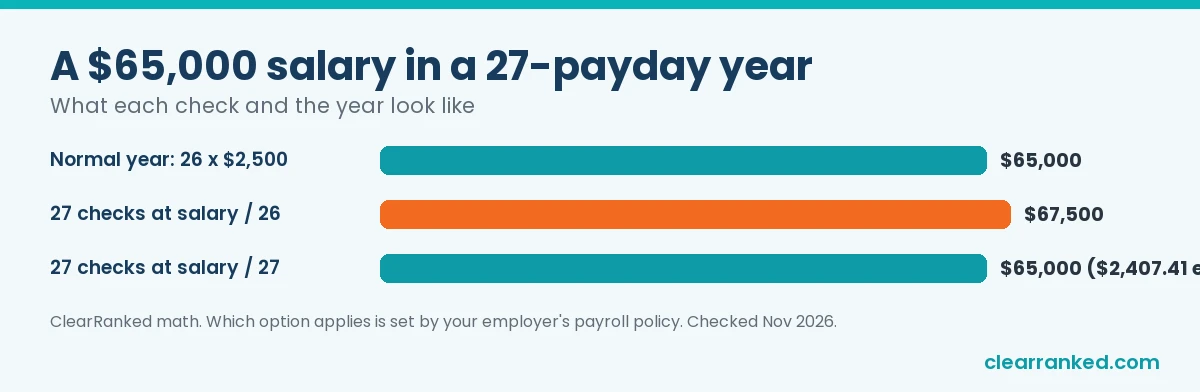
If you run payroll, decide and announce the policy early, ideally in the offer letter. Dividing by 27 surprises employees who budget by the check. Paying 27 full checks raises your labor cost by about 3.8% for that year, plus the matching payroll taxes, which our employer payroll tax calculator can estimate.
Is biweekly pay the same as semimonthly?
No. Biweekly pay comes every two weeks on the same weekday, for 26 checks a year. Semimonthly pay comes twice a month on set dates, such as the 15th and the last day, for 24 checks. On the same salary, each biweekly check is smaller, but you get two more of them.
| $65,000 salary | Biweekly | Semimonthly |
|---|---|---|
| Checks per year | 26 (sometimes 27) | 24 |
| Gross per check | $2,500.00 | $2,708.33 |
| Payday | Same weekday every 2 weeks | Fixed dates, such as the 15th and last day |
| Months with 3 paychecks | 2 a year | None |
For hourly workers, biweekly is usually simpler, since each check covers two complete workweeks and overtime lines up neatly. That's one reason many employers use it. Our pay periods guide compares weekly and monthly schedules too.
How much is my biweekly pay per year? Quick conversion table
Multiply your biweekly check by 26 to get your yearly pay. For example, $3,104 every two weeks is $80,704 a year, about $6,725 a month, and $38.80 an hour on an 80-hour pay period.
The table uses gross pay, so it shows what you earn before taxes. Monthly is the yearly total divided by 12, and the hourly figure assumes 40 hours a week, or 80 hours per check.
| Gross every 2 weeks | Per year (x 26) | Per month | Hourly (80 hours) |
|---|---|---|---|
| $1,000 | $26,000 | $2,166.67 | $12.50 |
| $1,600 | $41,600 | $3,466.67 | $20.00 |
| $2,000 | $52,000 | $4,333.33 | $25.00 |
| $2,500 | $65,000 | $5,416.67 | $31.25 |
| $3,104 | $80,704 | $6,725.33 | $38.80 |
| $4,000 | $104,000 | $8,666.67 | $50.00 |
Going the other way? Divide a yearly salary by 26. So a $52,000 salary pays $2,000 per check. In a year with 27 paydays, an hourly worker simply gets one more check, so $3,104 x 27 = $83,808. Salaried staff usually keep the same yearly salary, split into 27 smaller checks instead. To see the after-tax side, run your check through the calculator at the top of this page or the paycheck calculator.
Related calculators
- All ClearRanked calculators
- Paycheck calculator
- Prorated salary calculator
- Overtime calculator
- Hourly to salary guide
FAQ
If you're hourly, multiply your rate by your hours in the two weeks and add overtime at 1.5 times the rate. If you're salaried, divide your annual salary by 26. A $65,000 salary is $2,500 gross every two weeks.
Multiply by 26: $2,000 biweekly is $52,000 a year, or about $4,333 a month on average. In a year with 27 paydays, an hourly worker paid $2,000 every check would earn $54,000.
For a single filer in 2026 with no state tax or deductions, a $65,000 salary is $2,500 gross and about $2,092.60 net every two weeks, after federal withholding, Social Security and Medicare.
When the first biweekly payday of the year falls on January 1, or January 2 in a leap year. Thursday paydays starting January 1, 2026 give 27 checks in 2026, and Friday paydays starting January 1, 2027 give 27 in 2027.
No. Biweekly means every two weeks, which is 26 paychecks a year. Twice a month, or semimonthly, means 24 paychecks on set dates.
Yes. Enter overtime hours for the two weeks and they're paid at 1.5 times your rate. Under federal law, overtime is figured per workweek, so count only hours over 40 in each week.
About the author
I'm Ali Hassan, the founder of ClearRanked. Also, I run small businesses myself, and I know how much time goes into payroll, pay schedules and paycheck math. ClearRanked is where I share plain-English guides and honest comparisons, so small business owners can make decisions with confidence instead of guesswork.
How we work: this guide is research-based, and every source in it was checked in November 2026. We don't take payment for rankings, and we update guides when laws or prices change. Finally, read more on our About page.