Hourly to Salary Calculator: Convert Hourly Pay to Yearly (2026)
Hourly to salary is one multiplication: hourly rate times 2,080, which is 40 hours a week for 52 weeks. So $20 an hour equals $41,600 a year. Going the other direction, divide a salary by 2,080, and $50,000 becomes $24.04 an hour. For part-time or unusual schedules, use the converter below.
Job boards, payroll software and HR teams all lean on that 2,080 figure. It’s a fine default. But it quietly assumes 40 paid hours in every single week, and plenty of people don’t work that way.
A freelancer billing 25 hours a week, a nurse aide on three 12-hour shifts, a seasonal worker with eight unpaid weeks: each needs a different answer. The calculator handles all of them, and the sections below explain the math so you can check it.
How we researched this: the optional take-home estimate uses 2026 brackets and the single standard deduction from the IRS inflation adjustment release, plus Social Security and Medicare rates from the 2026 employer tax guide. National wage figures come from the Bureau of Labor Statistics. Checked October 2026.
Key takeaways
- Hourly to yearly: multiply by 2,080 for a standard full-time job.
- Yearly to hourly: divide by 2,080.
- Mental shortcut: double the wage and tack on three zeros. It runs about 4% low.
- $20 an hour gives $41,600 gross and about $35,606 net for a single filer in 2026.
- Fewer hours or unpaid weeks? Plug your real numbers in. $20 at 30 hours is only $31,200.
Hourly to salary converter (2026)
Convert an hourly wage to a yearly salary, or a salary to an hourly rate, with an optional 2026 take-home estimate.
Estimate only, not tax advice. Uses the 2026 single-filer standard deduction ($16,100) and brackets, 6.2% Social Security up to $184,500 and 1.45% Medicare. State and local taxes, pre-tax deductions and credits are not included.
How do you convert hourly to salary?
Take your hourly rate, multiply it by the hours you work in a typical week, then multiply by the weeks you're paid in a year. For a standard job that's rate x 40 x 52, or rate x 2,080. A $25 wage, for example, becomes $52,000 a year, or $4,333.33 a month.
- Grab your pre-tax hourly rate. We'll use $25.
- Multiply by weekly hours: $25 x 40 = $1,000.
- Multiply by paid weeks: $1,000 x 52 = $52,000.
- Divide by 12 for a monthly figure ($4,333.33) or 26 for a biweekly check ($2,000).
Doing it in your head? Double the wage, add three zeros. $25 becomes $50,000. That treats the year as 2,000 hours, so it's about 4% shy of the real number. Good for scanning listings, not for a lease application.
What's a full hourly to salary chart for 2026?
At 2,080 hours, $15 an hour is $31,200, $18 is $37,440, $25 is $52,000, $30 is $62,400 and $50 is $104,000. The last column estimates what a single filer keeps after 2026 federal tax and FICA, before any state tax.
| Wage | Per year | Per month | Per biweekly check | Kept after federal tax and FICA |
|---|---|---|---|---|
| $15 | $31,200 | $2,600 | $1,200 | $27,249 |
| $17 | $35,360 | $2,947 | $1,360 | $30,592 |
| $18 | $37,440 | $3,120 | $1,440 | $32,263 |
| $20 | $41,600 | $3,467 | $1,600 | $35,606 |
| $25 | $52,000 | $4,333 | $2,000 | $43,962 |
| $28 | $58,240 | $4,853 | $2,240 | $48,976 |
| $30 | $62,400 | $5,200 | $2,400 | $52,318 |
| $35 | $72,800 | $6,067 | $2,800 | $60,045 |
| $45 | $93,600 | $7,800 | $3,600 | $74,678 |
| $50 | $104,000 | $8,667 | $4,000 | $81,994 |

Want more detail on one rate? We've written full breakdowns of what $23 an hour pays per paycheck and what $40 an hour adds up to, including jobs, budgets and state taxes.
How do you convert salary to hourly?
Divide the annual salary by 2,080. A $60,000 salary is $28.85 an hour, $75,000 is $36.06, and $100,000 is $48.08. If you routinely work more than 40 hours, divide by your actual yearly hours instead, which gives a lower but more honest rate.
| Salary | Hourly at 2,080 hrs | Per week | Per month |
|---|---|---|---|
| $30,000 | $14.42 | $576.92 | $2,500.00 |
| $35,000 | $16.83 | $673.08 | $2,916.67 |
| $40,000 | $19.23 | $769.23 | $3,333.33 |
| $45,000 | $21.63 | $865.38 | $3,750.00 |
| $60,000 | $28.85 | $1,153.85 | $5,000.00 |
| $65,000 | $31.25 | $1,250.00 | $5,416.67 |
| $70,000 | $33.65 | $1,346.15 | $5,833.33 |
| $75,000 | $36.06 | $1,442.31 | $6,250.00 |
| $90,000 | $43.27 | $1,730.77 | $7,500.00 |
| $100,000 | $48.08 | $1,923.08 | $8,333.33 |
Here's why the honest version matters. Someone earning $50,000 who puts in 50-hour weeks is really making $50,000 / 2,600, or $19.23 an hour. That's nearly $5 below the headline rate. We dig into this in our guide to turning a $50k salary into an hourly wage.
How do hours and unpaid weeks change the answer?
Fewer paid hours lower the yearly figure in a straight line. At $20, a 35-hour week pays $36,400 a year rather than $41,600, and two unpaid weeks cut a full-time year to $40,000. Paid vacation and holidays leave the salary unchanged, since those hours are still paid.
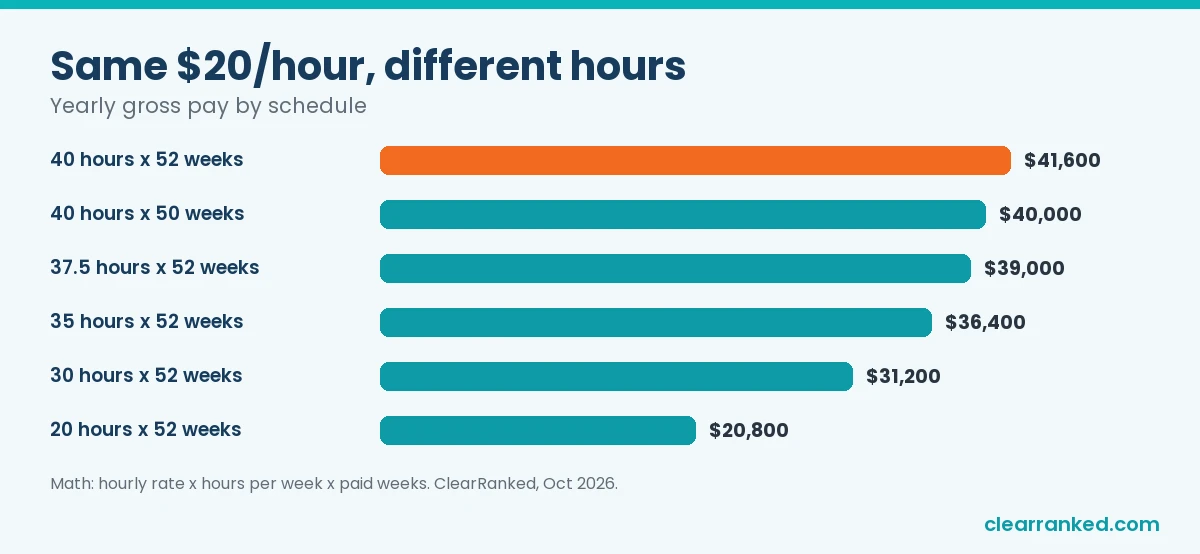
For part-timers, always use real hours. A freelancer billing 25 hours a week at $20 makes $20 x 25 x 52 = $26,000, before any business expenses. If hours swing a lot, average three months of pay stubs or invoices first.
What about that nurse aide on three 12-hour shifts? That's 36 hours a week. At $20, that's $720 a week and $37,440 a year. Some employers pay overtime by the day on those shifts, but the federal rule looks at the week.
Need to total messy shifts first? Our timesheet hours calculator turns clock-in and clock-out times into a weekly total you can drop into the converter.
Freelancers and contractors should flip this logic around. If you want the same yearly income as a $25-an-hour employee, you can't just bill $25. You'll cover the employer's share of Social Security and Medicare yourself, pay for your own health plan, and lose hours to unbilled admin work. Many contractors aim for a rate well above their old wage for exactly that reason.
Where does overtime fit in?
Add it on top. Non-exempt employees get at least 1.5 times their regular rate for hours over 40 in a workweek. At $20 an hour, five overtime hours every week add 5 x $30 x 52 = $7,800, lifting the year from $41,600 to $49,400.
That rule is in the Fair Labor Standards Act at 29 U.S.C. 207. Exempt salaried staff don't get it, which is why a salary that looks bigger can lose to an hourly wage with steady overtime. Exemption depends on both pay level and job duties.
So compare total expected pay, not base rates. Our overtime calculator handles weeks that mix regular and extra hours.
How much of the salary do you actually keep?
Filing single in 2026, federal income tax plus FICA leaves roughly 80% to 88% of gross pay at incomes from $30,000 to $85,000. At $20 an hour, that's about $35,606 of $41,600. State and local income taxes come out on top where they apply.
The steps are identical at any wage. Subtract the $16,100 standard deduction. Tax the result at 10% up to $12,400, 12% up to $50,400 and 22% up to $105,700. Then take 6.2% for Social Security and 1.45% for Medicare from the full gross.
| $20 an hour, step by step | Calculation | Result |
|---|---|---|
| Annual gross | $20 x 2,080 | $41,600 |
| After standard deduction | $41,600 - $16,100 | $25,500 |
| Federal income tax | $1,240 + 12% of $13,100 | $2,812 |
| Social Security and Medicare | 7.65% of $41,600 | $3,182.40 |
| Net for the year | Gross minus the above | $35,605.60 |
Married, or have side income? Our federal income tax estimator handles other filing statuses. Treat these as estimates, not tax advice, and check with a CPA for your situation.
Why do employers convert hourly pay to salary?
Employers do it to build pay bands, check whether a role can be exempt from overtime and forecast payroll. Workers do it to compare offers, fill in loan applications and set budgets. Using the same 2,080-hour yardstick keeps those comparisons fair.
If you run a small business, remember the wage is only part of the bill. You'll add your 7.65% share of FICA plus federal and state unemployment tax. That pushes a $41,600 employee past $44,782 before you've paid for a single benefit. Our guide to running payroll lays out each tax.
A useful benchmark: the BLS median wage across all jobs was $24.51 an hour in May 2025, which annualizes to about $50,981. I'd use it as a sanity check when setting pay, not as a target.
Is it better to be hourly or salaried?
It depends on your hours. Hourly workers get paid for every hour and earn overtime past 40 a week, while many salaried workers earn the same pay no matter how long they work. A salary only removes overtime if the job passes the duties tests and pays at least $684 a week ($35,568 a year).
That $684 floor is the federal minimum in 29 CFR 541.600, and it is the level the Labor Department enforces after a court threw out the 2024 increase. Some states set a higher floor. A salaried worker below it, or whose duties don't qualify, is still owed overtime.
Here is why the hours matter. Take a $60,000 salary for a job that really runs 50 hours a week. That is $23.08 an hour ($60,000 / 2,600 hours). An hourly job at $25 with 10 overtime hours a week pays $25 x 40 x 52 plus $37.50 x 10 x 52, or $71,500. Salaried roles often bring steadier pay and benefits, so compare the full package. Our guide to exempt vs non-exempt employees covers the duties tests.
Related guides
- $40 an hour as a salary
- $50,000 a year in hourly terms
- Federal tax estimator (2026)
- Hours worked calculator
- Overtime calculator
- Biweekly vs semi-monthly payroll
FAQ
Multiply the hourly wage by 2,080, the hours in a 40-hour, 52-week year. $25 an hour becomes $52,000.
$41,600 at full time. A single filer keeps about $35,606 after 2026 federal tax and FICA.
Divide the salary by 2,080. A $60,000 salary works out to $28.85 an hour.
Forty hours a week times 52 weeks equals 2,080. Most payroll systems and job sites use it as the standard full-time year.
No. Paid days off are still paid hours, so the yearly figure stays the same. Only unpaid time off reduces it.
Multiply the wage by your average weekly hours and then by 52. At $18 and 25 hours a week, that's $23,400.
Close. It assumes 2,000 hours, so it comes out about 4% low. Multiply by 2,080 for an exact figure.
About the author
I'm Ali Hassan, the founder of ClearRanked. Also, I run small businesses myself, and I know how much time goes into payroll, pay math and HR rules. ClearRanked is where I share plain-English guides and honest comparisons, so small business owners can make decisions with confidence instead of guesswork.
How we work: this guide is research-based, and every source in it was checked in October 2026. We don't take payment for rankings, and we update guides when laws or prices change. Finally, read more on our About page.