Holiday Pay Calculator: Time and a Half and Double Time (2026)

This holiday pay calculator figures what an hourly worker earns for a holiday at straight time, time and a half, double time or any custom rate. It returns holiday pay, the premium above normal pay, paid hours off, and total pay for the week with overtime handled the way federal rules allow.
Holiday Pay Calculator
Work out holiday pay for hourly workers at time and a half, double time or a custom rate, including overtime in a holiday week.
Estimate only, not legal advice. Uses the federal FLSA 40-hour weekly overtime rule. Holiday premiums come from your employer’s policy or contract, and some states add their own rules.
The quick answer for most people: holiday pay is your hourly rate x the holiday multiplier x the hours you work that day. At $24 an hour, eight hours at time and a half is $288.00. The harder question is what happens when that holiday pushes your week past 40 hours, and that's the part this calculator spends most of its effort on.
How we researched this: the Department of Labor's holiday pay page says federal law doesn't require pay for holidays off. The overtime rules come from the federal regulations on premium pay for holidays (29 CFR 778.203) and pay for idle hours (29 CFR 778.218). The 2026 dates come from OPM. We checked them in November 2026.
Key takeaways
- No federal law makes private employers pay extra for holidays, worked or not. It's a policy or contract benefit.
- Holiday pay = hourly rate x multiplier x hours. At $20, an 8-hour shift is $240 at time and a half and $320 at double time.
- Paid holiday hours you don't work don't count toward the 40-hour overtime line.
- A holiday premium of at least 1.5x can be credited toward overtime owed that week. A smaller premium can't.
- There are 11 federal holidays in 2026, and July 4 is observed on Friday, July 3.
How do you use the holiday pay calculator?
Enter your hourly rate and the hours you'll work on the holiday, then pick the rate your employer pays for it. Add any paid holiday hours you get without working, plus your other hours that week. Finally, choose how your employer treats overtime. The result shows holiday pay and the full week.
- Holiday pay rate. Time and a half is the most common premium. Double time shows up in many union contracts and for the biggest holidays. Pick custom for anything else.
- Paid holiday hours not worked. If your employer gives you 8 paid hours for a day you don't work, enter 8 here. They're paid at straight time.
- Other hours that week. This is what decides overtime. Only hours actually worked count toward 40.
- Overtime treatment. Paying overtime on top is the more generous choice and is common in handbooks. The credit option is the federal minimum, explained below.
How is holiday pay calculated for hourly workers?
Multiply the hourly rate by the holiday multiplier and the hours worked on the holiday. Time and a half holiday pay is rate x 1.5 x hours, and double time holiday pay is rate x 2 x hours. The premium is the part above straight time, such as the extra 0.5x or 1x.
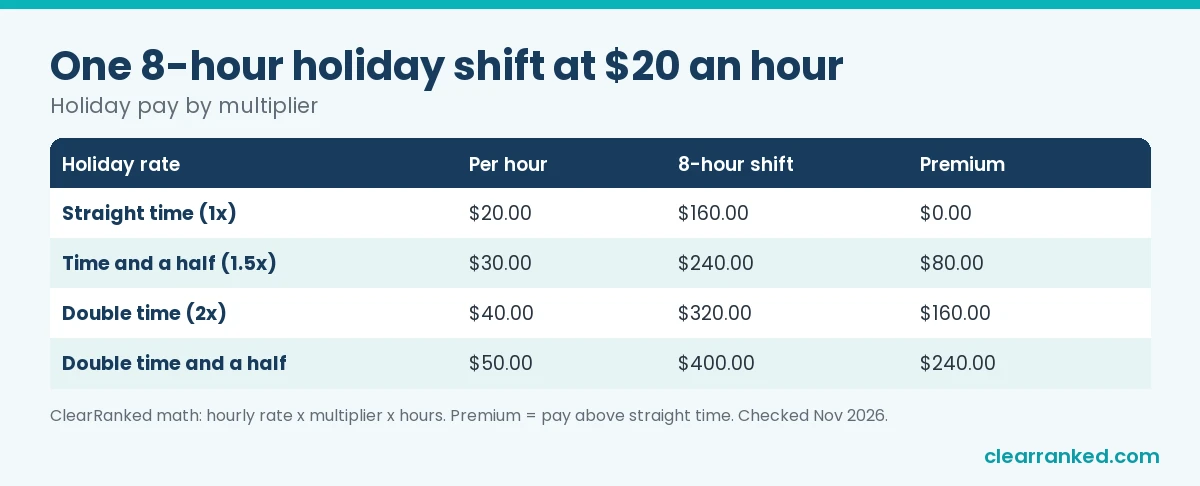
For example, a cashier earning $20.00 who works 8 hours on Thanksgiving at double time and 32 other hours that week earns 8 x $40.00 = $320.00 for the holiday. The whole week is 40 hours, so there's no overtime, and the check shows $960.00 before taxes. Without the holiday premium, the same 40 hours would pay $800, so the holiday is worth an extra $160.00.
Paid holidays off work differently. If your employer closes on Christmas and pays 8 hours at your normal rate, that's just your rate x 8. At $24.00, it's $192. Some employers pay salaried and hourly staff for the day by policy, and some don't pay at all. Both are legal under federal law, as long as the employer follows its own written policy and any state rules.
Does holiday pay count toward overtime?
Paid hours off for a holiday don't count toward the 40 hours that trigger federal overtime, because they aren't hours worked. Hours you actually work on a holiday do count. And if your employer pays the holiday work at 1.5x or more, the extra premium may be credited against the overtime it owes for that week.
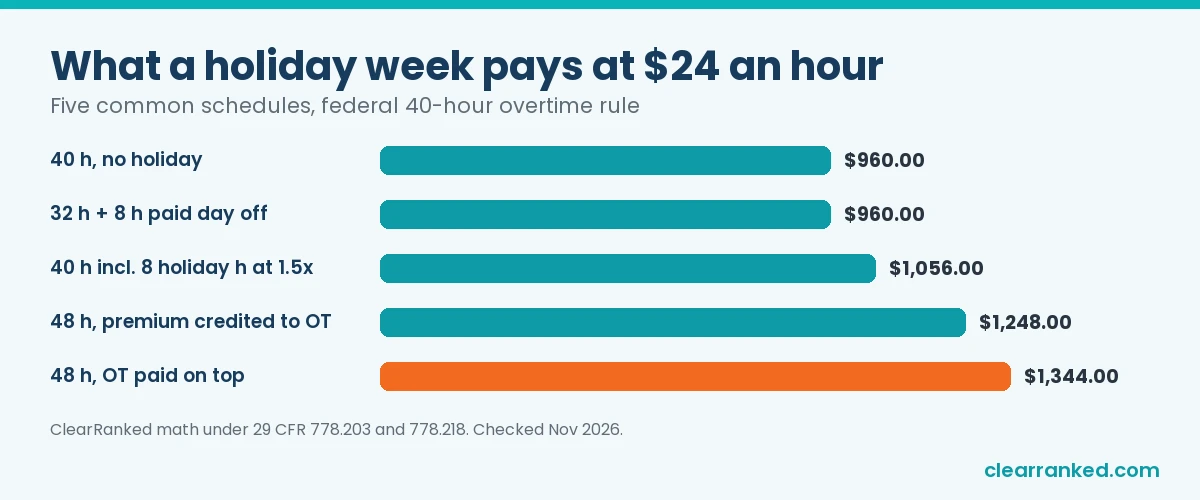
Here's why that credit matters. A worker at $24.00 works 8 holiday hours at time and a half plus 40 other hours, 48 in all. Straight time is 48 x $24 = $1,152, and the holiday premium is 8 x $12 = $96. Federal overtime owed for the 8 extra hours is also 8 x $12 = $96.
- Overtime paid on top: $1,152 + $96 holiday premium + $96 overtime = $1,344.00
- Premium credited: the $96 holiday premium already covers the $96 overtime premium, so the week pays $1,248.00
Both are lawful under 29 CFR 778.203, which treats a holiday rate of at least time and a half as an overtime premium. So the answer depends on your employer's policy. If your handbook says holiday and overtime premiums don't stack, the credit version applies. If it promises both, use the first.
One trap is a holiday premium below 1.5x. Say the policy pays 1.25x on holidays. That extra quarter can't be credited toward overtime. Instead, it's added into the regular rate, so in the same 48-hour week the regular rate becomes $25.00 and the overtime premium is $100.00. The calculator applies this automatically when you pick a custom multiplier under 1.5.
Which holidays are paid in 2026?
Private employers choose their own paid holidays. Many follow the 11 federal holidays that OPM lists for 2026,, or pick a shorter list of major days. Federal employees get all 11. When a holiday falls on a Saturday, the federal observed day moves to the Friday before.
| Federal holiday | 2026 date observed |
|---|---|
| New Year's Day | Thursday, January 1 |
| Martin Luther King Jr. Day | Monday, January 19 |
| Washington's Birthday | Monday, February 16 |
| Memorial Day | Monday, May 25 |
| Juneteenth | Friday, June 19 |
| Independence Day | Friday, July 3 (July 4 is a Saturday) |
| Labor Day | Monday, September 7 |
| Columbus Day | Monday, October 12 |
| Veterans Day | Wednesday, November 11 |
| Thanksgiving Day | Thursday, November 26 |
| Christmas Day | Friday, December 25 |
If your employer observes a different set, such as the day after Thanksgiving or Christmas Eve, the math in the calculator doesn't change. What changes is which days carry the premium. Check your handbook or your PTO balance, because some companies give floating holidays as PTO instead of fixed days.
Do employers have to pay holiday pay?
Not under federal law. The FLSA doesn't require pay for holidays off or a premium for working on one, so holiday pay is set by company policy, an employment contract or a union agreement. Still, once a policy promises holiday pay, the employer generally has to follow it, and some states have their own rules for certain industries.
- Written policy wins day to day. Eligibility rules such as working the day before and after the holiday are common and legal if applied consistently.
- Exempt employees on salary usually get their full weekly salary in a holiday week anyway. Our exempt vs non-exempt guide explains why.
- Holiday pay is taxable wages, withheld like the rest of your check.
- Night shift on a holiday? A shift differential stacks with the holiday rate under most policies. Try our shift differential calculator for that part.
Not legal advice. If a promised holiday premium is missing from your check, start with payroll and your pay stub, then your state labor department.
Is Memorial Day time and a half, and which holidays pay extra?
Memorial Day is time and a half only if your employer's policy, contract or union agreement says so. Federal law doesn't require private employers to pay a premium on any holiday, including Memorial Day (May 25, 2026), Christmas or Christmas Eve.
Employers that do pay extra name the days in their handbook, so check the exact list there. Christmas Eve is not one of the 11 federal holidays on the OPM schedule, so even employers that copy the federal list often treat it as a normal day.
Federal employees are the exception people hear about. Under OPM's premium pay rules, a federal worker who works on a holiday gets holiday premium pay equal to their basic rate for each hour worked, so each holiday hour pays double. That rule covers federal jobs only, not private ones.
If your employer does pay time and a half, run the hours through the calculator above. Some states add their own premium rules, so check our overtime pay laws by state too.
Related calculators
- All ClearRanked calculators
- Overtime calculator
- Shift differential calculator
- Biweekly pay calculator
- PTO calculator
FAQ
Multiply your hourly rate by 1.5, then by the hours you work on the holiday. At $24 an hour, 8 hours at time and a half is $24 x 1.5 x 8 = $288, which is $96 more than a normal 8-hour day.
Double time is your hourly rate x 2 x the hours worked on the holiday. At $20 an hour, an 8-hour shift pays $320 instead of $160. The extra $160 is the holiday premium.
No. The Department of Labor says the FLSA does not require payment for time not worked, such as holidays, and it doesn't require a premium for working on one. Holiday pay comes from company policy, a contract or a union agreement.
No. Paid hours for a holiday you didn't work aren't hours worked under federal rules, so they don't count toward the 40 hours that trigger overtime. Hours you actually work on the holiday do count.
Yes, if the holiday rate is at least time and a half. Federal regulations let that premium be credited toward overtime owed in the same week. A holiday rate below 1.5x can't be credited and instead raises the regular rate.
There are 11. New Year's Day, MLK Day, Washington's Birthday, Memorial Day, Juneteenth, Independence Day (observed Friday, July 3), Labor Day, Columbus Day, Veterans Day, Thanksgiving and Christmas.
About the author
I'm Ali Hassan, the founder of ClearRanked. Also, I run small businesses myself, and I know how much time goes into payroll, holiday schedules and overtime rules. ClearRanked is where I share plain-English guides and honest comparisons, so small business owners can make decisions with confidence instead of guesswork.
How we work: this guide is research-based, and every source in it was checked in November 2026. We don't take payment for rankings, and we update guides when laws or prices change. Finally, read more on our About page.