Shift Differential Calculator: Night Pay and Overtime (2026)
This shift differential calculator shows what a night, evening or weekend premium adds to your pay. Enter your base rate, the differential in dollars or percent and your hours, and it returns the shift rate, the FLSA regular rate, correct overtime pay and the extra you earn per week and per year.
Shift Differential Calculator
Find the shift rate, the FLSA regular rate and the overtime pay for a week that mixes base-rate and differential hours.
Estimate only, not legal or tax advice. Uses the federal FLSA 40-hour weekly overtime rule. Some states also require daily overtime, and union contracts may pay more.
Most people can do the basic math in their head: a $2 night premium on 24 hours is $48. Where it gets tricky is overtime. Under federal law, the differential has to be folded into the regular rate before time and a half is figured, and plenty of payroll setups still miss that. In our example, the mistake costs the worker $4.00 a week, which is small per check but adds up across a crew and a year.
How we researched this: the rule that night shift differentials belong in the regular rate is in 29 CFR 778.207(b), and the weighted-average method for workers paid two rates in one week is in 29 CFR 778.115. The Department of Labor's night work page confirms the premium itself is optional. We checked these sources in November 2026.
Key takeaways
- Federal law doesn't require a shift differential, but once you pay one, it must go into the overtime math.
- A percent differential is base rate x percent: 10% on $18 is $1.80 an hour.
- With mixed shifts, the regular rate is total straight-time pay divided by total hours worked.
- Our 48-hour example pays $1,092.00, and paying overtime on the base rate alone would short it by $4.00.
- On a 2,080-hour year, every $1 of differential is worth $2,080 before overtime.
How do you use the shift differential calculator?
Type your base hourly rate, choose whether the differential is a flat dollar amount or a percent, and enter it. Then split the week's hours between differential hours and base-rate hours. The calculator adds them, figures overtime above 40 hours with the weighted regular rate, and projects the yearly extra.
- Base rate. Your normal hourly pay before any premium.
- Differential. Check your offer letter or handbook. Hospitals and warehouses often quote dollars per hour, while manufacturers often quote a percent.
- Differential hours. Only the hours that qualify. Some employers pay the premium for the whole shift once most of it falls in the night window, and others pay only for hours after a cutoff such as 11 p.m.
- Base-rate hours. Everything else you worked in the same workweek, including day shifts you picked up.
- Weeks per year. Use the weeks you actually work the schedule to get a fair annual figure.
How is shift differential calculated?
Shift differential is calculated per hour. For a dollar premium, add it to the base rate. For a percent premium, multiply the base rate by the percent and add the result. Then multiply the shift rate by the hours worked on that shift. The extra pay is simply the differential times those hours.
| Type | Formula | Example |
|---|---|---|
| Dollar differential | Base rate + $ per hour | $20.00 + $2.00 = $22.00 |
| Percent differential | Base rate x (1 + %) | $18.00 x 1.10 = $19.80 |
| Weekly differential pay | Differential x shift hours | $1.80 x 40 = $72.00 |
| Yearly differential pay | Weekly extra x weeks | $72.00 x 52 = $3,744.00 |
A nurse example makes the dollar version concrete. At $38.00 an hour with a $4.50 night premium on three 12-hour shifts, the night rate is $42.50 and the premium alone is $4.50 x 36 = $162.00 a week, or $8,424.00 over 52 weeks. That's real money, and it's why night shifts are often the first to fill at hospitals that pay a strong premium.
Percent and dollar premiums also behave differently over time. A $2.00 premium stays $2.00 after a raise, so it shrinks as a share of pay. A 10% premium grows with every raise. If you're comparing two job offers, run both through the calculator at the base rate you expect a year or two out.
How does a shift differential affect overtime pay?
Under the FLSA, a shift differential is part of the regular rate, so overtime has to be paid at 1.5 times a rate that includes it. When a week mixes base-rate and differential hours, the regular rate is the weighted average: total straight-time pay divided by total hours. Overtime hours then earn half that rate on top of straight time.
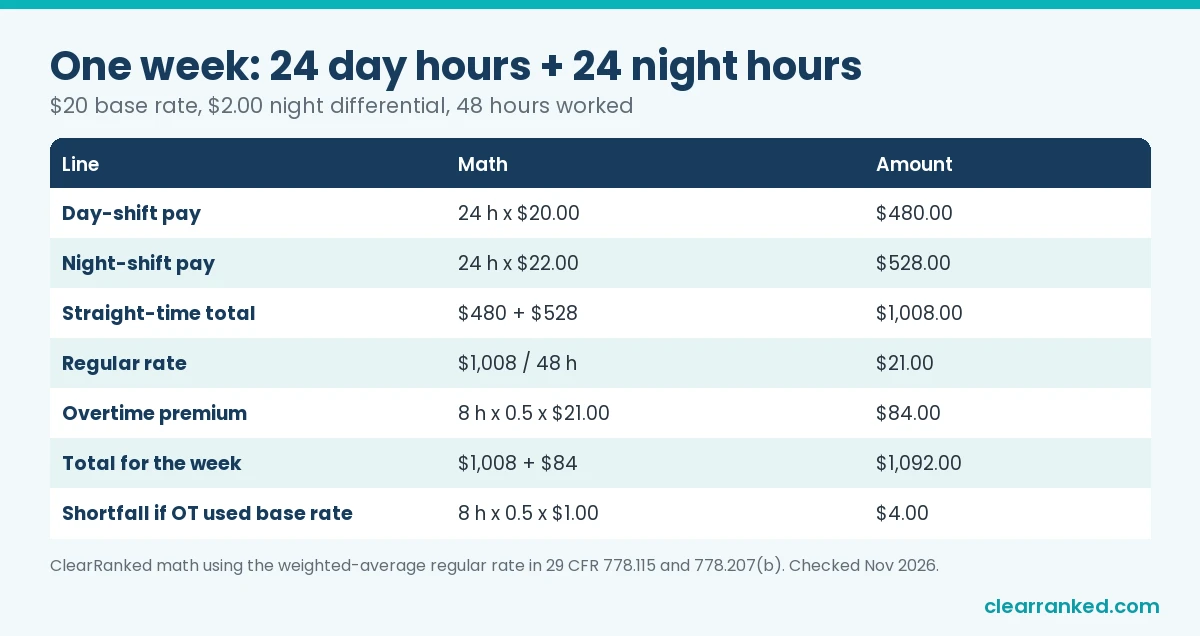
Here's the full example. A warehouse worker earns $20.00 an hour with a $2.00 night differential and works 24 day hours plus 24 night hours, 48 in all.
- Straight time: 24 x $20.00 + 24 x $22.00 = $480 + $528 = $1,008
- Regular rate: $1,008 / 48 hours = $21.00
- Overtime premium: 8 hours x 0.5 x $21.00 = $84.00
- Total for the week: $1,008 + $84.00 = $1,092.00
- Base-rate shortcut: 8 x 0.5 x $20.00 = $80, which underpays by $4.00
Notice that it doesn't matter which shift the overtime hours fell on. Even if the last eight hours of the week were day hours, the regulation still uses the blended $21.00. On the other hand, if all the hours are on nights, the math is simpler: a worker on 46 night hours at $18.00 plus 10% has a regular rate of $19.80 and earns $970.20 for the week, including $59.40 of overtime premium.
Daily overtime rules in some states, such as California, add another layer. The calculator follows the federal weekly rule only, so check our overtime laws by state if you work more than eight hours in a day.
What is a typical night differential?
There's no legal standard, so the amount is whatever the employer or a union contract sets. Flat dollar premiums are common in warehouses, retail and hospitals, while many manufacturers quote a percent of the base rate. Instead of chasing a typical number, compare offers by what the premium is worth over a year.
We didn't find an official government survey of differential amounts that we could verify, so we won't quote an average here. What we can do is show the math. The bars below turn five common-looking premium levels into yearly dollars on a $22.00 base rate and a full-time night schedule.

For employers, the same chart is the cost side. A $2.00 premium for 10 night workers is $41,600 a year in wages before payroll taxes and before the overtime effect. If that premium cuts turnover on a hard-to-staff shift, it can be cheaper than constant rehiring. For a complete picture of a night schedule, our second shift hours guide covers how evening and overnight shifts are usually set up.
Is shift differential pay required by law?
No. The Fair Labor Standards Act doesn't require extra pay for night, evening or weekend work. A differential is a policy or contract choice. However, once an employer pays one to nonexempt workers, federal rules say it counts in the regular rate, and the overtime math must include it.
- Union contracts often set the differential and the qualifying hours, and they can be stricter than federal law.
- Government jobs may have their own night pay rules, so check your agency's pay policy.
- Exempt salaried staff aren't owed overtime under the FLSA, so the regular-rate issue doesn't arise for them. Our exempt vs non-exempt guide explains the tests.
- Taxes treat differential pay as ordinary wages, withheld like the rest of your paycheck.
Not legal advice: if you think your overtime has been figured on the base rate only, ask payroll to show the regular rate on your pay stub first, then talk to your state labor department if it isn't fixed.
Related calculators
- All ClearRanked calculators
- Overtime calculator
- Holiday pay calculator
- Biweekly pay calculator
- Overtime pay guide
FAQ
Multiply the base hourly rate by 0.10 to get the differential, then add it to the base rate. At $18.00 an hour, 10% is $1.80, so the shift rate is $19.80. Multiply the $1.80 by the hours worked on that shift to see the extra pay.
Yes. Federal rules say night shift differentials must be included in the regular rate, so overtime is paid at 1.5 times a rate that already contains the premium. When a week mixes shifts, the regular rate is a weighted average of all the hours.
On a full-time schedule of 40 hours a week for 52 weeks, a $2.00 differential adds $4,160 a year before overtime. With 36 hours a week, it adds $3,744.
No federal law requires it. The Department of Labor says the FLSA does not require extra pay for night work, so it depends on company policy, a union contract or, for public employees, the agency's pay rules.
Add up all straight-time pay for the week, including the premium, and divide by total hours to get the regular rate. Overtime hours over 40 then earn an extra half of that rate. In our example, $1,008 divided by 48 hours is $21.00.
No. A shift differential is regular wages, so it gets the same federal income tax withholding, Social Security, Medicare and state tax as the rest of your pay.
About the author
I'm Ali Hassan, the founder of ClearRanked. Also, I run small businesses myself, and I know how much time goes into payroll, shift scheduling and overtime math. ClearRanked is where I share plain-English guides and honest comparisons, so small business owners can make decisions with confidence instead of guesswork.
How we work: this guide is research-based, and every source in it was checked in November 2026. We don't take payment for rankings, and we update guides when laws or prices change. Finally, read more on our About page.