Paid Family Leave New York: 2026 Benefits, Cost and Rules
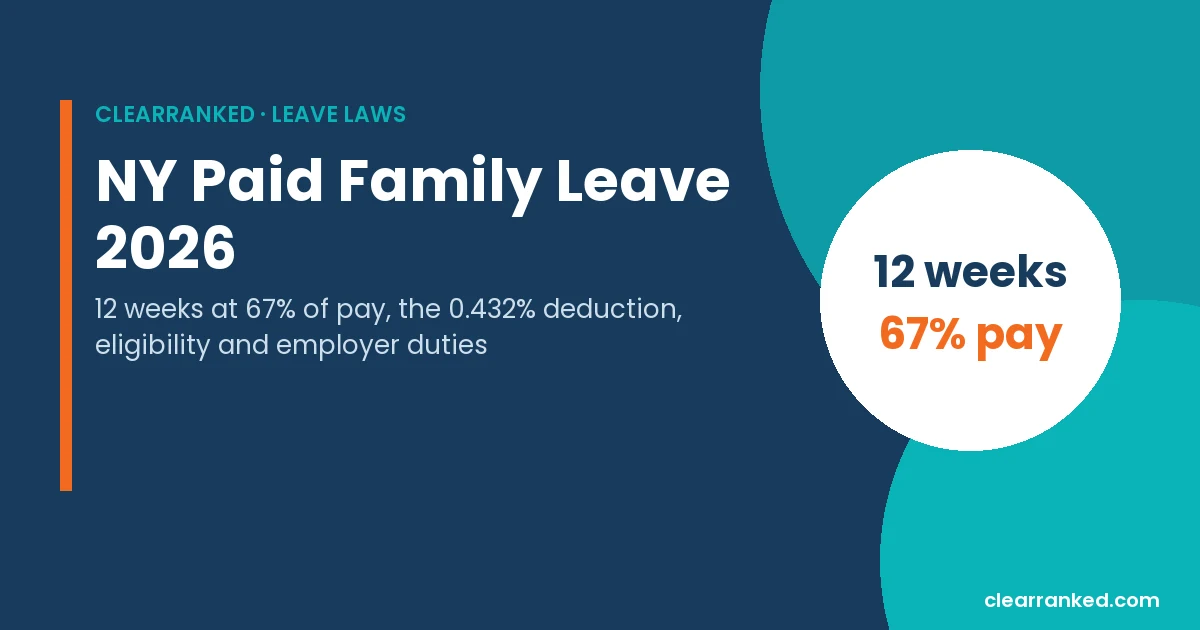
Paid family leave in New York lets most private-sector workers step away for as long as 12 weeks, with pay and a protected job, after a birth or adoption, while a relative is seriously ill, or when a close relative is sent overseas on military duty. In 2026 it pays 67% of the worker’s average weekly wage, up to $1,228.53 a week, funded by a 0.432% payroll deduction.
For a worker, that’s real money and a guaranteed job when you come back. For a small employer, it’s mostly an insurance and payroll task, because benefits come from your PFL insurance carrier, not your bank account.
Below I’ll cover who qualifies, how the benefit and the deduction are calculated, how the 12 weeks can be split, and what you need to do as an employer. I’ll also point you to where the 2027 numbers live, since New York resets them every year.
How we researched this: figures come from the state’s official program site, paidfamilyleave.ny.gov, including its 2026 update page and its eligibility page. The live site blocked our automated check, so we read official copies saved in late September and early October 2026 through the Internet Archive. This isn’t legal advice. Call the PFL Helpline at (844) 337-6303 or check the site for your situation.
Key takeaways
- Eligible workers get a maximum of 12 weeks in any rolling 52-week period.
- The benefit is 67% of the worker’s average weekly wage, capped at $1,228.53 a week for leave starting in 2026.
- Employees pay for it through a deduction of 0.432% of gross wages, up to $411.91 for 2026.
- Full-time workers qualify after 26 straight weeks. Part-timers under 20 hours a week qualify after 175 workdays.
- New York posted an Updates for 2027 page. Check it for next year’s rate and cap before you run January payroll.
What is paid family leave in New York?
New York Paid Family Leave is a state-mandated insurance benefit. Nearly every private employer, even one with a single worker, must buy it, usually as a rider on their disability policy. It pays partial wages and protects the job of an eligible worker who takes time off for a new child, a family member’s serious health condition, or a relative’s military deployment.
The three qualifying reasons are specific:
- Bonding with a child after birth, adoption or foster placement.
- Caring for a relative who is seriously ill.
- Handling family needs when a spouse, domestic partner, child or parent is sent overseas on active duty.
PFL isn’t for the worker’s own illness. That falls under New York’s separate disability coverage, the policy PFL is usually attached to. However, while someone is on PFL, the law protects their job and keeps their health insurance going on the same terms as before.
Who is eligible for paid family leave in New York?
Workers at private employers in New York are eligible after 26 straight weeks if they normally work at least 20 hours weekly, or after 175 days of work if they normally work fewer than 20 hours. Citizenship and immigration status don’t matter, and the worker’s home state doesn’t matter either.
Approved time off counts toward those weeks if PFL contributions were paid for that period. So a cashier who used a week of vacation in month four still reaches 26 consecutive weeks on schedule. Periods of statutory disability don’t count, though.
A few groups need a closer look, based on the program’s eligibility page:
- Part-timers. The 175 days don’t have to be in a row and can build up over several years.
- Seasonal workers. Many never qualify, because the count restarts each time they’re rehired.
- Public employees. Covered only if their employer opts in or it’s negotiated in a union contract.
- Self-employed people and independent contractors. Not covered automatically, but they can buy coverage voluntarily.
- Out-of-state workers. Covered if their work is based in New York. Remote work for a New York company from another state usually isn’t.
Workers who won’t meet the time requirement can sign a waiver and skip the deduction. It’s actually the employer’s job to spot these people and offer the waiver form. If a schedule change later makes them eligible, the waiver is revoked automatically, and you may collect deductions back to the date it was signed.
How much does New York paid family leave pay?
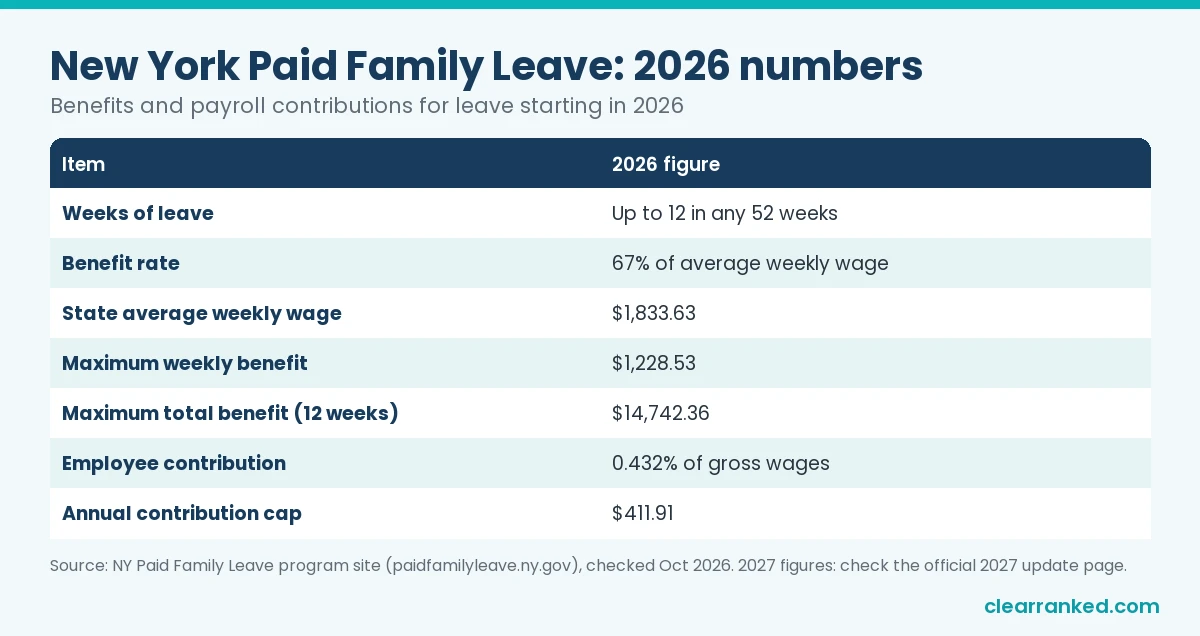
For leave starting in 2026, New York PFL pays 67% of the worker’s average weekly wage, up to 67% of the state average weekly wage of $1,833.63. That makes the maximum weekly benefit $1,228.53, and up to $14,742.36 over a full 12 weeks.
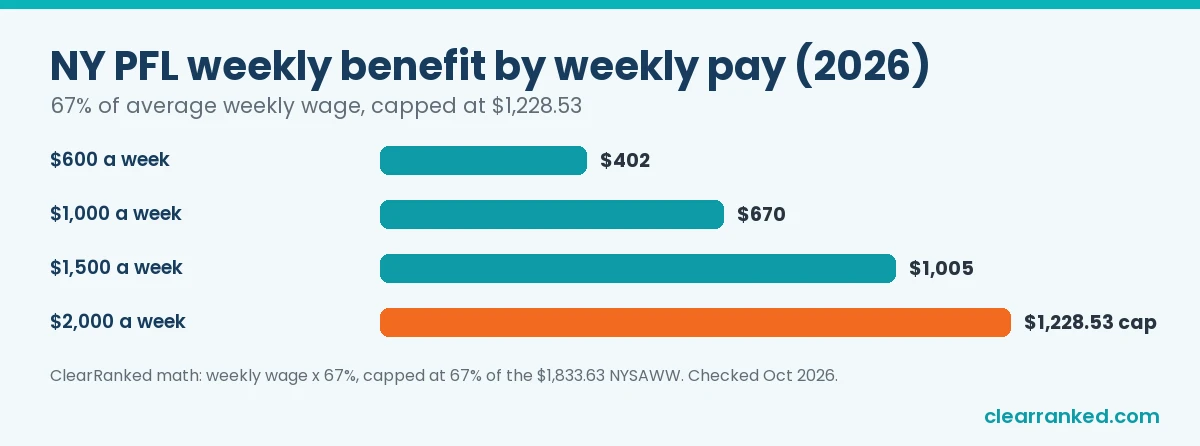
The math is short. Multiply the average weekly wage by 0.67, then compare it to the cap.
| Weekly pay | 67% of pay | Weekly benefit | 12-week total |
|---|---|---|---|
| $600 | $402.00 | $402.00 | $4,824.00 |
| $1,000 | $670.00 | $670.00 | $8,040.00 |
| $1,500 | $1,005.00 | $1,005.00 | $12,060.00 |
| $2,500 | $1,675.00 | $1,228.53 (cap) | $14,742.36 |
The 2026 cap is $51.21 a week higher than the 2025 cap. One timing rule matters for people on leave around New Year’s. The benefit rate is set by the date leave starts. However, if more than three months pass between PFL days, the next stretch counts as a new claim at the newer rate.
How much is the NY paid family leave deduction?
In 2026, employers may deduct 0.432% of each employee’s gross wages per pay period for PFL, up to $411.91 for the year. Someone earning $1,000 a week pays about $4.32 a week. Workers earning less than the state average weekly wage never reach the yearly cap.
Here’s what that looks like on real paychecks:
| Annual pay | Weekly pay | Weekly deduction | Yearly deduction |
|---|---|---|---|
| $31,200 | $600 | $2.59 | $134.78 |
| $52,000 | $1,000 | $4.32 | $224.64 |
| $78,000 | $1,500 | $6.48 | $336.96 |
| $104,000 | $2,000 | $8.64 | $411.91 (cap) |
At $104,000 a year, 0.432% would be $449.28, so the cap kicks in and the deduction stops once $411.91 has been taken. You can also choose to pay the cost for your team as a benefit, which at $224.64 a year for a $52,000 worker is a cheap perk.
How long is paid family leave in New York, and can you split it?
The cap is 12 weeks in any 52-week stretch, counted on a rolling basis from the first day off. Workers can use it in one block or a full day at a time, such as every Tuesday for a mother’s dialysis visits.
Picture a dad at a 9-person accounting firm in Albany. He takes six weeks after his daughter is born, then saves the other six for one day a week across the next season. That works, as long as each piece is a full day and everything fits inside his 52-week window.
Once the 12 weeks are used, the next eligible date is one year from the first day of that leave. A second baby or a new illness in the family doesn’t reset the clock early.
What do New York employers have to do for paid family leave?
Almost every private employer that has staff must buy PFL insurance, usually as a rider on their disability policy, and can fund it with the employee deduction. They also post a notice of coverage, explain PFL in writing, offer waivers where they fit, and return workers to the same or a comparable job.
A practical checklist for a small team:
- Confirm PFL is on your disability policy. Your carrier gives you a Notice of Compliance to post where staff can see it.
- Put PFL in your handbook, or give written guidance on how to request it if you don’t have a handbook.
- Update the deduction rate in payroll every January. The state recommends telling employees before you withhold, and it offers a template notice.
- When someone requests leave, fill in Part B, the employer section, of the PFL-1 request form.
- Don’t cut pay, discipline or fire anyone for taking PFL. If a worker asks to be reinstated, you have 30 calendar days to respond.
Your handbook should explain how PFL fits with your own PTO. See our PTO policy guide and the handbook checklist for wording ideas. For wages, see the current minimum wage in New York, and to compare states, read our guides to California paid family leave and Washington paid family leave.
What changes for New York paid family leave in 2027?
New York sets a new contribution rate, cap and state average weekly wage each year. The official program site has posted an Updates for 2027 page, but we couldn’t load it to confirm the figures. Check paidfamilyleave.ny.gov before your first 2027 payroll rather than reusing the 2026 numbers.
The page is at paidfamilyleave.ny.gov. When you open it, look for three numbers: the new employee contribution rate, the new annual contribution cap, and the new maximum weekly benefit. Update your payroll system and your employee notice, and you’re done.
Not legal advice: rules depend on your workforce, so confirm with your insurance carrier or the PFL Helpline.
Related guides
- California paid family leave
- WA paid family leave
- Minimum wage in New York
- PTO policy for small business
- What is PTO
- HR leave management system
FAQ
For leave starting in 2026, it pays 67% of your average weekly wage, up to $1,228.53 a week. Over 12 weeks, the most you can receive is $14,742.36.
Up to 12 weeks in any rolling 52-week period. You can take it all at once or in full-day pieces.
It’s 0.432% of gross wages per pay period, up to $411.91 for the year.
People who usually work 20 hours a week or more qualify after 26 straight weeks. Those under 20 hours qualify after 175 days of work.
Yes. Your employer must return you to the same or a comparable job and keep your health insurance going while you’re on PFL.
New York has posted a 2027 update page on paidfamilyleave.ny.gov. Check it for the new contribution rate and weekly cap, as we couldn’t confirm them.
No. PFL covers bonding, caring for a family member and military family needs. Your own illness falls under New York’s separate disability benefit.
About the author
I’m Ali Hassan, the founder of ClearRanked. Also, I run small businesses myself, and I know how much time goes into payroll, leave rules and HR paperwork. ClearRanked is where I share plain-English guides and honest comparisons, so small business owners can make decisions with confidence instead of guesswork.
How we work: this guide is research-based, and every source in it was checked in October 2026. We don’t take payment for rankings, and we update guides when laws or prices change. Finally, read more on our About page.