Employer of Record Services: What an EOR Does, Costs and Best Providers (2026)
Employer of record services let a company hire someone in a country or state where it has no legal entity. The EOR becomes the worker’s legal employer, running payroll, taxes, benefits and local contracts, while you direct the daily work. Published 2026 prices start at $399 to $699 per employee per month, before salary.
If you’re a US small business that just found the perfect designer in Lisbon or a sales rep in Toronto, an EOR is usually the fastest legal way to hire them as an employee. The alternative is opening your own foreign entity, and that’s slow and expensive for one or two people.
This guide explains what an EOR actually does, how it differs from a PEO, what the main providers publicly charge right now, and when an EOR is the wrong tool.
How we researched this: we pulled pricing directly from each vendor’s own pricing page on October 26, 2026, including Deel, Remote, Oyster, G-P and Pebl. Where a page wouldn’t load or showed no price, we say so instead of guessing. We haven’t tested these platforms hands-on.
Key takeaways
- An EOR is the legal employer on paper; you manage the work, the EOR handles employment law, payroll and benefits.
- Published starting prices in October 2026: $399 (Pebl, Playroll), $599 (Deel, Remote, G-P, Justworks) and $699 (Oyster) per employee per month.
- A PEO co-employs US staff with you; an EOR employs people where you have no entity, often abroad.
- Rippling doesn’t publish an EOR price. Multiplier and Papaya Global pages blocked our check, so we couldn’t confirm theirs.
- The fee sits on top of salary, local employer taxes and benefits, which vary a lot by country.
What is an employer of record?
An employer of record is a company that legally employs a worker on your behalf. It signs the local employment contract, pays salary through local payroll, withholds and files taxes, provides mandatory benefits and handles terminations under local law. You choose the person, set their work and pay the EOR an invoice each month.
Here’s how that looks in practice. A 12-person software agency in Ohio wants to hire a developer in Spain. It picks an EOR, agrees on salary, and the EOR issues a Spanish employment contract within its own Spanish entity. Each month the agency gets one invoice covering salary, Spanish employer contributions and the EOR fee.
The developer is a real employee with local benefits, not a contractor. That matters, because misclassifying a full-time foreign worker as a contractor can bring back taxes and penalties under local law. Our contractor payroll services guide covers when contractor status is actually fine.
How much do employer of record services cost in 2026?
On their own pricing pages, EOR fees start at $399 a month per employee for Pebl and Playroll, $599 for Deel, Remote, G-P and Justworks, and $699 for Oyster. Rippling quotes on request. These are starting prices; country, contract length and volume can change your actual quote.
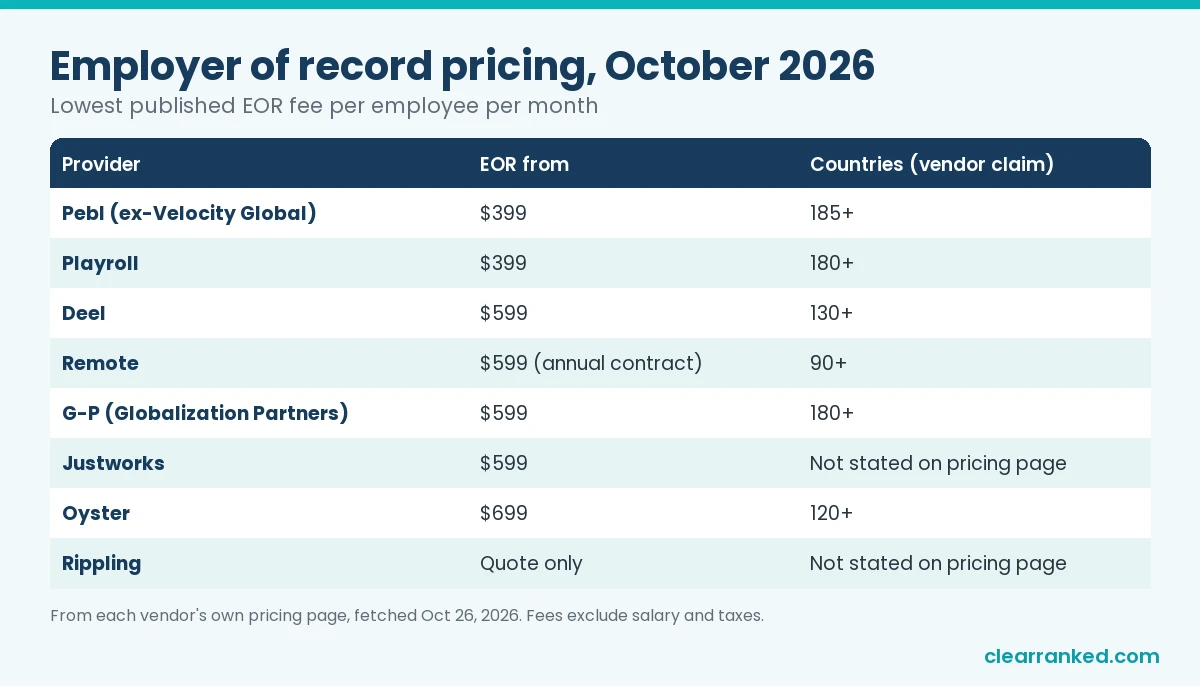
A few details from those pages are worth knowing. Remote’s $599 applies to annual contracts. G-P mentions volume discounts. Oyster offers an annual seat option that can be reused when someone leaves. Playroll says it has no minimum commitment. Remote and Oyster both say they don’t charge separate setup or onboarding fees.
Now the part the headline price hides. The EOR fee is only the service charge. You also pay the person’s gross salary, the employer’s share of local social contributions and any mandatory benefits. In some countries those employer costs are modest; in others they add a big percentage on top of salary. Ask every vendor for a full employment cost estimate for your exact country and salary before you compare.
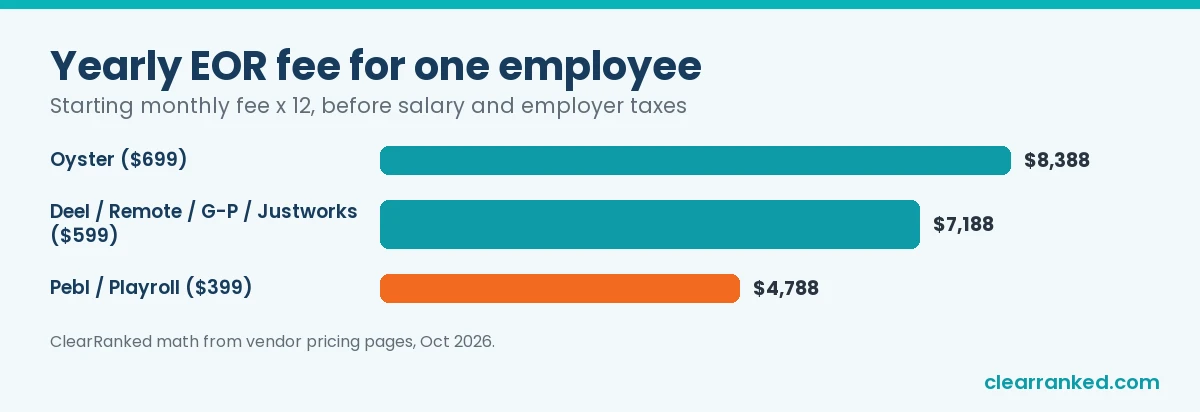
For a single hire, $599 x 12 = $7,188 a year in fees. At $399, it’s $4,788. At $699, $8,388. Is that a lot? Compare it with the alternative. Rippling’s EOR page says setting up a local entity can take 6 to 12 months, and you’d still need local payroll, accounting and legal help after that.
What’s the difference between an EOR and a PEO?
A PEO, or professional employer organization, co-employs your existing US workers: you stay an employer, and the PEO shares HR, payroll and benefits duties. An EOR is the sole legal employer, usually in a country where you have no entity. PEOs suit domestic teams; EORs suit hires abroad.
| EOR | PEO | |
|---|---|---|
| Legal employer | The EOR alone | You and the PEO (co-employment) |
| Typical use | Hiring where you have no entity, often abroad | Running HR and benefits for US staff |
| Needs your own entity? | No, in that country | Yes, your US company |
| Published price examples | $399 to $699 per employee/month | Remote from $99; Justworks $79 or $124; Deel from $125 |
| Best for | 1 to a few hires in a new country | Growing US teams wanting better benefits |
Some US firms do use EOR-style arrangements domestically, for example to hire in a state where they’re not registered yet. But for most American small businesses with US staff, a PEO or regular payroll software is the cheaper route. Our small business HR solutions guide compares those options.
Which are the best employer of record providers for small businesses?
There isn’t one best EOR for everyone. On price alone, Pebl and Playroll publish the lowest starting fees at $399. G-P claims the widest country reach in the $599 group, at 180+. Justworks suits US firms already on its PEO. Oyster is the priciest published option at $699, with annual seats.
- Pebl (formerly Velocity Global): $399 a month per employee and 185+ countries claimed. Velocity Global rebranded as Pebl.
- Playroll: from $399 a month, no minimum commitment, 180+ countries.
- Deel: EOR from $599, plus contractor tools from $49 and a US PEO from $125, all in one platform.
- Remote: $599 on annual contracts, a PEO from $99, and contractor management from $29.
- G-P: from $599, 180+ countries, with volume discounts mentioned.
- Justworks: Global EOR at $599, sold alongside its US PEO plans.
- Oyster: $699 a month, with a reusable annual seat model.
- Rippling: no published EOR price; its platform pricing begins around $8 a head monthly, plus a base fee.
Our opinion: for one or two hires, shortlist three vendors that cover your country, then ask each for a full annual cost on the same salary. The cheapest headline fee doesn’t always produce the cheapest total, because benefits packages and currency handling differ. Also read the termination terms. Ending employment abroad can involve notice periods and severance that a US owner wouldn’t expect; our severance pay calculator covers only US-style math, so ask the EOR for local figures.
When should a small business use an employer of record?
Use an EOR when you want a full-time employee in a country where you have no entity, you’re hiring a handful of people there, and you need to start within weeks. Consider your own entity once headcount in that country grows large enough that the monthly fees outweigh the cost of running a local company.
There’s also a middle path. If the person genuinely works like a freelancer, setting their own hours on defined projects, a contractor agreement might be appropriate. Deel and Remote both sell contractor management for much less than their EOR fee. However, the test is how the work actually happens, not what the contract says.
Before signing, check four things:
- Whether the EOR owns an entity in your country, or which partner does the hiring there.
- The quote lists every cost: salary, employer contributions, benefits, fees and currency markup.
- IP and confidentiality terms transfer work product to your company.
- The exit terms: what happens if you leave the EOR or the employee resigns.
This is general information, not legal advice. Employment law abroad differs a lot, so confirm details with the provider and, for large hires, a local lawyer.
How does employer of record payroll work for employees in the USA?
A US employer of record puts your worker on its own payroll. It withholds federal and state income tax and 7.65% for Social Security and Medicare, pays the employer taxes, carries workers’ comp, files the returns and issues the W-2. You pay the salary, those employer costs and the monthly EOR fee.
Foreign companies use this most, along with US companies hiring in a state where they aren’t registered yet. The fee is only part of the bill. Here’s the federal floor on a $60,000 hire at a $599 monthly fee:
| Cost | Math | Yearly |
|---|---|---|
| Salary | $60,000 | |
| Social Security, employer | $60,000 x 6.2% | $3,720 |
| Medicare, employer | $60,000 x 1.45% | $870 |
| FUTA (after state credit) | $7,000 x 0.6% | $42 |
| EOR fee | $599 x 12 | $7,188 |
| Total before state costs | $71,820 |
Add state unemployment tax, workers’ comp and any benefits the EOR passes through, which vary by state and provider. FUTA math is from IRS Topic 759. If you already have a US entity, a PEO or a plain payroll service usually costs less; see our guide to how to set up payroll.
Related guides
- Contractor payroll services
- Small business HR solutions
- Cloud-based HR software
- Form 1099 for contractors
- How to set up payroll
FAQ
An employer of record legally employs a worker for you in a place where you have no entity. It handles contracts, payroll, taxes and benefits, while you manage the person’s work.
Published October 2026 starting prices run from $399 to $699 per employee per month. That fee is on top of salary, employer taxes and benefits.
A PEO co-employs your US workers alongside your own company. An EOR is the only legal employer, usually in a country where you have no entity.
Among pages we could check, Pebl and Playroll list the lowest starting fee at $399 a month per employee. Total cost still depends on the country and benefits.
Not on its pricing page as of October 2026. Rippling lists platform plans from $8 per employee per month plus a base fee and quotes EOR separately.
Yes. An EOR makes the person a proper employee under local law, which avoids the misclassification risk of treating a full-time worker as a contractor.
About the author
I’m Ali Hassan, the founder of ClearRanked. Also, I run small businesses myself, and I know how much time goes into hiring, payroll and HR tools. ClearRanked is where I share plain-English guides and honest comparisons, so small business owners can make decisions with confidence instead of guesswork.
How we work: this guide is research-based, and every source in it was checked in October 2026. We don’t take payment for rankings, and we update guides when laws or prices change. Finally, read more on our About page.