
Pre Employment Physical: What It Includes, When It’s Legal and How Employers Do It Right
A pre employment physical is a medical exam a new hire takes after receiving a job offer, to confirm they can safely do the job. Under the ADA, employers with 15 or more workers may require one only after a conditional offer, and only if everyone entering the same job category gets the same exam. Results must be kept in a separate, confidential medical file.
Physicals make sense for jobs with real physical demands, like lifting, driving or working at heights. They’re far less useful for desk jobs, where they mostly add cost and legal risk.
This guide explains what the exam usually covers, the timing rules that trip employers up, how to handle results, and where drug tests and DOT physicals fit. Not legal advice; state laws can add rules, so check yours.
How we researched this: we read the ADA regulations at 29 CFR 1630.13, 1630.14 and 1630.16, the GINA rule at 29 CFR 1635.8, the DOT driver exam rule at 49 CFR 391.45, and the EEOC small business coverage page. All were checked in October 2026.
Key takeaways
- Never require a medical exam before a job offer. Before the offer, you may only ask whether someone can do the job’s tasks.
- After a conditional offer, you can require a physical if every new hire in that job category takes the same one.
- Keep results in a separate, confidential medical file, not the regular personnel file.
- You can only withdraw an offer for medical reasons that are job-related, and only if a reasonable accommodation wouldn’t solve it.
- A drug test isn’t a medical exam under the ADA, but state drug testing laws still apply.
- Commercial drivers need a DOT physical at least every 24 months.
What is a pre-employment physical?
It’s a health exam done after you offer someone a job and before they start, to check whether they can perform the duties safely. A clinician reviews health history and checks things like blood pressure, vision, hearing and physical ability. The employer usually gets a fit-for-duty answer, not the full medical details.
Think of it as a safety check matched to the job. A warehouse role that requires lifting 50-pound boxes might include a lifting test. A delivery driver role might include a vision check. An accounting role usually doesn’t need anything at all.
The exam is separate from a background check or drug test, though employers often schedule them together at the same clinic. Keeping them distinct on paper helps you follow the different rules for each.
When can an employer legally require a pre-employment physical?
Only after making a conditional job offer. The ADA bans medical exams and disability questions for applicants before an offer. After the offer, an employer may require an exam and make the offer depend on the result, as long as all new hires in the same job category get the same exam, regardless of disability.
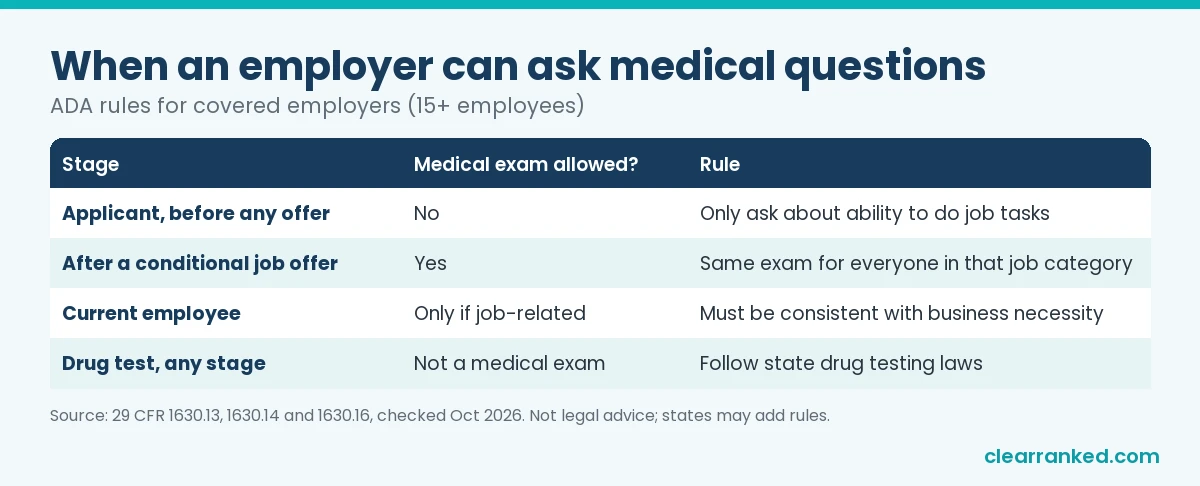
That’s the core rule in 29 CFR 1630.14(b). Before the offer, you can still ask applicants whether they can do specific job tasks, with or without accommodation, and even ask them to show how. What you can’t do is ask about conditions, medications or disabilities.
Here’s how timing goes wrong. A landscaping company sends a candidate for a physical before deciding whether to hire them, just to save a step. That exam happened before an offer, so it breaks 29 CFR 1630.13. The fix is easy: make the offer first, in writing, conditioned on passing the physical.
The ADA applies to employers with 15 or more employees, according to the EEOC. Smaller employers should still follow the same order, because many state disability laws reach smaller businesses.
What does a pre-employment physical include?
It depends on the job, but most include a health history form, vital signs like blood pressure and pulse, height and weight, and vision and hearing checks. Physically demanding jobs may add a lifting or mobility test. Some roles need special exams, such as a DOT physical for commercial drivers.
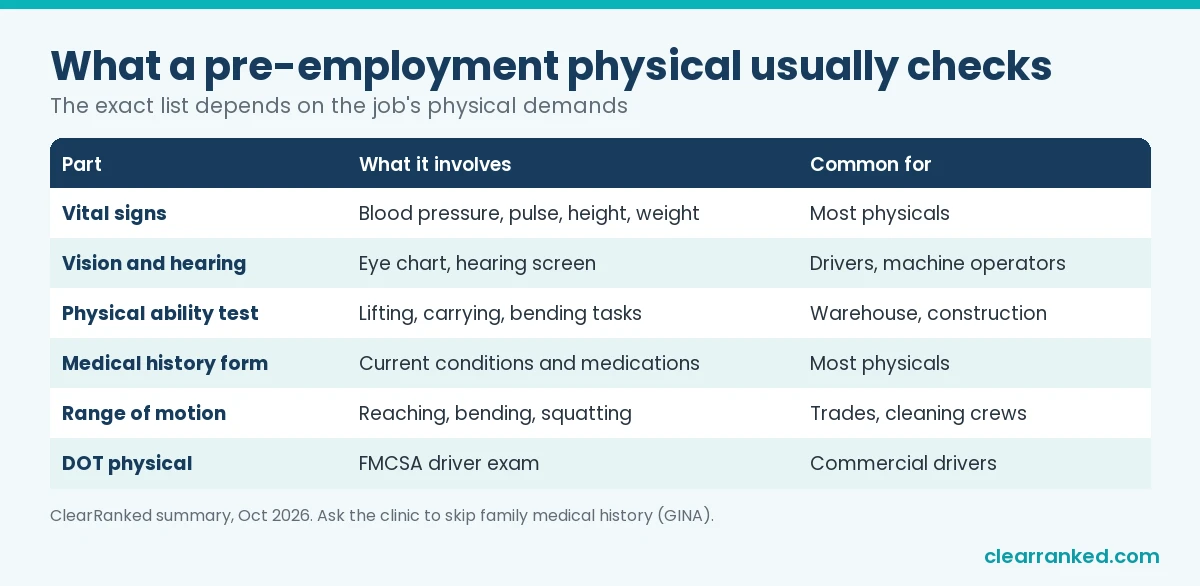
Give the clinic a written job description with the physical demands spelled out. For example: lift up to 50 pounds, stand for 8 hours, climb ladders. That lets the clinician test what matters and tell you whether the person can do those things, with or without accommodation.
One thing to leave out: family medical history. Under the Genetic Information Nondiscrimination Act, genetic information includes family medical history. The rule at 29 CFR 1635.8 even gives sample language employers can send with a medical request, asking providers not to collect genetic information. Use it.
How should employers handle physical exam results?
Store results on separate forms in a separate medical file, treated as confidential. Share only what’s needed: supervisors may learn about work restrictions and accommodations, first aid and safety staff may be told if emergency treatment could be needed, and government investigators can get relevant records on request. Results can’t be used to discriminate.
Those exceptions come straight from 29 CFR 1630.14(b)(1). In practice, ask the clinic to send you a short fit-for-duty form, such as cleared, cleared with restrictions, or not cleared, and keep any detailed records locked away from the main personnel file.
| Who | What they can know |
|---|---|
| Hiring manager or supervisor | Work restrictions and needed accommodations |
| First aid and safety staff | Conditions that might need emergency treatment |
| Government investigators | Relevant information on request |
| Coworkers | Nothing |
| Regular personnel file | No medical details; keep them in a separate file |
Can an employer withdraw a job offer after a physical?
Only if the reason is job-related and consistent with business necessity, and the person can’t do the essential functions even with a reasonable accommodation. A finding unrelated to the job’s real demands, or one an accommodation could address, isn’t a lawful reason to pull the offer.
Say a physical shows a new warehouse hire can lift 40 pounds but the job description says 50. Before withdrawing anything, ask how often 50-pound lifts actually happen, and whether a cart, a team lift or a different task mix would work. Document that conversation.
If you’re unsure, pause and get advice before you act. Our employment law attorney guide explains when that call is worth making. Withdrawn offers are a common source of disability claims.
Is a drug test part of a pre-employment physical?
Often it happens at the same visit, but legally it’s separate. Under the ADA rules, a test for illegal drug use isn’t considered a medical examination, so it isn’t bound by the post-offer timing rule. However, state drug testing laws vary widely, and some limit when and how employers can test.
That’s from 29 CFR 1630.16(c). Note the narrow wording: illegal drug use. Testing for alcohol or for legally prescribed medications is treated differently, and questions about prescriptions can count as disability-related inquiries. Our employee drug testing guide covers the state rules and cutoff levels.
Who needs a DOT physical?
Commercial motor vehicle drivers covered by federal motor carrier rules must pass a DOT medical exam and hold a valid medical certificate. A driver must be re-examined and recertified at least every 24 months, and sooner in some cases. Track each certificate’s expiration date carefully.
The 24-month rule is in 49 CFR 391.45. If you run trucks or larger vehicles, track each driver’s certificate expiration date the same way you’d track a license. An expired card can take a driver off the road the same day.
How much does a pre-employment physical cost?
Prices vary by clinic, city and what’s included, so get quotes from occupational health clinics near you. A basic physical costs less than one bundled with a drug screen, lifting test or DOT exam. Most employers pay for the exam, which also keeps the process consistent for every new hire.
We didn’t find a current official price table to quote, so ask two or three local clinics for itemized pricing. Many offer employer accounts with set rates and quick turnaround.
Budget it as part of your hiring cost, along with background checks and onboarding time. Paying for the exam yourself, rather than asking new hires to cover it, keeps things fair and simpler to manage. For the rest of your hiring paperwork, see our employee handbook guide and small business HR solutions.
What reasons can make you fail a pre-employment physical?
Under the ADA, you can only “fail” a pre-employment physical if a result shows you can’t do the job’s essential functions even with a reasonable accommodation, or that you would pose a direct threat to safety. Having a medical condition is not, by itself, a reason to pull an offer.
A direct threat means a significant risk of substantial harm that accommodation can’t remove. It has to rest on an individual assessment of your current ability, not a general fear about a diagnosis (29 CFR 1630.2(r)). In practice, common reasons include:
- Not meeting a tested job demand, such as lifting 50 pounds, when no aid or task change would close the gap.
- Failing a federal safety standard. For DOT drivers, that includes vision worse than 20/40 in each eye (with or without glasses), a horizontal field under 70 degrees, or not hearing a forced whisper at 5 feet (49 CFR 391.41).
- A condition likely to cause sudden loss of control in a safety-critical role.
- A positive test for illegal drugs, which is handled separately from the medical exam.
What is a pre-employment fit test?
A pre-employment fit test usually means a respirator fit test. OSHA requires workers who wear a tight-fitting respirator to get a medical evaluation first, then a fit test before first use, whenever the facepiece model or size changes, and at least once a year after that.
The order matters for employers. The medical evaluation comes before the fit test, under 29 CFR 1910.134. Also, facial hair that sits under the seal rules out a tight-fitting mask, so a bearded hire may need a loose-fitting powered respirator instead. Some employers also use “fit test” for a physical abilities test. If so, it should match the written job duties, like any other part of the physical.
Related guides
- Employee drug testing rules
- When to hire an employment law attorney
- Employee handbook guide
- Small business HR solutions
- Employment verification letter templates
- Contractor insurance basics
FAQ
A medical exam a new hire takes after a job offer to confirm they can safely do the job, usually covering health history, vital signs, vision, hearing and sometimes a lifting test.
No, not if the ADA applies. Medical exams are only allowed after a conditional job offer, and the same exam must be given to everyone in that job category.
An offer can only be withdrawn for a medical reason that is job-related and consistent with business necessity, and only if a reasonable accommodation would not let you do the job.
Sometimes at the same visit, but a test for illegal drugs is not a medical exam under the ADA. State drug testing laws still apply.
Results go in a separate confidential medical file. Supervisors may learn about work restrictions, and safety staff may learn about conditions needing emergency care.
At least every 24 months under 49 CFR 391.45, and sooner in some cases.
About the author
I’m Ali Hassan, the founder of ClearRanked. Also, I run small businesses myself, and I know how much time goes into hiring steps, HR rules and staff paperwork. ClearRanked is where I share plain-English guides and honest comparisons, so small business owners can make decisions with confidence instead of guesswork.
How we work: this guide is research-based, and every source in it was checked in October 2026. We don’t take payment for rankings, and we update guides when laws or prices change. Finally, read more on our About page.