
Solo 401(k) Guide 2026: Contribution Limits, Math for the Self-Employed, and Solo 401(k) vs SEP IRA
A solo 401(k) is a 401(k) plan for a business owner with no employees other than a spouse. For 2026, you can defer up to $24,500 as the employee, add an employer contribution of up to 25% of pay, and put in no more than $72,000 in total. Catch-up contributions of $8,000 at age 50, or $11,250 at ages 60 to 63, go on top.
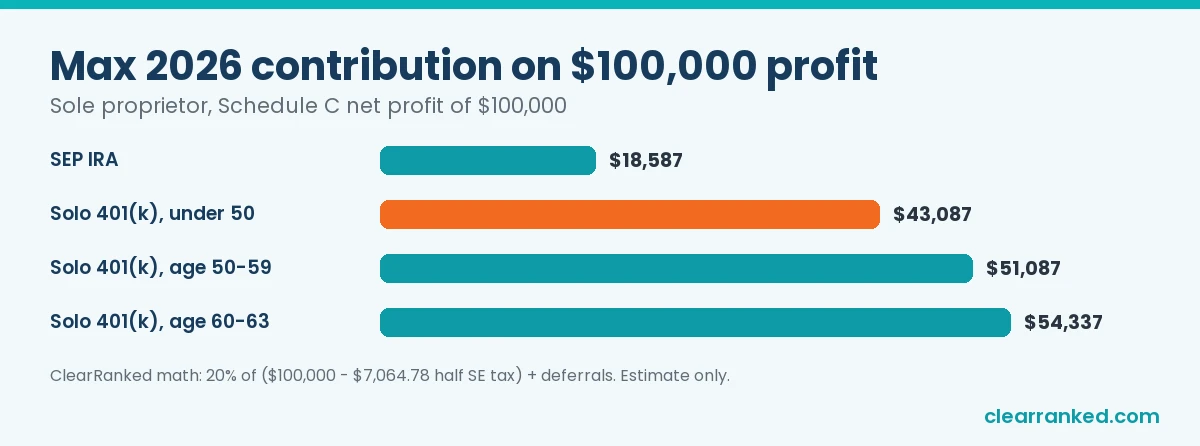
Think of a solo consultant clearing $100,000 a year. With a SEP IRA she can shelter roughly $18,600. With a solo 401(k), the same profit supports about $43,000. That gap is the whole reason this plan is popular with freelancers and one-person LLCs, and in my view it’s the better default for most of them.
Below you’ll get the 2026 limits, the step-by-step math (sole proprietor and S corp versions), a side-by-side with the SEP IRA, and the small amount of paperwork the plan brings.
How we researched this: we used the IRS 2026 limits announcement and Notice 2025-67, the IRS one-participant 401(k) page, and Publication 560, Retirement Plans for Small Business. Every figure was checked in October 2026. The IRS hadn’t yet announced 2027 limits on the date we checked.
Key takeaways
- 2026 solo 401(k) employee deferral limit: $24,500. Catch-up: $8,000 at 50 or older, or $11,250 at ages 60 to 63.
- 2026 total cap for employee plus employer money: $72,000, or $80,000 and $83,250 with catch-ups.
- Sole proprietors figure the employer part as 20% of net earnings after half of self-employment tax. Corporate owners use 25% of W-2 pay.
- On $100,000 of Schedule C profit, the 2026 maximum is about $43,087, versus about $18,587 in a SEP IRA.
- Missed December? A solo owner with no staff can still set up the plan for last year, up to the regular tax filing date.
- Once the plan holds $250,000 on December 31, you owe a Form 5500-EZ each year.
What is a solo 401(k)?
A solo 401(k), also called a one-participant 401(k), solo-k or uni-k, is a regular 401(k) plan that covers only a business owner, or the owner and a spouse. It follows the same rules as any 401(k). The difference is that no common-law employees take part, so the plan skips nondiscrimination testing.
Here’s something many owners don’t realize. The IRS doesn’t treat it as its own plan type at all (IRS). It’s an ordinary 401(k) where the only participant happens to be you, and brokerages just package the paperwork for one-person shops.
The catch comes when you hire. If an employee meets the plan’s eligibility rules, you must include them, and testing applies unless the plan is a safe harbor design. So the solo 401(k) suits freelancers, consultants, solo contractors and married couples who run a business together.
What are the solo 401(k) contribution limits for 2026?
For 2026, the solo 401(k) limits are a $24,500 employee deferral, an employer contribution of up to 25% of compensation, and a $72,000 combined cap. Owners aged 50 or older can add an $8,000 catch-up, and owners aged 60 to 63 can add $11,250 instead, for totals of $80,000 or $83,250.

These figures come from IRS Notice 2025-67, announced on November 13, 2025. The deferral rose from $23,500 in 2025, and the overall cap rose from $70,000. Also, the plan can only count the first $360,000 of compensation (IRS).
Two limits trip people up. First, the $24,500 deferral is per person, not per plan. So if you also defer $15,000 at a day job, only $9,500 of deferral room is left for your solo 401(k). However, the $72,000 cap applies to each unrelated employer’s plan separately, so employer contributions to your own plan aren’t reduced by the day-job plan.
Second, there’s a Roth catch-up rule. For 2026, workers whose prior-year FICA wages from the plan sponsor topped $150,000 must make catch-up contributions as Roth. Check with your plan provider on how it applies to you.
How do you calculate a solo 401(k) contribution if you’re self-employed?
If you file Schedule C, start with net profit, subtract half of your self-employment tax, and multiply the result by 20%. That’s your employer contribution. Then add your employee deferral of up to $24,500, plus any catch-up. The total can’t exceed $72,000, not counting catch-ups, or your earned income.
Why 20% and not 25%? For owners, the plan contribution and net earnings depend on each other. Publication 560 handles this with a rate table, and a 25% plan rate works out to 20% once you apply it to your own net self-employment income.
Self-employment tax is 15.3%, made up of 12.4% for Social Security and 2.9% for Medicare (IRS). It applies to 92.35% of your net profit, per Schedule SE. Here is the full calculation for $100,000 of profit:
| Step | Math | Result |
|---|---|---|
| 1. Net profit (Schedule C) | Given | $100,000.00 |
| 2. Earnings subject to SE tax | $100,000 x 92.35% | $92,350.00 |
| 3. Self-employment tax | $92,350 x 15.3% | $14,129.55 |
| 4. Half of SE tax (deduction) | $14,129.55 / 2 | $7,064.78 |
| 5. Net earnings for the plan | $100,000 – $7,064.78 | $92,935.22 |
| 6. Employer contribution | $92,935.22 x 20% | $18,587.04 |
| 7. Employee deferral | 2026 limit | $24,500.00 |
| 8. Total, under age 50 | $18,587.04 + $24,500 | $43,087.04 |
If this owner is 55, the $8,000 catch-up raises the total to $51,087.04. At age 61, the $11,250 catch-up brings it to $54,337.04. Treat these as estimates. Your tax preparer should run the final numbers, since other deductions can change net profit.
How does the math work for an S corp or C corp owner?
If your business is a corporation that pays you a W-2 salary, the employer contribution is simply up to 25% of that W-2 pay. Your deferral of up to $24,500 comes out of the same salary. Profit paid out as distributions doesn’t count as compensation for the plan.
For example, an S corporation owner with an $80,000 salary can receive an employer contribution of $80,000 x 25% = $20,000. Add the $24,500 deferral, and the 2026 total is $44,500 before any catch-up.
So the salary you set matters twice. A higher salary raises the plan contribution, but it also raises payroll taxes. If you run payroll for just yourself, we rank cheap ways to do it in one-employee payroll services.
Solo 401(k) vs SEP IRA: which is better?
For most self-employed people earning under about $250,000, a solo 401(k) allows larger contributions than a SEP IRA, because it adds the $24,500 employee deferral on top of the same 20% or 25% employer share. A SEP IRA is simpler, but it has no employee deferral and no catch-up contributions.
| Feature (2026) | Solo 401(k) | SEP IRA |
|---|---|---|
| Who can use it | Owner and spouse, no other employees | Any employer, but must cover eligible staff |
| Employee deferral | Up to $24,500 | None |
| Employer share | 25% of pay (20% for sole props) | 25% of pay (20% for sole props) |
| Overall cap | $72,000 plus catch-ups | $72,000 |
| Catch-up at 50+ | Yes, $8,000 or $11,250 | No |
| Roth option | Yes, if the plan allows | Yes, Roth SEP IRA if the plan allows |
| Latest setup date | Tax filing deadline, no extensions (sole prop, no staff) | Filing deadline including extensions |
| Annual filing | Form 5500-EZ at $250,000+ in assets | Usually none with Form 5305-SEP |
The SEP still has a place. It’s quick to open, it can be set up as late as your extended filing deadline (IRS), and it has almost no paperwork. However, at $100,000 of profit the SEP tops out near $18,587, while the solo 401(k) allows about $43,087. At very high incomes, both plans hit the same $72,000 cap, and the gap shrinks to the catch-up.
How do you open a solo 401(k) and keep it compliant?
To open a solo 401(k), choose a provider, sign the plan document, and open the account before you make contributions. Since 2023, a one-person sole proprietorship gets extra time: the plan can be set up after December 31, up to the original tax return due date. After that, keep records and watch for the $250,000 balance that triggers Form 5500-EZ.
- Confirm you have self-employment income and no eligible common-law employees.
- Get an EIN for the plan or business if your provider asks for one.
- Pick a provider and decide whether you want a Roth deferral option.
- Sign the plan document. The general rule in Pub. 560 is that a plan has to exist by year end to deduct that year’s contributions. Solo sole proprietors get a break and can sign by the original filing date.
- For a new plan adopted after year end, pay first-year elective deferrals into the plan before the return due date, without extensions.
- Make the employer contribution by your tax return due date, including extensions.
- Watch the balance. When it hits $250,000 on the last day of a plan year, file Form 5500-EZ for that year.
A tip from experience: keep a one-page worksheet with net profit, half of SE tax and the 20% math. It takes five minutes in March and saves an argument with your preparer in April.
What happens to a solo 401(k) when you hire employees?
Once you hire an employee who meets the plan’s eligibility rules, the plan is no longer a one-participant plan. You must let that employee join, and the plan becomes subject to nondiscrimination testing unless you switch to a safe harbor design. Many owners then move to a standard small-business 401(k).
You can keep the plan running if you plan ahead. Part-time staff may not be eligible right away, because a 401(k) can require up to one year of service. However, for plan years starting after 2024, long-term part-time workers with 500 hours in two straight years must be allowed to defer.
If you’re hiring your first worker, read how to set up payroll and our exempt vs non-exempt guide before you post the job.
Related guides
- Payroll services for one employee
- How to set up payroll
- Florida paycheck calculator
- Exempt vs non-exempt employees
- All ClearRanked calculators
FAQ
For 2026, you can defer up to $24,500 as the employee and add an employer contribution of up to 25% of pay, or 20% of net self-employment earnings, up to a $72,000 total. Catch-ups add $8,000 at age 50 or $11,250 at ages 60 to 63.
Yes. The IRS says a one-participant 401(k) can cover the business owner and his or her spouse. If your spouse earns pay from the business, they can make their own deferrals and receive employer contributions.
For most self-employed people under about $250,000 of income, yes, because the solo 401(k) adds a $24,500 employee deferral. On $100,000 of profit in 2026, the solo 401(k) allows about $43,087 versus about $18,587 in a SEP IRA.
Yes. However, the $24,500 deferral limit is per person across all plans. The $72,000 overall limit applies to each unrelated employer’s plan separately, so you can still make employer contributions to your own plan.
If you’re a sole proprietor with no staff, you can set up a new plan after December 31 and still use it for the prior year, as long as you sign before your original return due date. Your first-year deferrals need to be deposited by then too.
Form 5500-EZ is due for any year your one-participant plan ends with a balance of $250,000 or more. Smaller plans can usually skip the annual filing.
Not as of October 26, 2026. The IRS announced the 2026 limits on November 13, 2025, so 2027 figures usually arrive in the fall. We will update this guide when they are published.
About the author
I’m Ali Hassan, the founder of ClearRanked. Also, I run small businesses myself, and I know how much time goes into retirement plans, payroll and pay math. ClearRanked is where I share plain-English guides and honest comparisons, so small business owners can make decisions with confidence instead of guesswork.
How we work: this guide is research-based, and every source in it was checked in October 2026. We don’t take payment for rankings, and we update guides when laws or prices change. Finally, read more on our About page.