Florida Paycheck Calculator: 2026 Take-Home Pay After Taxes
A Florida paycheck calculator only needs to take out federal taxes, because Florida has no state income tax. In 2026, that means federal income tax (10% to 37% after a $16,100 standard deduction for single filers), 6.2% Social Security on wages up to $184,500 and 1.45% Medicare. For example, a single worker earning $50,000 takes home about $1,629 every two weeks.
That’s a real perk. A nurse in Orlando keeps money that the same nurse in a high-tax state would lose to state withholding every payday. But the federal side moves every year, and a 401(k) or a health premium shifts the math again. Below you’ll find a free calculator, the checked 2026 numbers and worked examples, so you can size up a job offer, a budget or a new hire’s pay in a couple of minutes.
How we researched this: we took the 2026 tax brackets and standard deductions from the IRS 2026 inflation adjustments and Revenue Procedure 2025-32, the Social Security wage base and Medicare rules from IRS Publication 15 (2026), Florida’s income tax rule from Article VII, Section 5 of the Florida Constitution, and the state minimum wage from FloridaCommerce. We checked every figure against these sources in October 2026.
Key takeaways
- Florida has no personal state income tax, so there’s no state withholding on Florida paychecks.
- Federal income tax for 2026 uses seven brackets from 10% to 37%. The standard deduction is $16,100 single, $32,200 married filing jointly and $24,150 head of household.
- Social Security is 6.2% on the first $184,500 of 2026 wages. Medicare is 1.45% on all wages, plus 0.9% withheld on wages above $200,000.
- A $50,000 salary works out to about $42,355 a year, or $1,629.04 biweekly, for a single filer.
- Florida’s minimum wage rose to $15.00 an hour on September 30, 2026. Full-time at $15 is $31,200 a year, or about $1,048 biweekly take-home.
- Florida reemployment (unemployment) tax is paid by employers, not taken from employee paychecks.
Florida take-home pay calculator (2026)
Federal income tax + Social Security + Medicare. Florida has no state income tax, so state tax is $0.
Estimate only, not tax advice. It uses 2026 IRS brackets and the standard deduction, and ignores credits, other deductions and W-4 adjustments.
How does a Florida paycheck calculator work?
A Florida paycheck calculator starts with gross pay, subtracts pre-tax deductions, and then takes out federal income tax, Social Security and Medicare. There's no state income tax step. The result is net pay, or take-home pay, which is what lands in your bank account each payday.
Here's the order our calculator follows. First, it turns your pay into an annual figure. For hourly pay it uses hours per week x 52, so $20 x 40 hours x 52 weeks = $41,600. Next, it subtracts any 401(k) deferral and pre-tax health premium.
- Step 1: annual gross pay (salary, or hourly rate x hours x 52).
- Step 2: subtract pre-tax deductions to get federal taxable wages.
- Step 3: subtract the 2026 standard deduction for your filing status.
- Step 4: apply the 2026 federal tax brackets to what is left.
- Step 5: apply Social Security (6.2%) and Medicare (1.45%) to FICA wages.
- Step 6: divide each annual amount by your number of paychecks.
However, your real paycheck may differ by a few dollars. Employers figure withholding with the IRS tables in Publication 15-T and the choices on your Form W-4, such as extra withholding, dependents or other income. So treat the result as a planning estimate. Check with a CPA for your situation.
Does Florida have state income tax on paychecks?
No. Florida doesn't tax the wages of its residents, so employers don't withhold any state income tax from Florida paychecks. The state constitution bars a state tax on the income of natural persons, which is why the state tax line on a Florida pay stub is always $0.
The rule comes from Article VII, Section 5(a) of the Florida Constitution. On top of that, the Florida Department of Revenue lists the taxes it collects, such as sales tax, corporate income tax and reemployment tax, and a personal income tax isn't one of them.
There's one catch. If you live in Florida but work for an employer in a state that taxes nonresident wages, that state may still withhold tax. Similarly, people who move to Florida mid-year may owe tax to their old state for the months they lived there.
What federal taxes come out of a Florida paycheck in 2026?
Three federal taxes come out of a Florida paycheck in 2026: federal income tax, Social Security tax at 6.2% on wages up to $184,500, and Medicare tax at 1.45% on all wages. Employers also withhold an extra 0.9% Medicare tax on wages above $200,000 in a calendar year.
The income tax brackets below come straight from Rev. Proc. 2025-32. They apply to taxable income, which is income after the standard deduction. For example, a single filer with a $50,000 salary has $50,000 - $16,100 = $33,900 of taxable income.
| Rate | Single | Married filing jointly | Head of household |
|---|---|---|---|
| 10% | $0 to $12,400 | $0 to $24,800 | $0 to $17,700 |
| 12% | $12,401 to $50,400 | $24,801 to $100,800 | $17,701 to $67,450 |
| 22% | $50,401 to $105,700 | $100,801 to $211,400 | $67,451 to $105,700 |
| 24% | $105,701 to $201,775 | $211,401 to $403,550 | $105,701 to $201,750 |
| 32% | $201,776 to $256,225 | $403,551 to $512,450 | $201,751 to $256,200 |
| 35% | $256,226 to $640,600 | $512,451 to $768,700 | $256,201 to $640,600 |
| 37% | Over $640,600 | Over $768,700 | Over $640,600 |
| Standard deduction | $16,100 | $32,200 | $24,150 |
Social Security and Medicare together are called FICA. According to IRS Publication 15, the 2026 Social Security wage base is $184,500, up from $176,100 in 2025, and there's no wage cap for Medicare. So the most Social Security tax an employee pays in 2026 is $184,500 x 6.2% = $11,439.
As of October 26, 2026, the IRS has not yet published its 2027 inflation adjustments, and we could not confirm the 2027 Social Security wage base. We will add both when they are official.
What is the take-home pay on a $50,000 salary in Florida?
A $50,000 salary in Florida is about $42,355 a year after taxes in 2026 for a single filer with no pre-tax deductions. That's $1,629.04 per biweekly paycheck, $3,529.58 a month or $814.52 a week. Federal income tax is $3,820 and FICA is $3,825.
Here's the full math, so you can check it yourself:
- Taxable income: $50,000 - $16,100 standard deduction = $33,900
- Federal income tax: 10% x $12,400 = $1,240, plus 12% x ($33,900 - $12,400) = $2,580, for a total of $3,820
- Social Security: $50,000 x 6.2% = $3,100
- Medicare: $50,000 x 1.45% = $725
- Take-home: $50,000 - $3,820 - $3,100 - $725 = $42,355
- Biweekly: $42,355 / 26 = $1,629.04
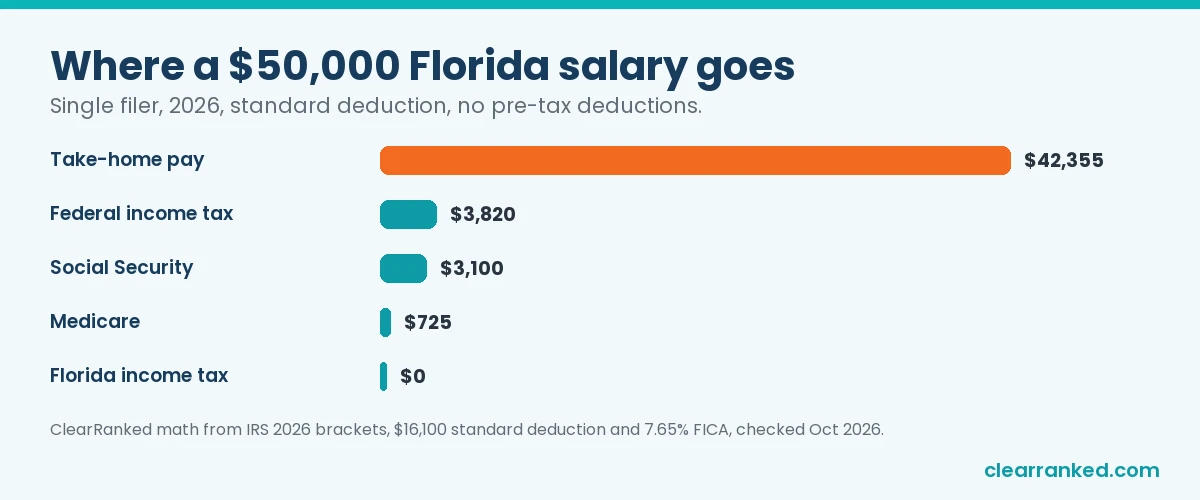
Notice that federal income tax grows faster than FICA as pay rises, because more income falls into the 22% and 24% brackets.
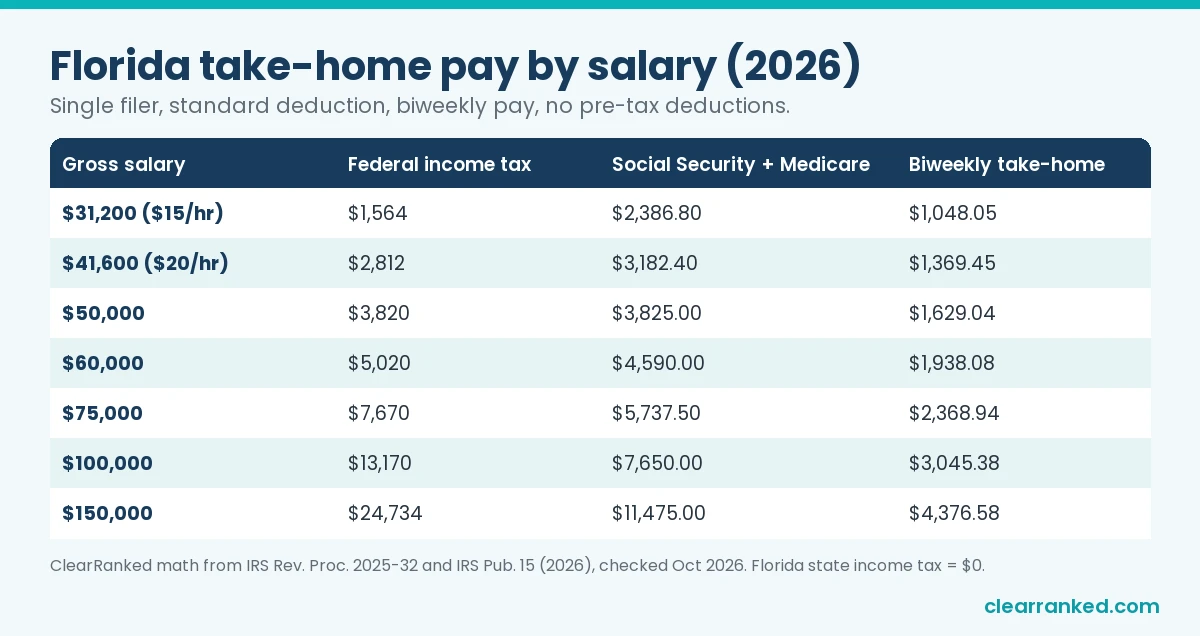
For example, at $75,000 the taxable income is $58,900. Federal tax is $5,800 + 22% x ($58,900 - $50,400) = $7,670. After $5,737.50 of FICA, take-home is $61,592.50, or $2,368.94 biweekly.
What is the take-home pay for hourly workers in Florida?
A full-time Florida worker earning the $15.00 state minimum wage grosses $31,200 a year ($15 x 40 hours x 52 weeks) and takes home about $27,249 after federal taxes in 2026. That's roughly $1,048 every two weeks or $524 a week for a single filer.
Florida's minimum wage went up to $15.00 an hour on September 30, 2026, and FloridaCommerce says it stays at $15.00 through December 31, 2027. After that, it will be adjusted each year for inflation, with each change taking effect on January 1. Tipped workers who qualify get a direct cash wage of $11.98 an hour.
| Hourly wage | Annual gross (x 2,080 hours) | Annual take-home | Weekly take-home | Biweekly take-home |
|---|---|---|---|---|
| $15.00 | $31,200 | $27,249.20 | $524.02 | $1,048.05 |
| $20.00 | $41,600 | $35,605.60 | $684.72 | $1,369.45 |
| $25.00 | $52,000 | $43,962.00 | $845.42 | $1,690.85 |
| $30.00 | $62,400 | $52,318.40 | $1,006.12 | $2,012.25 |
| $40.00 | $83,200 | $67,361.20 | $1,295.41 | $2,590.82 |
These rows assume a single filer working 40 hours a week for 52 weeks, with no overtime and no pre-tax deductions. Real hourly pay rarely looks that tidy, though. Shifts get added, a slow week gets cut. If you work overtime, the extra hours are paid at 1.5 times your regular rate, and the higher check means more tax withheld that week. Our overtime calculator handles that part.
How do 401(k) and health deductions change a Florida paycheck?
Pre-tax deductions lower your federal taxable wages, so they cut your income tax. A traditional 401(k) deferral reduces federal income tax but not Social Security or Medicare. A pre-tax health premium under a cafeteria plan usually reduces both income tax and FICA, so each dollar costs you less than a dollar.
IRS Publication 15 confirms the split: elective 401(k) deferrals are generally exempt from federal income tax withholding but are still taxable for Social Security and Medicare. For example, take a $60,000 salary with a 5% 401(k):
- 401(k): $60,000 x 5% = $3,000 a year, or $115.38 per biweekly check
- Taxable income: $60,000 - $3,000 - $16,100 = $40,900
- Federal income tax: $1,240 + 12% x ($40,900 - $12,400) = $4,660
- FICA still applies to the full $60,000: $3,720 + $870 = $4,590
- Take-home: $60,000 - $4,660 - $4,590 - $3,000 = $47,750, or $1,836.54 biweekly
So saving $115.38 per paycheck only lowers take-home pay by $101.54 ($1,938.08 - $1,836.54), because the deferral saves $360 a year in federal income tax. That's the part people miss: the paycheck hit's smaller than the amount you save. Roth money is the reverse case: you put it in after tax, so today's withholding stays the same.
How does pay frequency change each Florida paycheck?
Pay frequency doesn't change your yearly take-home pay, only the size of each check. On a $50,000 salary in Florida, a single filer takes home about $814.52 weekly, $1,629.04 biweekly, $1,764.79 semimonthly or $3,529.58 monthly in 2026.
| Pay schedule | Paychecks a year | Gross per check ($50,000) | Take-home per check |
|---|---|---|---|
| Weekly | 52 | $961.54 | $814.52 |
| Biweekly | 26 | $1,923.08 | $1,629.04 |
| Semimonthly | 24 | $2,083.33 | $1,764.79 |
| Monthly | 12 | $4,166.67 | $3,529.58 |
One quirk catches people. Depending on where paydays land, some years have 27 biweekly paydays, not 26. If your employer splits the same salary across 27 checks, each one shrinks a bit. Picking a schedule for your own team? For a small roofing crew, weekly pay is common because workers expect it. For a 4-person office, I'd go biweekly, since it halves the number of payroll runs you have to check.
What do Florida employers have to withhold and pay?
Florida employers withhold federal income tax, Social Security and Medicare from each paycheck and add a matching 6.2% and 1.45% employer share. They don't withhold state income tax. Instead, they pay Florida reemployment tax themselves on the first $7,000 of each employee's wages per year.
The Florida Department of Revenue says reemployment tax is paid by employers and funds benefits for workers who lose their jobs. Rates vary by employer, and employers with stable records earn lower rates over time. One more Florida rule: private employers with 25 or more employees must use E-Verify for new hires.
Say you run a 6-person bakery in Tampa. Each payday you'll withhold federal tax and FICA, match the FICA, and pay reemployment tax on the first $7,000 of each baker's wages. That's the whole state side. Honestly, with a team that small, a full-service payroll app is worth its monthly fee just so federal deposits and filings never slip. Hiring your first Florida worker? Our guides on how to set up payroll and payroll services for one employee walk through registration, pay schedules and tools. For contractors, see contractor payroll services.
How do you file for unemployment in Florida?
You file online in FloridaCommerce's Reconnect system, and claims filed in 2026 pay $32 to $275 a week for up to 12 weeks. That caps one claim at $3,300, which is low next to most states, so it helps to know the number before you budget around it.
After you apply, there is one unpaid waiting week. Then you request benefits every two weeks and report five job contacts a week. Benefits are taxable for federal income tax, but Florida has no state income tax to take a second cut. Our Florida unemployment guide covers who qualifies, how the weekly amount is worked out and what employers pay into the system.
Related guides
- How to read your pay stub (what FICA, OASDI and FIT mean)
- All ClearRanked calculators
- Bonus tax calculator
- Overtime calculator
- How to set up payroll
- Payroll services for one employee
- PTO payout laws by state
FAQ
No. Florida has no personal income tax, so employers don't withhold state income tax. Only federal income tax, Social Security and Medicare come out, plus any deductions you choose, such as a 401(k) or health plan.
For a single filer in 2026 with no pre-tax deductions, $60,000 is about $50,390 a year after taxes. That's $1,938.08 biweekly. Federal income tax is $5,020 and FICA is $4,590.
It depends on income. For a single filer in 2026, total taxes are about 14.4% of pay at $41,600, 15.3% at $50,000 and 20.8% at $100,000, because Florida adds no state income tax.
The 2026 Social Security wage base is $184,500, according to IRS Publication 15. Wages above that amount aren't subject to the 6.2% Social Security tax, but Medicare still applies to all wages.
Florida's minimum wage is $15.00 an hour as of September 30, 2026, and it stays there through December 31, 2027. The direct wage for eligible tipped workers is $11.98 an hour.
No. It's an estimate based on 2026 IRS brackets, the standard deduction and FICA rates. Your employer uses IRS Publication 15-T and your W-4, so the actual withholding can differ slightly.
About the author
I'm Ali Hassan, the founder of ClearRanked. Also, I run small businesses myself, and I know how much time goes into payroll, paycheck math and HR rules. ClearRanked is where I share plain-English guides and honest comparisons, so small business owners can make decisions with confidence instead of guesswork.
How we work: this guide is research-based, and every source in it was checked in October 2026. We don't take payment for rankings, and we update guides when laws or prices change. Finally, read more on our About page.