
$19 an Hour Is How Much a Year? Take-Home, Shift Pay and Overtime
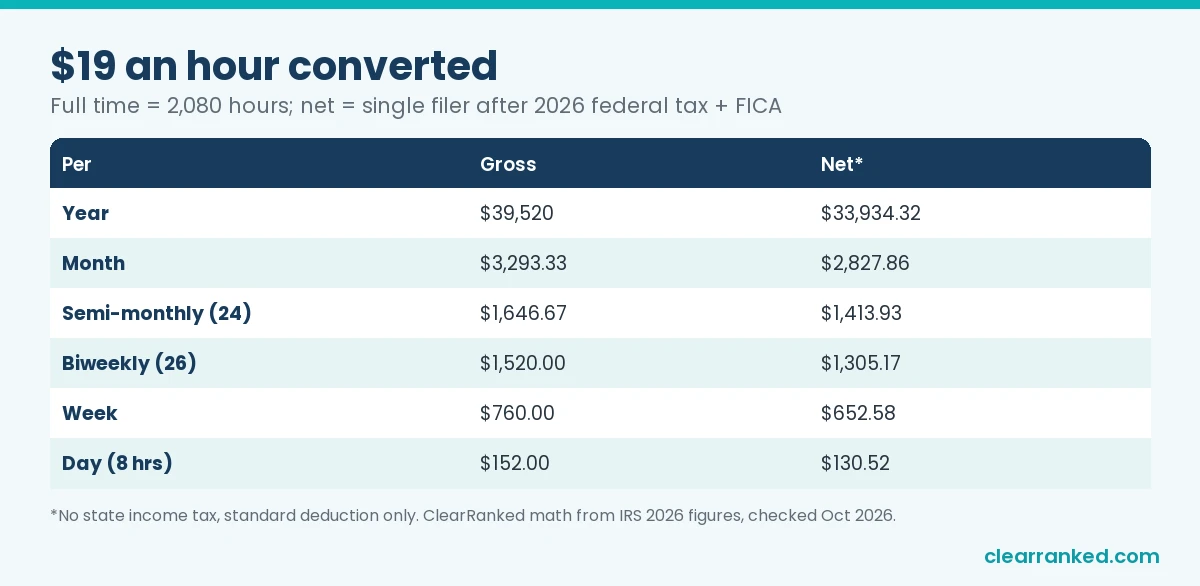
$19 an hour is $39,520 a year before taxes for a 40-hour week worked all 52 weeks (2,080 hours). That’s $3,293.33 a month, $1,520 per biweekly check and $760 a week. After 2026 federal income tax and FICA, a single filer in a state with no income tax keeps about $33,934, or $652.58 a week.
For many people, $19 is a step up: the first raise past a state minimum, or the base rate at a warehouse, hospital or call center. And at those jobs, the base rate often isn’t the whole story. Night and weekend differentials, overtime and a second earner in the house can change the yearly figure a lot.
So after the standard conversion and tax math, this guide looks at shift pay. You’ll see what a $1 or $2 differential is worth, how overtime must be figured when one applies, and what happens when two people each earn $19 an hour.
How we researched this: brackets and the standard deduction come from the IRS 2026 inflation adjustment release. FICA rates come from IRS Publication 15. Overtime and regular-rate rules come from 29 U.S.C. 207, and minimum wages from federal law and Washington L&I. Everything was checked in October 2026.
Key takeaways
- $19 an hour = $39,520 a year, $3,293.33 a month, $760 a week.
- Single take-home after federal taxes: about $33,934, which is $16.31 per paid hour.
- A $2 night differential raises a full-time year to $43,680.
- When you earn a differential, overtime must be based on your blended rate, not your $19 base.
- Two earners at $19 make $79,040 together and keep about $67,869 filing jointly.
How much is $19 an hour a year?
19 an hour is how much a year? $39,520 at full time. Multiply $19 by 40 hours to get $760 a week, then by 52 weeks. Monthly, it averages $3,293.33. If you’re paid twice a month, each check is $1,646.67; if you’re paid every two weeks, it’s $1,520.
Hours change everything at this wage, so here’s the same rate on other schedules.
| Weekly hours | Weekly pay | Yearly pay |
|---|---|---|
| 16 (two shifts) | $304 | $15,808 |
| 24 (three shifts) | $456 | $23,712 |
| 30 | $570 | $29,640 |
| 36 (three 12s) | $684 | $35,568 |
| 40 | $760 | $39,520 |
A $40,000 salary works out to $19.23 an hour, so $19 hourly and a $40K salary are nearly the same deal on paper. The difference shows up in long weeks: the hourly worker usually gets overtime, and an exempt salaried worker doesn’t.
How much is $19 an hour after taxes?
About $33,934 a year for a single filer, or $2,827.86 a month. Federal income tax is $2,562.40, about 6.5% of gross. Social Security takes $2,450.24 and Medicare $573.04. In other words, you keep about $16.31 of every $19 you earn.
The math is short. Subtract the $16,100 standard deduction from $39,520 and you have $23,420 of taxable income. The first $12,400 is taxed at 10% ($1,240) and the remaining $11,020 at 12% ($1,322.40). That’s $2,562.40 of federal income tax.
Then 6.2% Social Security and 1.45% Medicare come out of every dollar, $3,023.28 together. State income tax, if your state has one, is extra. These are planning estimates, and a CPA can check them against your own situation.
One bonus at this income: you’re under the 2026 Saver’s Credit limit of $40,250 for single filers without doing anything. So money you put in a Roth or traditional IRA, up to $2,000, can earn a federal credit on top of the savings itself.
What does a shift differential add to $19 an hour?
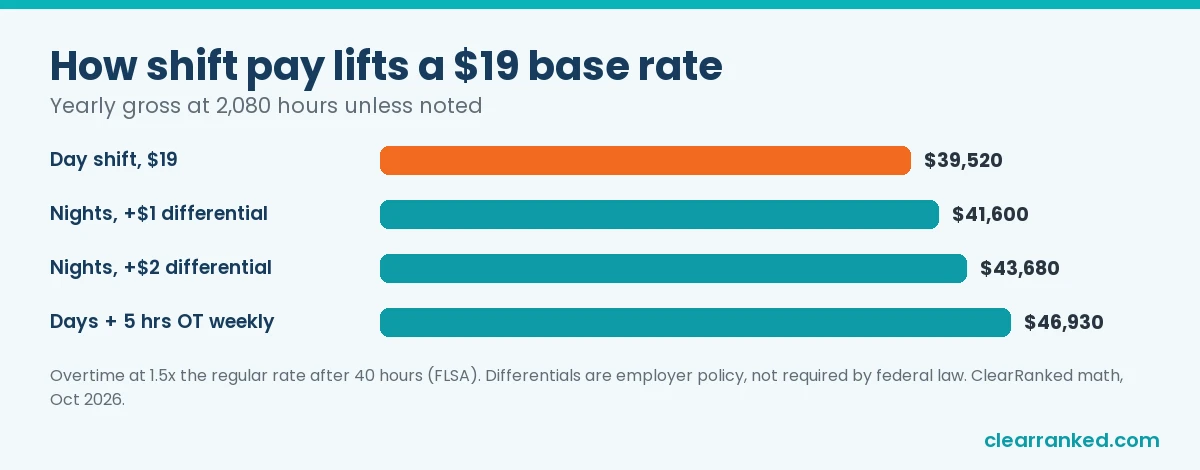
A $1 night differential turns $19 into $20 an hour, worth $2,080 more over a full-time year. A $2 differential means $21 an hour and $43,680 a year, $4,160 above the day rate. Weekend or holiday premiums add more, though employers set those, not federal law.
Federal law doesn’t require shift differentials at all. They’re a recruiting tool. Hospitals, factories, warehouses and security firms use them to staff nights, and they’re usually a flat amount per hour, sometimes a percentage.
| Schedule at $19 base | Hourly pay | Yearly gross (2,080 hrs) | Extra vs days |
|---|---|---|---|
| Day shift | $19.00 | $39,520 | $0 |
| Nights, +$1 | $20.00 | $41,600 | $2,080 |
| Nights, +$1.50 | $20.50 | $42,640 | $3,120 |
| Nights, +$2 | $21.00 | $43,680 | $4,160 |
Is the night shift worth it? That’s personal. Sleep, childcare and health all count, and a $2 differential is worth about $3,343 a year after federal taxes, roughly $279 a month. For some people that’s worth it, and for others it isn’t. Our guide to second shift hours covers how shifts are usually split.
How is overtime calculated at $19 an hour with a differential?
Overtime must be paid at 1.5 times your regular rate, and the regular rate includes shift differentials. So if part of your week is paid at a higher night rate, the overtime premium is based on your blended average for the week, not your $19 base. Getting this wrong shorts workers a few dollars every week.
The rule comes from 29 U.S.C. 207(e), which says the regular rate includes all pay for the work, apart from a short list of exclusions such as gifts. Shift differentials aren’t on that list.
A worked example
- You work 50 hours: 25 day hours at $19 and 25 night hours at $22 (a $3 differential).
- Straight-time pay: 25 x $19 + 25 x $22 = $475 + $550 = $1,025.
- Regular rate: $1,025 / 50 hours = $20.50.
- Overtime premium: half of $20.50, times 10 overtime hours = $102.50.
- Total for the week: $1,025 + $102.50 = $1,127.50.
If payroll figured the premium on the $19 base instead, it would pay $95, or $7.50 less. That sounds small. Over 52 weeks like that, though, it’s $390 owed to one worker, and multiplied across a crew it’s the kind of mistake that triggers back-pay claims.
Business owners, our overtime pay guide explains the regular rate in more depth, and the overtime calculator handles mixed-rate weeks. Workers, the simpler case still applies: at a flat $19, overtime is $28.50 an hour, so five extra hours a week adds $7,410 a year.
What if two people in the house each earn $19 an hour?
Together you’d make $79,040 a year. Filing jointly, federal income tax is about $5,125 and FICA about $6,047, so the household keeps roughly $67,869, or $5,656 a month. All of that taxable income stays in the 12% joint bracket.
The joint standard deduction is $32,200, which leaves $46,840 taxable. Tax is 10% of the first $24,800 ($2,480) plus 12% of the remaining $22,040 ($2,644.80). Notice the household pays exactly double what one single $19 earner pays. That’s because joint brackets are twice the single ones in this range.
With children, the $2,200 child tax credit per child cuts that bill further. Two kids would bring federal income tax down to about $725. The earned income credit is a different story: at $79,040, a married couple with two children is past the 2026 phase-out of $65,899, so it doesn’t apply.
Want to see how a single parent at a slightly higher wage fares? Our $21-an-hour guide runs the credit math for one- and two-child households.
Is $19 an hour good pay?
It’s a working wage, but below the national middle. The BLS all-jobs median was $24.51 an hour in May 2025, so $19 sits about 22% under it. It’s 2.6 times the $7.25 federal minimum and $1.27 above Washington’s 2027 minimum of $17.73.
The federal floor, set in 29 U.S.C. 206, hasn’t moved since 2009, while many states index theirs every year. Washington’s L&I has already set $17.73 for 2027. In high-minimum states, $19 is close to entry level. Our Florida minimum wage guide shows how another large state handles its rate, and how quickly those floors have climbed toward $19.
Employers hiring at $19 should also budget for the payroll taxes on top. Matching Social Security and Medicare adds 7.65%, or $3,023.28 a year per full-time worker, before unemployment insurance and workers’ comp. That puts the true hourly cost above $20.45 before any benefits.
The fastest ways up from $19 are usually a differential, overtime, a certification or a job change. Even $1 more is $2,080 a year before tax. And if you’re comparing offers, check paid time off too, since unpaid holidays at $19 cost $152 each.
How much is $19 an hour biweekly after taxes?
About $1,305 every two weeks for a single filer, after 2026 federal income tax and FICA. A married worker filing jointly as the only earner keeps about $1,376 per biweekly check.
| Pay schedule | Gross per check | Net, single | Net, married jointly |
|---|---|---|---|
| Weekly (52) | $760.00 | $652.58 | $687.78 |
| Biweekly (26) | $1,520.00 | $1,305.17 | $1,375.57 |
| Twice a month (24) | $1,646.67 | $1,413.93 | $1,490.20 |
| Monthly (12) | $3,293.33 | $2,827.86 | $2,980.39 |
The married column is higher because the 2026 joint standard deduction is $32,200, double the single amount. On $39,520 that leaves only $7,320 of taxable income, all in the 10% bracket, so federal income tax drops to $732 a year. FICA doesn’t change: it’s still $3,023.28, since Social Security and Medicare ignore filing status.
Your real check will run a little lower if you pay state income tax, health premiums or 401(k) deferrals. Plug those into our paycheck calculator to see the exact figure.
Related guides
- $20 an hour: take-home and gig pay
- $21 an hour: weekly pay and credits
- How overtime pay works
- Second shift hours and pay
- Florida minimum wage
- Hourly to salary chart
FAQ
$39,520 before taxes, based on 40 hours a week for 52 weeks (2,080 hours).
About $33,934 a year for a single filer with no state income tax in 2026, or $2,828 a month. Federal income tax is about $2,562 and FICA $3,023.
$1,520 gross every two weeks, or about $1,305 after federal taxes for a single filer.
$28.50 an hour, which is 1.5 times $19. If you also earn a shift differential, the overtime rate is based on your blended regular rate for the week.
Close. It’s $39,520 at full time. A $40,000 salary equals about $19.23 an hour.
At 30 hours a week it’s $570 a week or $29,640 a year. At 24 hours it’s $456 a week or $23,712 a year.
About the author
I’m Ali Hassan, the founder of ClearRanked. Also, I run small businesses myself, and I know how much time goes into payroll, pay math and HR rules. ClearRanked is where I share plain-English guides and honest comparisons, so small business owners can make decisions with confidence instead of guesswork.
How we work: this guide is research-based, and every source in it was checked in October 2026. We don’t take payment for rankings, and we update guides when laws or prices change. Finally, read more on our About page.