$40 an Hour Is How Much a Year? 2026 Salary and Take-Home Pay
$40 an hour is $83,200 a year before taxes on a full-time schedule of 40 hours a week for 52 weeks (2,080 hours). Per month that’s $6,933.33, per two-week paycheck $3,200, and per week $1,600. A single filer in a state without income tax should net roughly $67,361 a year after 2026 federal tax, Social Security and Medicare.
Getting to $83,200 is simple multiplication. The harder question is what actually reaches your checking account. At this wage you cross into the 22% federal bracket, and your state can swing the answer by thousands.
Picture a staff accountant in Dallas and one in Chicago, both paid $40 an hour. Same job, same hours. The Texan keeps about $4,100 more a year, purely because of where the paycheck is taxed. We’ll show you exactly why.
How we researched this: brackets and the standard deduction come from the IRS release on 2026 inflation adjustments, payroll tax rates from Publication 15 (Circular E), and job and wage figures from the BLS Occupational Employment and Wage Statistics plus the Current Population Survey. We checked all of it in October 2026.
Key takeaways
- Gross: $83,200 a year, $6,933.33 a month, $1,600 a week.
- Net (single, no state tax): about $67,361, after $9,474 in federal income tax and $6,365 in FICA.
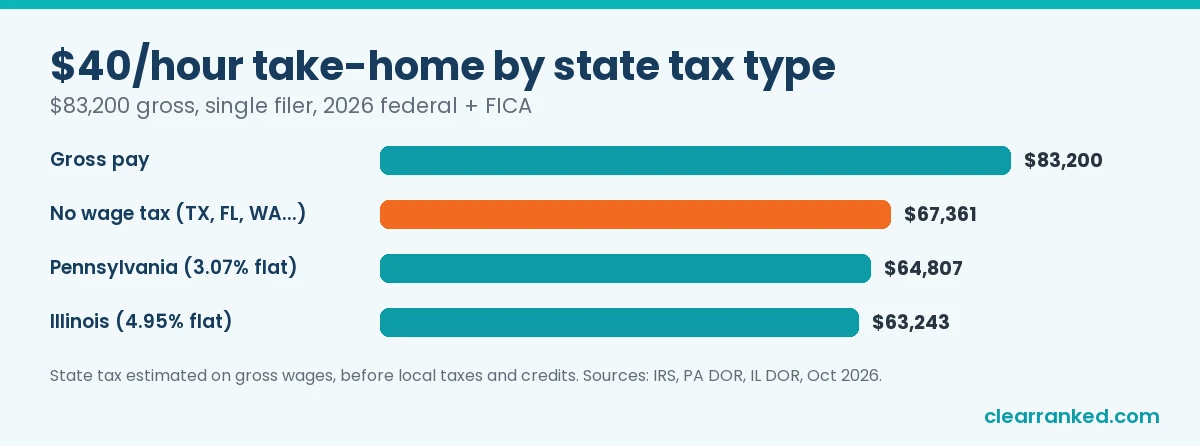
- Pennsylvania residents keep roughly $64,807; Illinois residents about $63,243.
- You’d out-earn the typical full-time US worker by about 30%.
- Accountants and auditors sit right at this rate, with a $40.23 median in May 2025.

$40 an hour is how much a year before taxes?
It’s $83,200. Take $40, multiply by 40 hours to get $1,600 for the week, then multiply by 52 weeks. That total assumes your holidays and vacation days are paid. If they aren’t, knock off $1,600 for every unpaid week.
Payroll schedules slice that yearly figure differently, so your check size depends on how often you’re paid:
| How often you’re paid | Checks per year | Each gross check |
|---|---|---|
| Every week | 52 | $1,600.00 |
| Every two weeks | 26 | $3,200.00 |
| Twice a month | 24 | $3,466.67 |
| Once a month | 12 | $6,933.33 |
Here’s a budgeting trap. Biweekly pay gives you 26 checks, so two months a year you’ll get three. Don’t build your rent plan on $6,400 a month (two checks). Use $6,933.33, the true monthly average. Our explainer on weekly, biweekly and semi-monthly pay schedules goes deeper.
What’s left of $40 an hour after 2026 taxes?
Roughly $67,361 a year for a single filer, which is about $5,613 a month or $2,591 per biweekly check. Federal income tax runs $9,474 and FICA $6,365, together about 19% of gross. State tax, if you have it, comes on top.
The IRS doesn’t tax your first $16,100. That’s the 2026 standard deduction for single filers, and it shrinks your taxable income to $67,100. Then the brackets work like stacked buckets, each with its own rate:
| Bucket of taxable income | Rate | Tax from this bucket |
|---|---|---|
| $0 to $12,400 | 10% | $1,240 |
| $12,400 to $50,400 | 12% | $4,560 |
| $50,400 to $67,100 | 22% | $3,674 |
| Total federal income tax | $9,474 |
So only $16,700 of your income is taxed at 22%. Your effective federal income tax rate is about 11.4%, a lot friendlier than the 22% people fear when they hear their bracket.
Social Security takes 6.2% ($5,158.40) and Medicare 1.45% ($1,206.40). You won’t hit the Social Security cap; it’s $184,500 for 2026. This assumes one job and no other income. Your own CPA can adjust this for your situation.
Does your state change $40-an-hour take-home much?
Yes, by up to about $4,100 a year in our examples. No state wage tax leaves you roughly $67,361. Pennsylvania’s 3.07% flat rate drops that to about $64,807. Illinois, at 4.95%, brings it to about $63,243.
Which states skip the income tax? Per the Tax Foundation, it’s Alaska, Florida, Nevada, New Hampshire, South Dakota, Tennessee, Texas and Wyoming. Washington is a ninth for practical purposes, since it taxes capital gains but not paychecks.
Our state math is deliberately rough. We multiplied $83,200 by Pennsylvania‘s 3.07% ($2,554) and by Illinois‘s 4.95% ($4,118). Real bills shift with exemptions, credits and local wage taxes, and Pennsylvania towns often add their own.
Don’t move for the tax savings alone, though. Texas and Florida lean harder on property and sales taxes. If you’re in Florida, plug your numbers into our Florida take-home pay calculator.
Is $40 an hour good money in the US?
Yes. The BLS put median weekly pay for full-time workers at $1,232 in the third quarter of 2026, roughly $64,064 a year. At $1,600 a week, you’d be about 30% ahead. Against the all-jobs median of $24.51 an hour, $40 is far above the middle.
Why two different medians? The $1,232 figure only counts full-timers. The $24.51 figure, from a separate survey, includes part-time jobs, which drags it down. Either way, $40 lands comfortably in the upper half.
My honest take: $40 an hour feels wealthy in Tulsa and merely fine in San Jose. Rent decides it. So test the take-home number, not the gross, against your local housing costs before you call it good.
Run a business? Remember the wage isn’t your full cost. You’ll also owe 7.65% employer FICA, about $6,365 on $83,200, plus unemployment taxes and whatever benefits you offer.
Who earns about $40 an hour?
Accountants and auditors are the closest match, with a $40.23 median hourly wage in the May 2025 BLS survey. Executive assistants ($36.82), patrol officers ($36.64) and HR specialists ($36.51) sit a few dollars lower. Registered nurses come in higher, at $46.90.
- Registered nurses: $46.90 median, or about $97,552 on a 2,080-hour year
- Accountants and auditors: $40.23, about $83,678
- Executive secretaries and executive administrative assistants: $36.82, about $76,586
- Police and sheriff’s patrol officers: $36.64, about $76,211
- Human resources specialists: $36.51, about $75,941
A median is just the midpoint, so plenty of people in each role earn well above or below it. City, experience and certifications move pay a lot.
Many of these jobs are salaried. If you’re exempt, a 50-hour week still pays the same, which quietly cuts your hourly rate. Not sure where you stand? Read our breakdown of exempt and non-exempt status.
Sitting at $38 and pushing for $40? That $2 bump is $4,160 a year before tax. Because those extra dollars land in the 22% bracket and still owe 7.65% FICA, you’d keep roughly $2,926 of it. Smaller than it sounds, sure, but it compounds with every future raise, since most raises are a percentage of your current rate.
What if your hours aren’t a clean 40 a week?
Then recalculate. Thirty hours a week at $40 pays $62,400 a year. Taking two weeks unpaid drops a full-time year to $80,000. Overtime goes the other way: non-exempt hours past 40 pay at least $60 each, so five extra hours a week adds $15,600 a year.
| Your schedule | The math | Yearly total |
|---|---|---|
| Half time, 20 hrs | $40 x 20 x 52 | $41,600 |
| 30 hrs a week | $40 x 30 x 52 | $62,400 |
| Four-day, 32 hrs | $40 x 32 x 52 | $66,560 |
| 40 hrs, 2 weeks unpaid | $40 x 40 x 50 | $80,000 |
| 45 hrs with overtime | ($1,600 + $300) x 52 | $98,800 |
The overtime premium comes from the Fair Labor Standards Act, which requires time and a half after 40 hours in a workweek. Try our overtime pay calculator for odd weeks, and the time card calculator if you need to total shifts first.
How can you keep more of $40 an hour?
Start with a traditional 401(k). Because your top federal rate is 22%, a $1,000 contribution trims your federal tax by about $220. Put 10% of pay ($8,320) in, and your 2026 federal bill falls by roughly $1,830.
FICA still applies to 401(k) money, and you’re locking it up until retirement. Still, I think it’s the best tax deal most hourly earners get. The 2026 deferral cap is $24,500, set by the IRS.
- Got a second job or a working spouse? Update your W-4 so withholding doesn’t fall short.
- Use pre-tax health premiums, an HSA or an FSA if your employer offers them.
- If you’re non-exempt and work overtime, the 2025 to 2028 overtime deduction can shelter the premium half of that pay.
- Save your pay stubs. Payroll mistakes happen, and stubs are how you catch them.
Related guides
- Pay periods per year, explained
- Florida paycheck calculator
- Hours worked calculator
- Exempt vs non-exempt: who gets overtime
- Overtime calculator
- Every ClearRanked calculator
FAQ
$83,200 before taxes, assuming 40 paid hours every week of the year.
Roughly $67,361 for a single filer with no state income tax, using 2026 federal brackets and FICA. That’s near $5,613 a month.
$3,200 gross. A single filer nets around $2,591 per check after federal tax and FICA.
$6,933.33 gross on average, since $83,200 divided by 12 months gives that figure.
The 22% bracket for a single filer in 2026, though only $16,700 of income is taxed at that rate. The effective federal income tax rate is about 11.4%.
Yes by national data. It beats the BLS full-time median of $1,232 a week by roughly 30%, though local housing costs decide how far it stretches.
$62,400 a year, or $1,200 a week, before taxes.
About the author
I’m Ali Hassan, the founder of ClearRanked. Also, I run small businesses myself, and I know how much time goes into payroll, pay math and HR rules. ClearRanked is where I share plain-English guides and honest comparisons, so small business owners can make decisions with confidence instead of guesswork.
How we work: this guide is research-based, and every source in it was checked in October 2026. We don’t take payment for rankings, and we update guides when laws or prices change. Finally, read more on our About page.