What Are Pay Stubs? How to Read One (2026 Guide + Template)
What are pay stubs? They’re the written breakdown that comes with each paycheck. They show your gross pay, every tax and deduction taken out, and the net amount you actually receive, plus year-to-date totals. For example, a $2,000 biweekly check for a single worker in 2026, with no state income tax in the picture, can shrink to about $1,620 after taxes and a 4% 401(k).
If you own a small business, the stub is also your proof. It shows the employee, and anyone who audits you later, exactly how you got from the hourly rate to the deposit. So a sloppy stub isn’t just ugly. It’s a payroll error waiting to be found.
This guide walks through each section of a stub, shows a real 2026 calculation line by line, and gives you a template layout you can copy into a spreadsheet or check against your payroll software.
How we researched this: the tax rates come from IRS Topic 751, the withholding math uses the IRS Publication 15-T for 2026, and the recordkeeping rules come from Publication 15 and the federal 29 CFR Part 516. Each figure was rechecked in October 2026.
Key takeaways
- A pay stub lists gross pay, pre-tax deductions, taxes, post-tax deductions and net pay for one pay period, plus year-to-date totals.
- For 2026, both the worker and the business pay Social Security at 6.2% (until wages reach $184,500) and Medicare at 1.45% with no ceiling.
- A 401(k) deferral lowers federal income tax withholding, but Social Security and Medicare still apply to that money.
- Federal wage law requires payroll records, not a stub handed to the worker. Many states add their own pay statement rules.
- Keep employment tax records for at least 4 years, per IRS Publication 15.
What are pay stubs, and what do they include?
A pay stub is a statement attached to a paycheck or sent with a direct deposit. It records the pay period, hours and rate, gross earnings, each deduction and withholding, and net pay. Most stubs also show running year-to-date totals, which is how employees and lenders check income without waiting for a W-2.
Think of the stub as a receipt that reads top to bottom. Earnings start at the top. Then money leaves in a fixed order: pre-tax deductions, taxes, and finally after-tax deductions. Whatever is left is net pay.
Here are the blocks you’ll find on almost every stub, whatever software printed it:
- Header: employer name and address, employee name, the last four digits of an ID, pay date and the pay period start and end dates.
- Earnings: regular hours, overtime hours, rates, plus any bonus, commission, tips or holiday pay.
- Pre-tax deductions: traditional 401(k), Section 125 health premiums, HSA or FSA contributions.
- Taxes: federal income tax, Social Security, Medicare, and state or local income tax where it applies.
- Post-tax deductions: Roth 401(k), wage garnishments, union dues, loan repayments.
- Net pay and YTD: the take-home amount and the totals for the calendar year so far.
How do you read a pay stub line by line?
Start with gross pay and confirm hours times rate. Next, check that pre-tax deductions match what you signed up for. Then scan the taxes: Social Security should be 6.2% and Medicare 1.45% of the taxable wages. Finally, subtract everything from gross and confirm it equals the net pay shown.
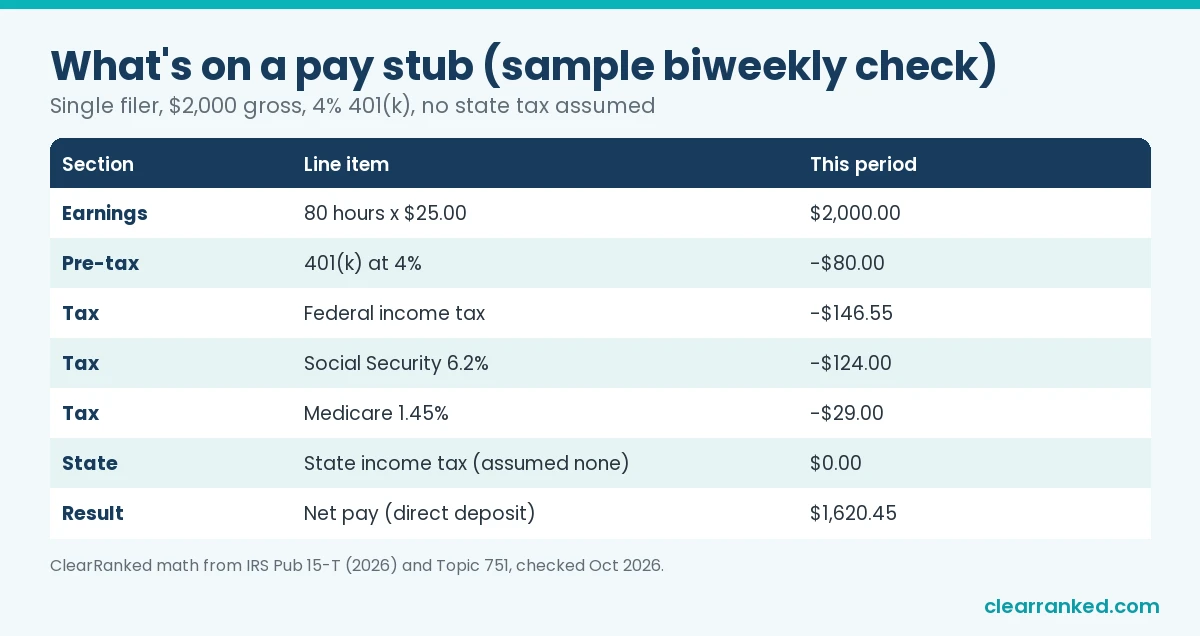
Let’s do it with a real number. Picture Maria, a front-desk worker at a 6-person dental office. She earns $25 an hour, works 80 hours in a two-week period, and puts 4% of pay into the office 401(k). Her 2026 Form W-4 says single, with no other boxes filled in.
- Gross pay: 80 hours x $25 = $2,000.00.
- 401(k): $2,000 x 4% = $80.00. That leaves $1,920 of wages for federal income tax.
- Federal income tax: $1,920 x 26 pay periods = $49,920 a year. Subtract the $8,600 single adjustment from Pub 15-T: $41,320. The 2026 single table taxes $1,240 on the first $19,900, plus 12% of the next $21,420 ($2,570.40). Total $3,810.40 a year, divided by 26 = $146.55.
- Social Security: $2,000 x 6.2% = $124.00. Notice it’s figured on the full $2,000, because 401(k) deferrals don’t escape FICA.
- Medicare: $2,000 x 1.45% = $29.00.
- State tax: $0 in this example, because we assume she works in a state without a wage income tax. If yours has one, it appears on this line (Florida owners can check does Florida have state income tax?).
- Net pay: $2,000 – $80 – $146.55 – $124 – $29 = $1,620.45.
If her stub showed $1,580, you’d know something is off. Maybe the 401(k) was set to 6%, or payroll used an old W-4. Spotting that in one pay period is far easier than fixing it at year end.

What taxes come out of a paycheck in 2026?
In 2026, workers lose 6.2% of pay to Social Security until their wages hit $184,500 for the year, 1.45% to Medicare on every dollar, and an extra 0.9% Medicare once wages pass $200,000 in the year. Federal income tax withholding depends on the Form W-4 and the IRS tables. State and local tax depends on where the person works.
| Tax line on the stub | Employee rate (2026) | Employer also pays? | Cap |
|---|---|---|---|
| Social Security (OASDI) | 6.2% | Yes, 6.2% | First $184,500 of wages |
| Medicare | 1.45% | Yes, 1.45% | No cap |
| Additional Medicare | 0.9% | No | Wages over $200,000 |
| Federal income tax | Per W-4 and Pub 15-T | No | Bracket based |
| State or local income tax | Varies by state | No | Varies |
One quirk trips up a lot of owners. The employer half of Social Security and Medicare doesn’t appear as a deduction on the worker’s stub, because it isn’t taken from their pay. Some payroll systems list it in a separate “employer taxes” box anyway, which is helpful for your own budgeting.
Also, high earners will see the Social Security line drop to zero late in the year. That happens once year-to-date wages hit $184,500. It’s not a mistake, and it often confuses salaried managers in November.
What do FICA, OASDI and FIT mean on my paycheck?
FICA is the Social Security and Medicare tax, OASDI is the Social Security part of it, and FIT is your federal income tax withholding. Payroll software shortens these to fit on one line, so the same tax can show up under three different names depending on who runs your payroll.
| Code on the stub | What it is | 2026 employee rate |
|---|---|---|
| FICA | Federal Insurance Contributions Act: Social Security plus Medicare | 7.65% in total |
| OASDI, Fed OASDI/EE, SS | Old-Age, Survivors and Disability Insurance (Social Security) | 6.2% on wages up to $184,500 |
| MED, Fed MED/EE | Medicare | 1.45%, plus 0.9% on wages over $200,000 |
| FIT, FWT, Fed W/H | Federal income tax withheld | Depends on your W-4 and pay |
| SIT, SWT | State income tax withheld | 0% in Texas, Florida and the other no-tax states |
| SDI, FLI, PFL | State disability or paid family leave | Only in states that run these programs |
The “EE” on some stubs means employee. Your employer pays its own matching 6.2% and 1.45%, but that half never shows as a deduction from your pay. If OASDI suddenly disappears late in the year, you have probably passed the $184,500 Social Security wage base, and it starts again in January.
FIT is the line people question most, because it changes with every raise, bonus and W-4 update. If it looks too high or too low, check the filing status and extra withholding on your W-4 first, then run your numbers through a paycheck calculator.
Are employers required to give pay stubs?
Federal law doesn’t require a pay stub. The Fair Labor Standards Act rules in 29 CFR Part 516 require you to keep detailed payroll records, such as hours, pay rate, deductions and pay dates. However, many states require a written or electronic wage statement every payday, so check your state labor department.
The federal record list is long. It covers the employee’s full name and address, the start of the workweek, daily and weekly hours, straight-time and overtime earnings, every addition or deduction, total wages, and the pay date and period. A good stub already contains most of that, which is why it doubles as a record.
Retention rules stack, too. Part 516 says core payroll records stay for at least 3 years and supporting time cards for 2 years. Meanwhile, IRS Publication 15 asks you to keep employment tax records for at least 4 years. In practice, keep four years of everything and you won’t have to remember which rule is which.
Our opinion? Give stubs even if your state doesn’t force you. It costs nothing once payroll is set up, and it heads off the most common employee complaint: “Why is my check smaller this time?” Check with an employment attorney or CPA for your state’s exact wording.
What should a paycheck stub template include?
A usable paycheck stub template needs a header with employer and employee details, the pay period and pay date, an earnings table with hours and rates, separate sections for pre-tax deductions, taxes and post-tax deductions, net pay, and a year-to-date column next to every line.
If you build one in a spreadsheet, set it up like this:
| Template block | Columns to include | Tip |
|---|---|---|
| Header | Business name, employee name, pay date, period | Show only the last 4 of any ID |
| Earnings | Type, hours, rate, current, YTD | Separate regular and overtime rows |
| Pre-tax deductions | 401(k), Section 125 health, HSA | List before taxes, not after |
| Taxes | Federal, Social Security, Medicare, state | Show the taxable wage base used |
| Post-tax deductions | Roth 401(k), garnishments, dues | Note the order a court requires |
| Summary | Gross, total deductions, net, YTD net | Net should match the deposit |
Here’s the catch with homemade templates. The math for federal withholding changes every year, and a spreadsheet won’t update itself. For one or two employees that’s manageable. For a 12-person roofing crew with overtime every week, it’s a liability. Most owners at that size move to software; the one-employee payroll roundup covers the cheaper options, and how to set up payroll covers the steps.
Never use an online “stub generator” to create stubs for pay that wasn’t actually run through payroll. Lenders and landlords verify income, and a fake stub can turn into fraud. Real stubs come from a real payroll run.
Why doesn’t my pay stub match what I expected?
Most mismatches come from four places: a changed Form W-4, a new or changed benefit deduction, overtime or a bonus taxed at a different rate, or the Social Security cap being hit. Compare the current column with last period’s line by line. The changed row usually explains the whole gap.
Bonuses deserve their own note. When a bonus is paid separately, employers can withhold federal tax at a flat 22% under the supplemental wage rules, so a $1,000 bonus often shows $220 of federal withholding before FICA. You can test numbers with our bonus tax calculator.
Overtime is the other big one. Time-and-a-half pushes gross up, and withholding rises with it, since the tables annualize each check. A worker who logs 10 extra hours at $25 earns $375 more gross, but they won’t see $375 more in the bank. Run the gross side through our overtime calculator first.
Finally, if you’re the employee and the math still looks wrong after all that, ask payroll for the calculation in writing. You’re entitled to understand your own pay.
How long should you keep pay stubs?
Employees should keep each stub until it matches their Form W-2, then keep the final December stub with that year’s tax return. Employers should keep payroll records for at least 4 years to satisfy IRS Publication 15, which also covers the 3-year and 2-year federal wage-law rules.
Digital is fine. A PDF in a dated folder beats a shoebox, and most payroll portals keep years of stubs online. Just download them before you leave a job, because access often ends with your last day.
Related guides
- Setting up payroll, step by step
- Weekly, biweekly or semimonthly: pay periods per year
- W-4 or W-2? The difference for employers
- Overtime pay rules explained
- Payroll services for one employee
FAQ
Pay stubs show how gross pay became net pay for one period. Employees use them to check their pay and prove income to lenders or landlords, and employers use them as part of their payroll records.
No. The paycheck or direct deposit is the money itself. The pay stub is the statement that explains it, listing earnings, taxes, deductions and year-to-date totals.
YTD means year to date. It is the running total for each line since January 1, so the December stub should closely match the amounts on your Form W-2.
In 2026, Social Security tax stops once your wages for the year reach $184,500. After that, only Medicare continues, so the Social Security line shows zero for the rest of the year.
Federal law requires payroll records but not a stub for the employee. Many states do require a wage statement each payday, so check your state labor department for the exact rule.
Keep them at least until they match your W-2, then keep the final stub of the year with your tax records. Employers should keep payroll records for at least 4 years.
About the author
I’m Ali Hassan, the founder of ClearRanked. Also, I run small businesses myself, and I know how much time goes into payroll, pay stubs and pay math. ClearRanked is where I share plain-English guides and honest comparisons, so small business owners can make decisions with confidence instead of guesswork.
How we work: this guide is research-based, and every source in it was checked in October 2026. We don’t take payment for rankings, and we update guides when laws or prices change. Finally, read more on our About page.