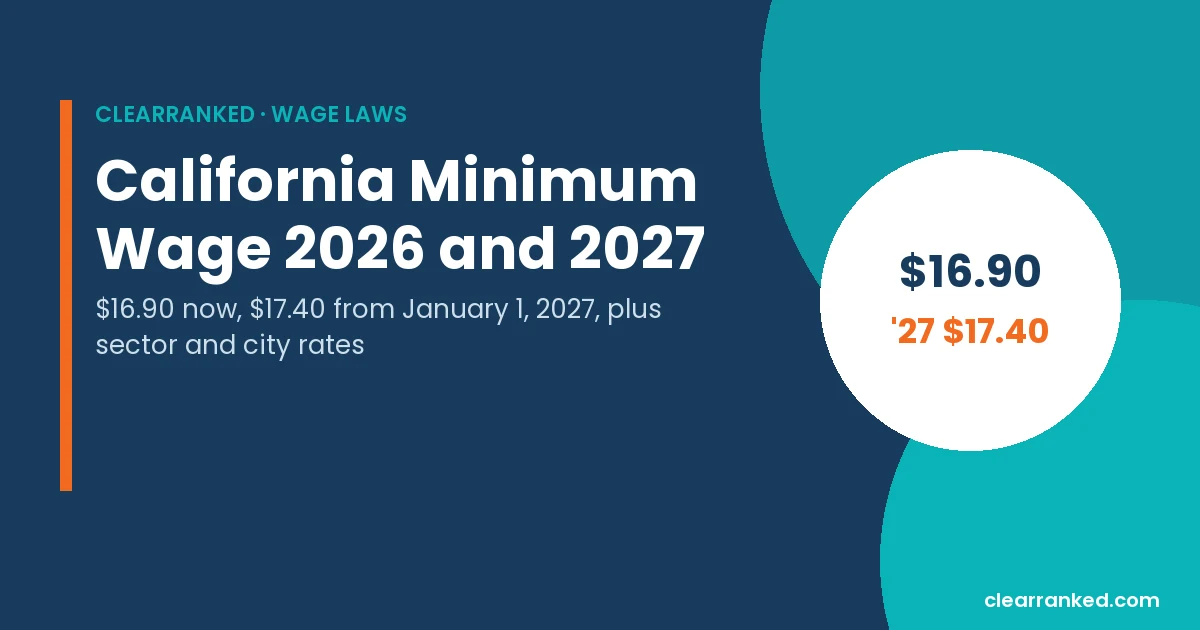
California Minimum Wage: $16.90 in 2026, $17.40 in 2027
The California minimum wage is $16.90 an hour for 2026, and it rises to $17.40 an hour on January 1, 2027. That’s $35,152 a year for a full-time worker now and $36,192 next year. However, many workers earn more by law: fast food chain staff get $20.00, large health systems pay $25.00, and dozens of cities set their own higher rates.
So the real question for a California employer isn’t just what the state rate is. It’s which of several minimums applies to each person on your payroll. A barista in Hayward, a cook at a national burger chain in Fresno and a medical assistant at a big hospital system can all be minimum wage workers with three different hourly floors.
This guide sorts those layers out in order: state, sector, then city. Then it covers the daily overtime rule that trips up owners who moved from other states, the exempt salary test, and what you have to post on the wall.
How we researched this: the state rate and rules come from the Labor Commissioner’s minimum wage FAQ on DIR, the 2027 rate from the Governor’s July 31, 2026 announcement, sector rates from DIR’s fast food and health care worker FAQs, and city rates from the UC Berkeley Labor Center inventory that DIR itself links to. DIR’s site doesn’t load from our network, so we read its pages through dated web.archive.org copies from October and November 2026. This is general information, not legal advice.
Key takeaways
- The statewide minimum is $16.90 per hour for all employers in 2026, with no small-business discount.
- It goes to $17.40 per hour on January 1, 2027, under the automatic inflation adjustment.
- California has no tip credit. Tipped staff get the full minimum before tips.
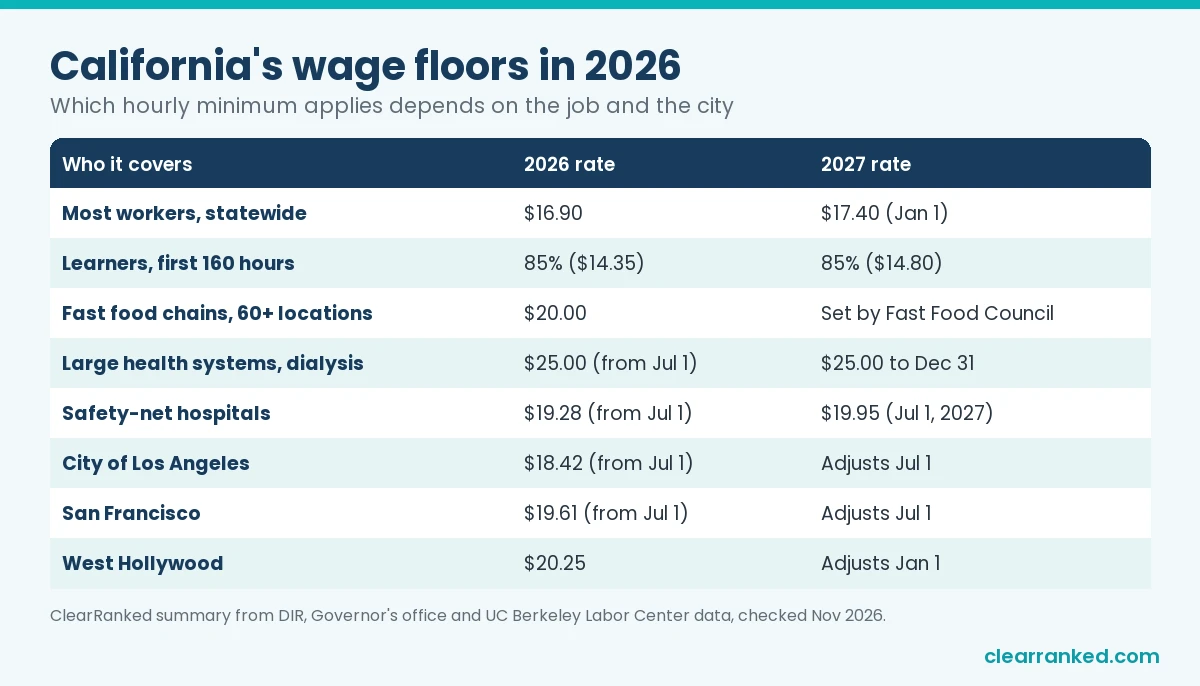
- Covered fast food workers earn at least $20.00, and health care workers earn $19.28 to $25.00 depending on the facility type.
- Cities such as Los Angeles ($18.42), San Francisco ($19.61) and West Hollywood ($20.25) set higher local floors.
- Overtime starts after 8 hours in a day, not just 40 in a week, and double time kicks in after 12.
What is the California minimum wage in 2026?
California’s minimum wage in 2026 is $16.90 per hour. It took effect January 1, 2026 and applies to every employer, whether you have one worker or 1,000. The old two-tier system for employers with 25 or fewer workers ended in 2023, so there’s no lower small-business rate anymore.
Here’s how $16.90 converts into paychecks on a standard 40-hour week. The yearly figure uses 2,080 hours, which is 40 hours times 52 weeks.
| Pay period | Gross pay at $16.90 |
|---|---|
| Hourly | $16.90 |
| Daily (8 hours) | $135.20 |
| Weekly (40 hours) | $676.00 |
| Biweekly | $1,352.00 |
| Semimonthly | $1,464.67 |
| Monthly | $2,929.33 |
| Yearly (2,080 hours) | $35,152.00 |
Those are gross figures before payroll taxes. If you’re deciding between biweekly and semimonthly pay, our pay periods guide shows why the checks differ even at the same rate. And for take-home estimates, try the California income tax calculator.
A few groups can be paid less. The DIR FAQ lists outside salespeople, the parent, spouse or child of the employer, and registered apprentices as exempt. Also, learners with no similar experience can be paid 85% of the minimum, rounded to the nearest nickel, during their first 160 hours. At $16.90, that works out to $14.35. Minors, though, get the same rate as adults.
What will California’s minimum wage be in 2027?
California’s minimum wage will be $17.40 per hour starting January 1, 2027. The Governor’s office announced the rate on July 31, 2026. It’s an automatic increase: state law ties the minimum to the CPI-W inflation index each year, with a 3.5% cap on any single raise and no cuts if prices fall.
The raise is $0.50 an hour, or about 3%. For one full-time worker, that’s $0.50 x 2,080 = $1,040 more in gross wages a year. Payroll taxes and workers’ comp premiums rise with it, so budget a bit more than the wage line alone.
Here’s a quick example. Say you run a car wash in Bakersfield with five workers at the state minimum, each averaging 32 hours a week. The 2027 raise costs $0.50 x 32 x 5 x 52 = $4,160 for the year. That’s not huge, but it’s real money for a small shop, and it lands on the first payroll of January.
Don’t forget the people paid just above the minimum. If your shift leads earn $17.25 today, they’ll fall below the floor on January 1 unless you raise them. Most owners also bump those leads a little so they stay ahead of new hires.
Who gets the $20 fast food minimum wage?
California’s fast food minimum wage of $20.00 an hour has applied since April 1, 2024. It covers workers at limited-service restaurants that belong to a national chain of at least 60 establishments, and it applies to franchisees as well as company-owned stores. A Fast Food Council can raise the rate later.
That 60-location test is the key. A family taqueria with three shops isn’t covered, but a franchise of a national sandwich brand is, even if the franchisee owns only one store. Ghost kitchens selling under a covered chain’s brand can count too, according to the DIR fast food FAQ.
At $20.00, a full-time cook earns $41,600 a year before taxes. Also, managers at covered chains need a higher salary to stay exempt from overtime, because the exempt test is based on twice the applicable minimum wage. DIR’s own example puts that at $83,200 a year for a fast food manager.
Fast food employers must also post a separate minimum wage order supplement for fast food workers, alongside the regular postings.
What is the health care worker minimum wage in California?
California’s health care worker minimum wage ranges from $19.28 to $25.00 an hour in late 2026, depending on the facility type. Large systems with 10,000 or more full-time employees, dialysis clinics and facilities run by large counties pay $25.00 from July 1, 2026. Safety-net hospitals pay $19.28, and other covered sites pay $22.00 or $23.00.
The schedule started October 16, 2024 and steps up every July 1. Here’s where the main categories stand, based on DIR’s table.
| Facility type | Jul 1, 2026 rate | Next step |
|---|---|---|
| Systems with 10,000+ full-time staff | $25.00 | Inflation-adjusted from Jan 1, 2028 |
| Dialysis clinics | $25.00 | Inflation-adjusted from Jan 1, 2028 |
| Large-county facilities (5M+ people) | $25.00 | Inflation-adjusted from Jan 1, 2028 |
| Community and rural clinics | $22.00 | $25.00 on Jul 1, 2027 |
| All other covered facilities | $23.00 | $25.00 on Jul 1, 2028 |
| Safety-net hospitals | $19.28 | $19.95 on Jul 1, 2027 |
The rule covers more than nurses. DIR’s FAQ says it reaches workers who spend more than half of a workweek at a covered facility, which can include janitors, food service staff and front desk workers. So if you’re a contractor sending cleaning crews into a hospital, check the FAQ before you price the bid.
Which California cities have a higher minimum wage?
About 40 California cities and counties set their own minimum wage above the state rate. In 2026, the highest include Emeryville at $20.34, West Hollywood at $20.25, Mountain View at $19.70, and Berkeley and San Francisco at $19.61. Los Angeles pays $18.42 and San Diego pays $17.75. You must pay whichever rate is highest where the work happens.
Timing is the tricky part. Some cities raise rates on January 1 and others on July 1, so your rates can change twice a year. Here’s a sample from the UC Berkeley Labor Center list, which DIR points employers to.
| City or county | Current rate | Effective |
|---|---|---|
| Emeryville | $20.34 | Jul 1, 2026 |
| West Hollywood | $20.25 | Jan 1, 2026 |
| Mountain View | $19.70 | Jan 1, 2026 |
| San Francisco | $19.61 | Jul 1, 2026 |
| Sunnyvale | $19.50 | Jan 1, 2026 |
| San Jose | $18.45 | Jan 1, 2026 |
| Los Angeles (city) | $18.42 | Jul 1, 2026 |
| Los Angeles County (unincorporated) | $18.47 | Jul 1, 2026 |
| San Diego | $17.75 | Jan 1, 2026 |
| Oakland | $17.34 | Jan 1, 2026 |
A few cities split by size. For example, Hayward’s small-employer rate matches the state’s $16.90, while its standard rate is $17.79. Novato has three tiers. So if you’re near a city line, check which side your worksite is on. Workers who travel between cities usually need the local rate for hours worked in each place, which means your timekeeping has to track location, not just hours.

How does overtime work at minimum wage in California?
California requires 1.5 times the regular rate after 8 hours in a workday or 40 in a workweek, and for the first 8 hours on the seventh straight day of work. Double time applies after 12 hours in a day and after 8 hours on that seventh day. At $16.90, that’s $25.35 for overtime and $33.80 for double time.
This daily rule is the one that catches owners who’ve worked in Texas or Nevada. For example, a worker who puts in four 10-hour days totals only 40 hours, yet earns 8 hours of overtime unless you’ve adopted a valid alternative workweek schedule. Here’s the math for one 10-hour day at the state rate:
- First 8 hours: 8 x $16.90 = $135.20
- Hours 9 and 10: 2 x $25.35 = $50.70
- Total for the day: $185.90, compared with $169.00 if you’d paid straight time
Our overtime calculator handles the weekly math, and the state overtime guide compares California’s rules with the rest of the country. According to the DIR overtime FAQ, the daily rule also covers 16- and 17-year-olds who aren’t required to attend school.
How much must a salaried worker earn to be exempt in California?
To be exempt from overtime in California, an executive, administrative or professional employee must earn at least twice the state minimum wage for full-time work. In 2026, that’s $1,352 a week, or $70,304 a year. In 2027, the floor rises to $1,392 a week, or $72,384 a year.
The formula is simple: $16.90 x 2 x 2,080 hours = $70,304. With the 2027 rate, it’s $17.40 x 2 x 2,080 = $72,384. So a manager you pay $71,000 today passes in 2026 but fails on January 1, 2027, and would become eligible for overtime unless you raise the salary.
Salary alone doesn’t make someone exempt, though. The job duties test still applies. Our exempt vs non-exempt guide walks through the duties side, and the hourly to salary converter helps if you’re switching someone’s pay basis.
What happens if a California employer pays less than minimum wage?
A California worker who’s paid below the minimum can file a wage claim with the Labor Commissioner, go to arbitration if an agreement requires it, or sue in court. The worker can recover the unpaid wages plus damages and penalties. The minimum can’t be waived, even by a signed agreement or union contract.
Local ordinances add their own penalties. For instance, the Los Angeles wage office lists added penalties of up to $120 a day to the employee and up to $50 a day to the city for certain violations. Also, retaliating against someone who asks about their pay is illegal under state law.
On the posting side, keep the current state minimum wage order (MW-2026, and MW-2027 once it’s issued) and your industry wage order up where workers can see them. Many cities require their own local poster as well. If you run payroll in more than one city, it’s worth a quarterly check of each city’s page, since the rates don’t all move on the same date. Check with an employment lawyer for your situation.
Related guides
- Overtime pay laws by state
- Exempt vs non-exempt employees
- California paid family leave
- California income tax calculator
- What goes on a pay stub
FAQ
The California minimum wage is $16.90 per hour for all employers in 2026. Some cities and some industries, such as fast food chains and health care facilities, require more.
It will be $17.40 per hour starting January 1, 2027, under the state’s automatic inflation adjustment announced by the Governor on July 31, 2026.
No. California doesn’t allow a tip credit, so tipped workers must get the full minimum wage per hour, and their tips stay on top of that.
Not anymore. Since 2023, every employer pays the same statewide rate, regardless of size. A few cities, such as Hayward and Novato, still have separate small-employer tiers.
At 40 hours a week for 52 weeks, $16.90 an hour equals $35,152 a year before taxes, or about $2,929 a month.
Yes. California makes no distinction between adults and minors. The only reduced rate is for learners in their first 160 hours, at 85% of the minimum.
About the author
I’m Ali Hassan, the founder of ClearRanked. Also, I run small businesses myself, and I know how much time goes into payroll, pay math and wage rules. ClearRanked is where I share plain-English guides and honest comparisons, so small business owners can make decisions with confidence instead of guesswork.
How we work: this guide is research-based, and every source in it was checked in November 2026. We don’t take payment for rankings, and we update guides when laws or prices change. Finally, read more on our About page.