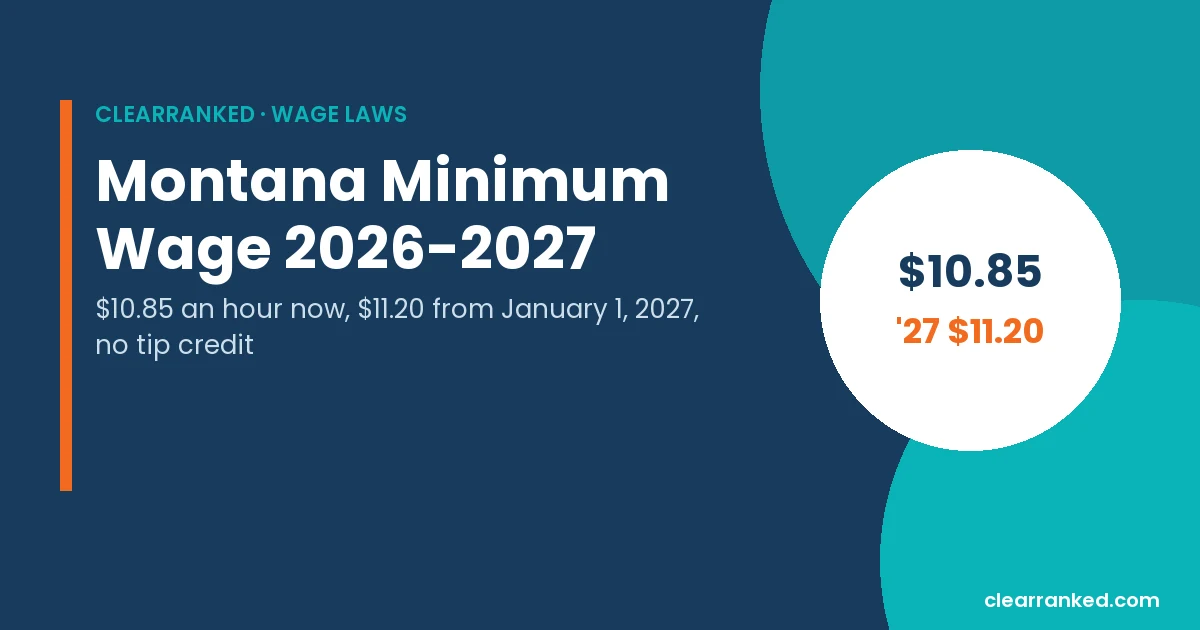
Montana Minimum Wage 2026: $10.85 Now, $11.20 on January 1, 2027
The Montana minimum wage is $10.85 an hour in 2026, and it rises to $11.20 an hour on January 1, 2027. Montana doesn’t allow a tip credit, a meal credit or a training wage, so servers, cooks and teenagers all get the full rate. Full time, $11.20 works out to $23,296 a year.
Montana is one of the few states where tipped workers get the same minimum as everyone else. That single rule shapes restaurant budgets in Billings, Missoula and Bozeman more than the yearly raise does.
In this guide, I’ll show how the 2027 rate was calculated, convert it to real paychecks, and walk through the small-business exception, the exemptions and the steps to take before New Year’s. Workers can use the same numbers to check their pay.
How we researched this: all figures come from the Employment Standards Division of the Montana Department of Labor and Industry (DLI), specifically its state minimum wage page, the October 7, 2026 determination letter for 2027 and DLI’s minimum wage history. Checked October 2026.
Key takeaways
- Montana’s minimum wage is $10.85 an hour for 2026 and $11.20 starting January 1, 2027.
- The 2027 rate reflects a 3.40% rise in the CPI-U, rounded to the nearest 5 cents.
- There’s no tip credit, meal credit or training wage in Montana.
- Businesses not covered by federal wage law with $110,000 or less in yearly gross sales may pay $4.00, unless a worker is individually covered by federal law.
- Overtime is 1.5 times the regular rate after 40 hours a week, or at least $16.80 an hour in 2027.
What is the Montana minimum wage in 2026?
Montana’s minimum wage in 2026 is $10.85 per hour. It took effect January 1, 2026 and runs through December 31, 2026. State law says employers must pay the higher of the federal or Montana rate, and $10.85 beats the federal $7.25 by $3.60 an hour.
Converted to the usual pay periods, $10.85 an hour looks like this for a 40-hour worker:
| Pay period | Calculation | Gross pay |
|---|---|---|
| Daily (8 hours) | $10.85 x 8 | $86.80 |
| Weekly | $10.85 x 40 | $434.00 |
| Every two weeks | $434 x 2 | $868.00 |
| Semimonthly | $22,568 / 24 | $940.33 |
| Monthly | $22,568 / 12 | $1,880.67 |
| Annual | $10.85 x 2,080 | $22,568.00 |
A ski lodge housekeeper working 32 hours a week at the minimum earns $347.20 a week. Over a 20-week winter season, that’s $6,944 before taxes.
What will Montana’s minimum wage be in 2027?
Montana’s minimum wage will be $11.20 an hour starting January 1, 2027. DLI announced it on October 7, 2026 under section 39-3-409 of the Montana Code. The CPI-U rose 3.40% from August 2025 to August 2026, which added $0.37 to $10.85. DLI then rounded $11.22 to the nearest nickel.

For a full-time worker, the raise is $0.35 x 2,080 = $728 a year. For an employer, it adds up fast. A Kalispell bakery with nine minimum-wage employees averaging 28 hours a week pays $0.35 x 28 x 9 x 52 = $4,586.40 more in 2027, before payroll taxes.
Montana’s formula runs every year. DLI must make the adjustment no later than September 30, and if the CPI doesn’t rise, the rate doesn’t change. So you can expect the 2028 rate to be announced next fall.
Does Montana allow a tip credit or training wage?
No. Montana allows no tip credit, no meal credit and no training wage. Tipped employees must receive at least $10.85 an hour in wages in 2026, and $11.20 in 2027, and they keep their tips on top. Teenagers and new hires get the full minimum from day one.
Here’s what that means for a restaurant. A server working 30 hours earns at least $11.20 x 30 = $336 in wages in 2027, plus every dollar in tips. In a state with the federal tip credit, the same server could get as little as $63.90 in cash wages for those hours. The difference shows up in menu prices and staffing levels, not in tip pooling tricks.
Meals work the same way. You can’t count a free shift meal toward the minimum. If you provide food, it’s a perk, not a wage credit. For comparison, Arizona allows a $3.00 tip credit, as our Arizona minimum wage guide explains.
Can small Montana businesses pay $4.00 an hour?
Only in a narrow case. A business that isn’t covered by the federal Fair Labor Standards Act and has gross annual sales of $110,000 or less may pay $4.00 an hour. But any individual employee who’s covered by the FLSA, such as one producing or moving goods across state lines, must get the higher Montana rate.
In practice, very few Montana employers can safely use $4.00. Selling online, shipping orders out of state, or handling interstate goods can bring an individual worker under federal law. And federal law requires at least $7.25 for those workers, while Montana law then pushes them to $10.85.
| Business | Gross sales | Likely rate |
|---|---|---|
| Ranch-supply store, sells in-state only | $95,000 | Possibly $4.00; get advice first |
| Etsy seller shipping nationwide | $80,000 | $10.85 for covered workers |
| Coffee cart in Helena | $140,000 | $10.85 (over $110,000) |
| Hardware store | $600,000 | $10.85 |
My advice: if you’re anywhere near the line, pay the full state rate. The savings aren’t worth a back-pay claim.
Who is exempt from Montana’s minimum wage?
Montana exempts certain workers from both minimum wage and overtime, including immediate family members, casual household workers like babysitters and lawn mowers, volunteers for nonprofits, and bona fide executive, administrative and professional staff. Computer professionals qualify only if paid at least $27.63 an hour.
- Students in an accredited distributive education program.
- People hired by a household head to care for that household’s children.
- Apprentices or learners, if the commissioner approves, for up to 30 days.
- Farm learners under 18, for up to 180 days, at no less than 50% of the minimum wage.
- Resident managers who live at a lodging or assisted living facility.
- Federal employees and licensed foster parents caring for up to six children at home.
Exemptions are read narrowly, and the employer has to prove one applies, week by week. A job title alone doesn’t make someone exempt. Our exempt vs non-exempt guide walks through the duties tests.
When are wages and final paychecks due in Montana?
Montana’s Wage Payment Act says wages are due within 10 business days after they become payable. A worker who quits must be paid by the next payday or within 15 days, whichever comes first. A worker who’s laid off or fired is owed wages immediately unless a written policy allows more time, capped at that same deadline.
Late pay is expensive. The law allows a penalty of up to 110% of the unpaid wages. So a $600 final check paid weeks late could, in a worst case, turn into a much larger bill.
- Montana counts tips and gratuities as wages under the Wage Payment Act, so they belong to the worker.
- You can’t withhold pay for cash shortages, breakage or mistakes. Only agreed room, board and similar items can be deducted.
- Overtime is 1.5 times the regular rate after 40 hours a week. If someone works at two pay rates, use the weighted average rate.
- Holiday, sick and vacation hours don’t count toward the 40 hours for overtime.
Workers who can’t resolve a pay problem with the employer can file an electronic wage claim with DLI, which may lead to mediation and a hearing, or file in district court. Have pay stubs, timecards and a written estimate of what’s owed ready before you start. Our pay stub guide shows what each line should say.
What should Montana employers do before January 1, 2027?
Before January 1, 2027, move every hourly rate below $11.20 up to at least $11.20, including tipped staff, and check overtime math against the new $16.80 floor. Then update the optional DLI poster, job postings and offer letters, and split any pay period that crosses New Year’s Day.
- Run a list of everyone earning under $11.20 and schedule the change in payroll.
- Remember that tips don’t count, so servers and bartenders need the full $11.20 in wages.
- Check overtime: 1.5 x $11.20 = $16.80 for hours over 40 in a week.
- Download DLI’s 2027 Wage and Hour poster. It’s optional, but it answers staff questions.
- Look at pay just above the minimum so experienced staff stay ahead of new hires.
If you employ teens, our child labor laws guide covers hours and job limits, and our overtime laws by state page compares Montana with its neighbors. Questions go to DLI’s Employment Standards Division at (406) 444-6543.
Not legal advice: this is general information. Check with Montana DLI or an employment lawyer for your situation.
What was Montana’s minimum wage in 2025 and earlier years?
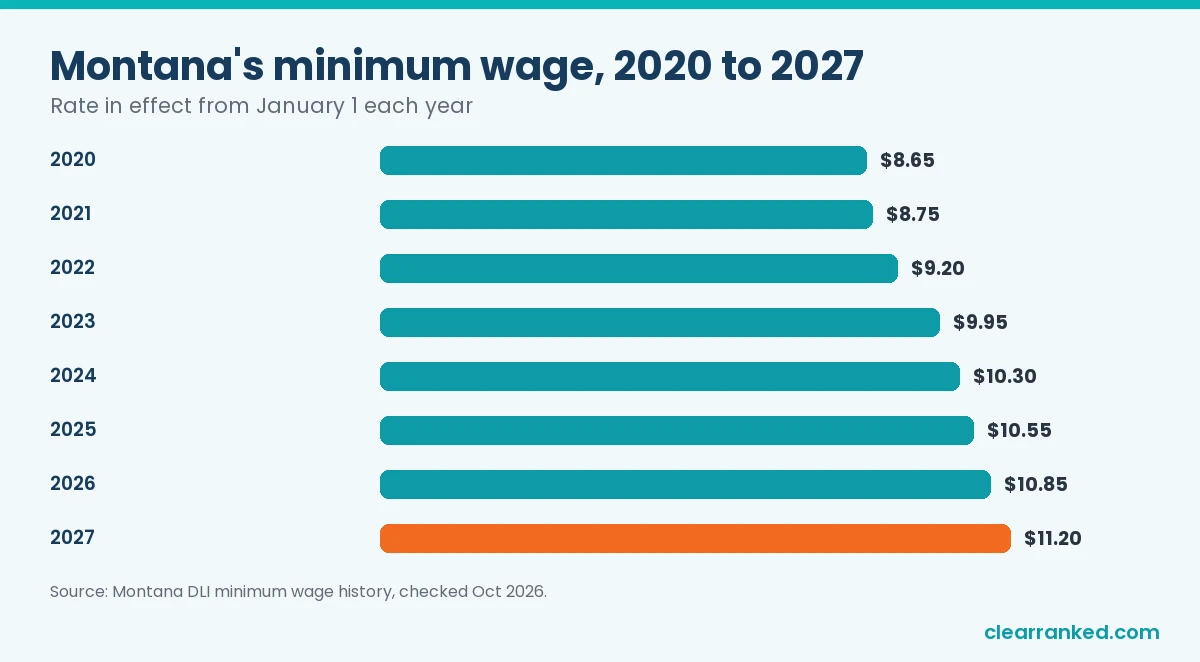
Montana’s minimum wage was $10.55 an hour in 2025, $10.30 in 2024 and $9.95 in 2023. It rose to $10.85 on January 1, 2026, and goes to $11.20 on January 1, 2027. Each raise comes from the yearly cost-of-living adjustment the state labor department announces every fall.
Here’s the recent history from the Department of Labor and Industry’s minimum wage history page. The full-time column uses 2,080 hours a year.
| Year | Hourly rate | Change | Full-time year |
|---|---|---|---|
| 2020 | $8.65 | +$0.15 | $17,992 |
| 2021 | $8.75 | +$0.10 | $18,200 |
| 2022 | $9.20 | +$0.45 | $19,136 |
| 2023 | $9.95 | +$0.75 | $20,696 |
| 2024 | $10.30 | +$0.35 | $21,424 |
| 2025 | $10.55 | +$0.25 | $21,944 |
| 2026 | $10.85 | +$0.30 | $22,568 |
| 2027 | $11.20 | +$0.35 | $23,296 |
The biggest jump came in 2023, when inflation was high. Through all of these years, DLI’s history lists the $4.00 alternative rate for businesses grossing $110,000 or less a year. If you’re checking back pay for an old period, use the rate in effect on the dates the work was done, not today’s rate.
Related guides
- Arizona minimum wage for 2027
- Child labor laws for employers
- Iowa minimum wage
- Overtime rules by state
- Exempt vs non-exempt employees
- DC minimum wage
FAQ
It’s $10.85 an hour. That’s $434 for a 40-hour week and $22,568 for a full year at 2,080 hours.
It rises to $11.20 an hour on January 1, 2027, after a 3.40% cost-of-living adjustment announced by DLI on October 7, 2026.
No. Montana doesn’t allow a tip credit, so tipped workers must be paid the full minimum wage plus their tips.
No. Montana law doesn’t allow a training wage, so new and young workers get the full rate. A narrow exception covers farm learners under 18.
Only businesses not covered by federal wage law with gross yearly sales of $110,000 or less. Workers individually covered by the FLSA must still get the Montana rate.
Each year DLI applies the August-to-August change in the CPI-U, rounds to the nearest 5 cents, and sets the rate by September 30 for the next January 1.
About the author
I’m Ali Hassan, the founder of ClearRanked. Also, I run small businesses myself, and I know how much time goes into payroll, pay math and HR rules. ClearRanked is where I share plain-English guides and honest comparisons, so small business owners can make decisions with confidence instead of guesswork.
How we work: this guide is research-based, and every source in it was checked in October 2026. We don’t take payment for rankings, and we update guides when laws or prices change. Finally, read more on our About page.