
W4 vs W2: The Difference Between Form W-4 and Form W-2 (2026)
W4 vs W2 comes down to direction. You complete Form W-4 and hand it to whoever runs payroll, so the company knows how much federal income tax to withhold. Your employer fills out Form W-2 after the year ends, showing what you earned and what was withheld. For 2026 pay, W-2s are due by February 1, 2027.
People mix them up because both start with W and both deal with withholding. But one is an instruction and the other is a receipt. The W-4 tells payroll what to do going forward. The W-2 reports what actually happened.
The 2026 versions also have new lines tied to the 2025 tax law, such as tips, overtime and a bigger child credit. If you run payroll or just started a new job, those changes are worth five minutes of your time.
How we researched this: we went through the 2026 Form W-4 line by line, the 2026 W-2 and W-3 instructions, the IRS About Form W-2 page and the reporting change in Public Law 119-21. Our review was done in October 2026.
Key takeaways
- Employees complete the W-4. Employers complete the W-2.
- The 2026 W-4 credits $2,200 per qualifying child under 17 and $500 per other dependent in Step 3.
- A new Step 4(b) worksheet lets you lower withholding for expected tips, overtime, car loan interest and the senior deduction.
- Employers must furnish 2026 W-2s and file them with the SSA by February 1, 2027.
- New W-2 codes show tips (box 12, code TP) and qualified overtime (box 12, code TT).

W4 vs W2: what is the difference?
Form W-4 is the Employee’s Withholding Certificate. You complete it and hand it to your employer. Form W-2 is the Wage and Tax Statement. Your employer completes it each year, sends copies to you and to the Social Security Administration, and you use it to file your tax return.
Here’s an easy way to remember it. The 4 comes first in life: you fill it out on day one. The 2 shows up later, every January or early February, once the year is over.
Another difference is how often each form moves. A W-4 stays on file until you replace it, and you can replace it any time. A W-2 is issued once per job per year. Worked two jobs in 2026? You’ll get two W-2s.
Neither form is something you mail to the IRS yourself. The W-4 stays with your employer. The W-2 reaches the government through your employer’s filing with the SSA, and its numbers flow into your Form 1040.
What is on the 2026 Form W-4?
The 2026 W-4 has five steps: personal info and filing status, multiple jobs, dependents, other adjustments and your signature. Only Steps 1 and 5 are required. Steps 2 through 4 are optional, but skipping them when they apply is the main reason people owe money in April.
| Step | What you enter | 2026 detail |
|---|---|---|
| 1 | Name, address, SSN, filing status | Single, joint or head of household |
| 2 | Multiple jobs or working spouse | Estimator, worksheet or a checkbox |
| 3 | Dependents and other credits | $2,200 per child under 17, $500 other dependents |
| 4(a) | Other income without withholding | Interest, dividends, retirement income |
| 4(b) | Deductions beyond the standard one | New lines for tips, overtime, car loan interest, seniors |
| 4(c) | Extra withholding per paycheck | Any dollar amount |
| 5 | Signature | Form isn’t valid unsigned |
Step 3 has an income limit. The per-child amounts apply only if you expect your income to stay at or below $200,000, or $400,000 for married couples filing jointly.
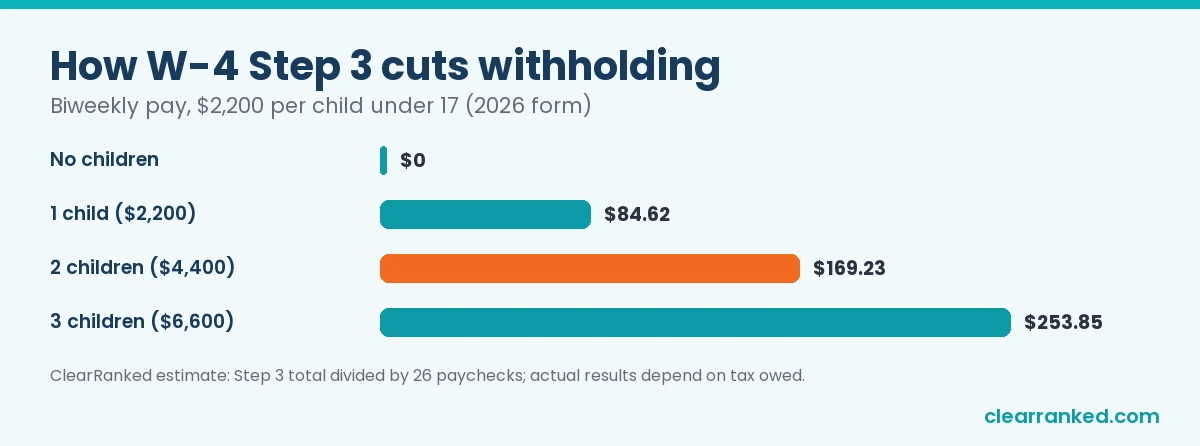
For example, a warehouse lead paid every two weeks who claims two children enters $4,400 in Step 3. Payroll spreads that over 26 paychecks, so withholding drops by about $4,400 / 26 = $169.23 per check. It’s an estimate, since the credit can’t cut withholding below zero.
How do tips and overtime change your W-4 in 2026?
The Step 4(b) worksheet now has lines for the new deductions. If your income is under $150,000 ($300,000 joint), you can enter expected qualified tips up to $25,000 and qualified overtime up to $12,500 ($25,000 joint). That lowers your withholding during the year instead of waiting for a refund.
Take Dana, a server at a busy diner who expects $9,000 in qualified tips for the year. She puts $9,000 on the tips line of the worksheet and carries the total to Step 4(b). Her employer then withholds as if her taxable income were $9,000 lower.
Overtime works a little differently. Only the extra half of time-and-a-half counts, not the full overtime pay. So a roofer who earns $30 an hour and works 200 overtime hours gets 200 x $15 = $3,000 of qualified overtime, not $9,000. Our hours worked calculator helps you total those hours.
The worksheet also covers interest on a qualifying car loan and the extra $6,000 deduction for people 65 and older, each with its own income limit. Not sure about the numbers? The IRS Tax Withholding Estimator walks you through it with your latest pay stub.
What is on a 2026 Form W-2?
A W-2 shows your total wages, federal income tax withheld, Social Security and Medicare wages and tax, plus state and local amounts. For 2026, box 12 adds code TP for cash tips reported to the employer and code TT for qualified overtime, and box 14 is split into 14a and 14b.
Box 14b is new. It holds a code for the worker’s tipped occupation, which helps the IRS match the tips deduction to jobs that actually qualify. Box 14a keeps the catch-all role box 14 used to have.
Here’s the practical point for workers. When you file your 2026 return, the TP and TT amounts are the starting point for the new deductions. If those boxes look wrong, ask payroll for a corrected W-2c before you file. Fixing it after the IRS has your return takes far longer.
Employers also have a new threshold. For wages paid after 2025, a W-2 is only required for small amounts of pay if they reach $2,000, up from $600, in cases where the employer withheld nothing at all, not even FICA. Most regular employees have FICA withheld, so most still get a W-2 no matter what they earn.
When are W-2s due for 2026 wages?
Employers must give 2026 W-2s to employees and file them with the Social Security Administration by February 1, 2027. January 31, 2027 is a Sunday, so the deadline rolls to Monday. Extensions to file with the SSA aren’t automatic.
Mailing counts as furnishing, so a W-2 that’s properly addressed and postmarked by February 1 is on time. Many small employers now post W-2s in an online portal instead, which needs the employee’s consent. Our guide to employee self-service portals explains how that works.
Late or wrong W-2s cost money. The IRS says its penalty amounts went up for returns due after December 31, 2026, because of inflation adjustments. If you’re the one-person HR department at a 10-person shop, put February 1 on the calendar now.
One more date for workers: if you claimed exemption from withholding on your 2026 W-4, it expires. You need to hand in a new W-4 by February 16, 2027, or payroll will start withholding at the single rate with no adjustments.
How do W-4 and W-2 compare with W-9 and 1099 forms?
W-4 and W-2 are for employees. Independent contractors use a different pair: Form W-9 to give you their taxpayer ID, and Form 1099-NEC to report what you paid them. Starting with 2026 payments, a contractor needs a 1099 only once you’ve paid them $2,000 or more, where the old trigger was $600.
| Worker type | Start of work | After year-end | Taxes withheld? |
|---|---|---|---|
| Employee | Form W-4 | Form W-2 | Yes: income tax and FICA |
| Independent contractor | Form W-9 | Form 1099-NEC | Usually no |
So a small electrical contractor might have four employees on W-4s and two subcontractors on W-9s. At year-end, the employees get W-2s, and each sub paid $2,000 or more gets a 1099-NEC.
Which forms you use depends on how the worker is classified, not on what you’d prefer. Treating an employee as a contractor to skip payroll taxes can lead to back taxes and penalties. If you’re unsure, our guide to contractor payroll services covers the basics.
When should you fill out a new W-4?
Fill out a new W-4 when you start a job, and again when your life or income changes: marriage, divorce, a new child, a second job, a spouse who starts working, or a big change in tips or overtime. It’s also smart to recheck it every January.
Got a big refund last year? That means too much was withheld, and you gave the government an interest-free loan. A big bill means too little. Neither is ideal, and the fix is usually a new W-4.
For employers, collect a W-4 before the first payroll run and keep it on file. If a new hire doesn’t hand one in, the law treats them as single with no adjustments. See our payroll setup steps for the rest of the new-hire paperwork. For unusual cases, a CPA can help you sort out your situation.
Related guides
- New-hire payroll setup
- Employee self-service portals
- Washington paycheck calculator
- Florida paycheck calculator
- Tax deductions for small business
- Contractor payroll services
FAQ
New employees fill out a W-4 when they start. The W-2 comes later, after the year ends, from the employer.
No. You give your W-4 to your employer, who uses it to figure withholding and keeps it on file.
Employers have until February 1, 2027, to furnish 2026 W-2s, because January 31, 2027, falls on a Sunday.
Step 3 uses $2,200 per qualifying child under 17 and $500 per other dependent, if total income is $200,000 or less ($400,000 joint).
Yes. The 2026 Step 4(b) worksheet has lines for expected qualified tips up to $25,000 and qualified overtime up to $12,500, or $25,000 for joint filers, with income limits.
A W-2 reports employee wages with tax withheld. A 1099-NEC reports payments to independent contractors, usually with no tax withheld, once payments reach $2,000 for 2026.
About the author
I’m Ali Hassan, the founder of ClearRanked. Also, I run small businesses myself, and I know how much time goes into payroll, pay math and HR rules. ClearRanked is where I share plain-English guides and honest comparisons, so small business owners can make decisions with confidence instead of guesswork.
How we work: this guide is research-based, and every source in it was checked in October 2026. We don’t take payment for rankings, and we update guides when laws or prices change. Finally, read more on our About page.