
Roth vs 401(k): Roth 401(k), Traditional 401(k) and Roth IRA Compared With 2026 Math
Roth vs 401(k) is really a question of when you pay income tax. A traditional 401(k) cuts your tax bill now and taxes withdrawals later. A Roth 401(k) or Roth IRA uses money you’ve already paid tax on, and qualified withdrawals come out tax-free. If you expect a lower tax rate in retirement, traditional usually wins. If you expect a higher one, Roth does.
The word “401(k)” confuses this, because a 401(k) can have both. Many plans now offer a Roth 401(k) option next to the regular pre-tax one. So the real choices are traditional 401(k), Roth 401(k) and Roth IRA, and plenty of people use two of them at once.
I’ll keep this practical. You’ll see a worked example on a $70,000 salary using 2026 tax brackets, a chart that shows why matching tax rates make the two equal, and a short checklist for picking a side.
How we researched this: rules come from the IRS Roth comparison chart, the required minimum distribution FAQs and the 2026 contribution limits. Tax math uses the IRS 2026 brackets. We went through each of them again in late October 2026.
Key takeaways
- Traditional 401(k): tax break today, taxable withdrawals later. Roth: no break today, tax-free qualified withdrawals.
- Roth and pre-tax 401(k) deferrals share one 2026 limit of $24,500, plus catch-ups.
- A Roth IRA is separate, with a $7,500 limit and an income phase-out starting at $153,000 for single filers.
- Neither Roth 401(k) accounts nor Roth IRAs require withdrawals during the owner’s lifetime.
- On a $70,000 salary, putting $7,000 in traditional instead of Roth lowers 2026 federal tax by about $1,190.
- If your tax rate is the same now and later, both choices leave you with the same money.
What is the difference between a Roth 401(k) and a traditional 401(k)?
The only big difference is tax timing. Traditional 401(k) contributions come out of your paycheck before income tax, so your taxable pay drops today, and every withdrawal is taxed later. Roth 401(k) contributions come out after tax, and qualified withdrawals of both contributions and growth are tax-free.
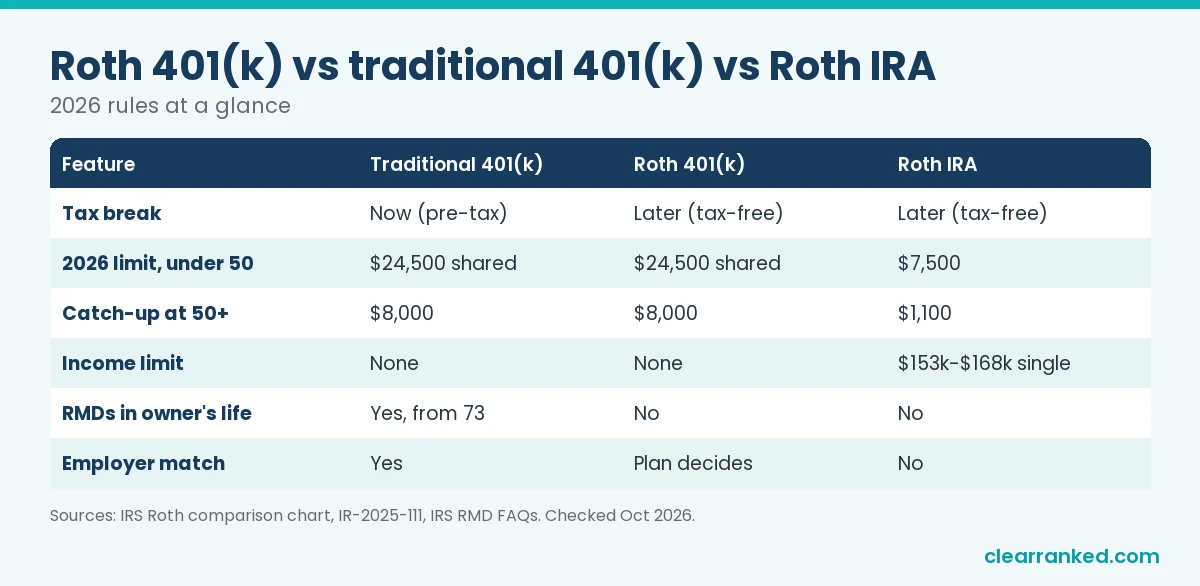
Almost everything else is the same. Both sit in the same plan, use the same investments and share the same limit. For 2026 that’s $24,500 across both sides combined, plus the age-based catch-up ($8,000 from 50, or $11,250 in the 60-63 window). You can split it any way you like, say $12,000 Roth and $12,500 pre-tax.
A Roth withdrawal is “qualified” when the account has been open at least five years and you’re 59 and a half, disabled, or the money goes to your heirs. Take money out early from either type and you’ll usually owe income tax on the taxable part plus a 10% additional tax, unless an exception applies.
Roth vs 401(k): which saves more on a $70,000 salary?
For a single filer earning $70,000 in 2026, putting $7,000 into a traditional 401(k) cuts federal income tax from about $6,570 to about $5,380, a $1,190 saving now. The Roth option gives up that saving today, but the $7,000 and all its growth can come out tax-free later.
| Step (2026, single) | Traditional $7,000 | Roth $7,000 |
|---|---|---|
| Salary | $70,000 | $70,000 |
| Minus pre-tax 401(k) | -$7,000 | $0 |
| Minus standard deduction | -$16,100 | -$16,100 |
| Taxable income | $46,900 | $53,900 |
| 10% on first $12,400 | $1,240 | $1,240 |
| 12% on $12,400 to $50,400 | $34,500 x 12% = $4,140 | $38,000 x 12% = $4,560 |
| 22% above $50,400 | $0 | $3,500 x 22% = $770 |
| Federal income tax | $5,380 | $6,570 |
Notice where the $1,190 comes from. Half the $7,000 would have been taxed at 22% and half at 12%: $3,500 x 22% + $3,500 x 12% = $770 + $420. So the traditional choice saves tax at a blended rate of 17%, not the full 22%.
This is federal income tax only. Social Security and Medicare apply to 401(k) deferrals either way, and state tax varies. It’s an estimate, so a tax pro can fine-tune it for your return.
Why do Roth and traditional come out equal at the same tax rate?
If your tax rate in retirement matches your rate today, a Roth and a traditional 401(k) leave you with exactly the same spending money. The traditional account is bigger, but you owe tax on it. The Roth account is smaller, but it’s yours in full. The math only tips one way when tax rates change.
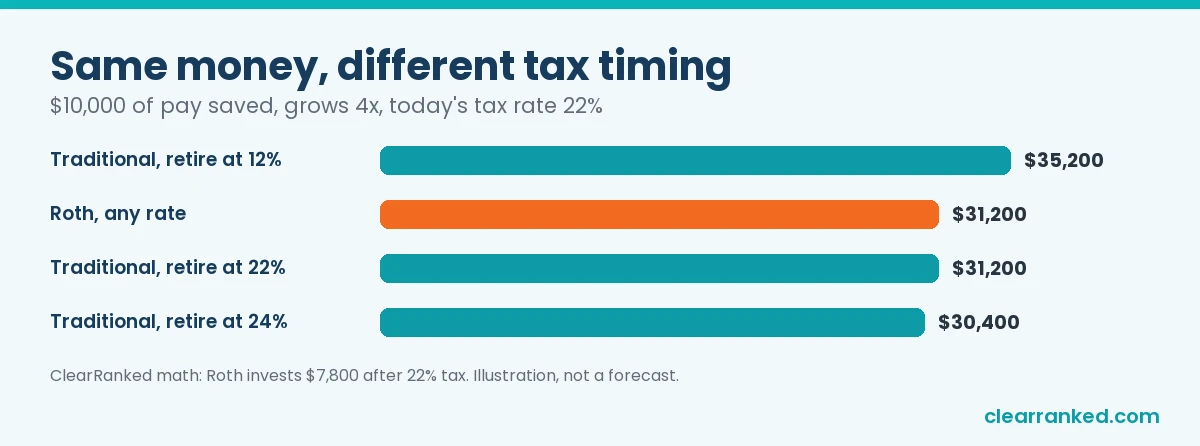
Here’s the chart’s logic. Say you set aside $10,000 of pay at a 22% rate and it grows four times. Traditional: $10,000 becomes $40,000, then 22% tax leaves $31,200. Roth: you pay $2,200 tax first, invest $7,800, and it grows to $31,200 tax-free. Same result.
Now change the retirement rate. At 12%, the traditional account nets $35,200, so it wins by $4,000. At 24%, it nets $30,400 and the Roth wins by $800. So the whole decision boils down to one guess: will your rate be higher or lower later?
When does a Roth make more sense than a traditional 401(k)?
A Roth usually makes more sense when your tax rate is low now and likely to rise. That fits early-career workers, people in the 10% or 12% bracket, and anyone expecting big income later. A Roth also helps if you want tax-free money to mix with taxable withdrawals in retirement.
- You’re early in your career. A 24-year-old bookkeeper in the 12% bracket gives up little today by choosing Roth.
- You had a down year. A contractor whose 2026 profit dipped can lock in a low rate with Roth money.
- You value flexibility. Tax-free Roth withdrawals don’t push up your taxable income in retirement.
- You want to avoid forced withdrawals. Roth IRAs and Roth 401(k) accounts don’t require distributions while you’re alive.
My take: if you’re in the 12% bracket or below, Roth is hard to argue against. You’re paying tax at a rate you may never see again, and the money compounds tax-free for decades.
When is a traditional 401(k) the better choice?
A traditional 401(k) is usually better when you’re in a high bracket now and expect lower income in retirement. It also helps if you need a smaller tax bill today, for example to qualify for income-based credits, or if you expect to retire in a state with lower or no income tax.
Consider a 52-year-old owner of a 12-person landscaping company who pays herself $240,000. After the standard deduction, her top federal rate on that income is 32%. If she expects to live on far less in retirement, deferring tax at 32% now and paying 22% or 24% later is a solid trade.
There’s also a cash-flow angle. The tax you save with traditional contributions is real money today. Put it to work, by paying down debt or investing it, and traditional gets more attractive. Spend it, and some of the advantage disappears.
Roth IRA vs 401(k): how do they compare?
A 401(k) lets you save far more, $24,500 in 2026 versus $7,500 in an IRA, and it may come with an employer match. A Roth IRA gives you more investment choices and tax-free growth, but it has income limits. Single filers start losing eligibility at $153,000 of 2026 income and are fully out at $168,000.
| Question | 401(k) (Roth or traditional) | Roth IRA |
|---|---|---|
| Who opens it | Your employer (or you, if self-employed) | You, at any brokerage |
| 2026 limit | $24,500 + catch-up | $7,500 + $1,100 at 50+ |
| Income limit | None | $153k-$168k single, $242k-$252k joint |
| Employer match | Often | Never |
| Investment choices | Plan menu | Almost anything |
| First-home exception | No | Yes, for qualified distributions |
A common order of operations works well. First, save enough in the 401(k) to get the full match. Next, fund a Roth IRA if you qualify. Then go back and add more to the 401(k). That way you never leave free match money behind.
Can you contribute to both a Roth and a traditional 401(k)?
Yes. Most plans with a Roth option let you split each paycheck between Roth and pre-tax contributions, as long as the total stays within $24,500 for 2026 plus any catch-up. You can also fund a Roth IRA on top, because IRA limits are separate from 401(k) limits.
Splitting is a reasonable hedge if you honestly can’t guess your future tax rate. Many people go 50/50 and adjust as income changes. For the full list of 2026 caps, see our 2026 401(k) contribution limits guide. Self-employed? The solo 401(k) offers both Roth and pre-tax sides too.
If you own the business, offering a Roth option costs little and gives staff a real choice. It pairs well with the deductions in our small business tax deductions guide.
Can you roll a 401(k) into a Roth IRA?
Yes. A Roth 401(k) can roll into a Roth IRA with no tax, and a traditional 401(k) can roll into a Roth IRA too, but the pre-tax amount you move counts as taxable income that year.
The IRS rollover chart allows both moves and flags the pre-tax one “must include in income.” So converting $50,000 from a traditional 401(k) adds $50,000 to your taxable income. For a single filer already earning $70,000, that pushes taxable income from $53,900 to $103,900, all of the added amount taxed at 22% in 2026, or about $11,000 of federal tax. Go much past that and the 24% bracket starts at $105,700, which is why many people convert in pieces over several years or in a low-income year.
How you move the money matters. Under the IRS rollover rules, a 401(k) check paid to you has 20% withheld, and you have 60 days to deposit the full amount, so you would cover that 20% from savings. A direct rollover from the plan to the IRA avoids the withholding. Plans set their own rules on when you can roll money out, so ask your plan administrator. Our Roth IRA limits guide covers yearly contributions. Check with a CPA for your situation.
Related guides
- 2026 401(k) limits and catch-ups
- Solo 401(k) for the self-employed
- Small business tax deductions
- Turning a $50k salary into an hourly rate
- Bonus tax calculator
FAQ
It depends on your tax rate now versus in retirement. Traditional wins if your rate will be lower later, Roth wins if it will be higher, and they come out equal if the rate stays the same.
Yes. For 2026, your Roth and pre-tax deferrals together can’t exceed $24,500, plus whatever catch-up your age allows.
No. Anyone in a plan with a Roth option can use it. Only the Roth IRA has income limits, phasing out between $153,000 and $168,000 for single filers in 2026.
No. Under current IRS rules, Roth 401(k) accounts and Roth IRAs don’t require withdrawals while the owner is alive. Traditional accounts generally require them starting at age 73.
For a single filer in 2026, a $7,000 traditional contribution cuts federal income tax by about $1,190, from about $6,570 to $5,380, using the $16,100 standard deduction.
Yes. The IRA limit of $7,500 for 2026 is separate from the 401(k) limit. You need to be under the Roth IRA income limits to contribute directly.
About the author
I’m Ali Hassan, the founder of ClearRanked. Also, I run small businesses myself, and I know how much time goes into retirement plans, taxes and pay math. ClearRanked is where I share plain-English guides and honest comparisons, so small business owners can make decisions with confidence instead of guesswork.
How we work: this guide is research-based, and every source in it was checked in October 2026. We don’t take payment for rankings, and we update guides when laws or prices change. Finally, read more on our About page.