
50k a Year Is How Much an Hour? $50,000 Salary to Hourly (2026)
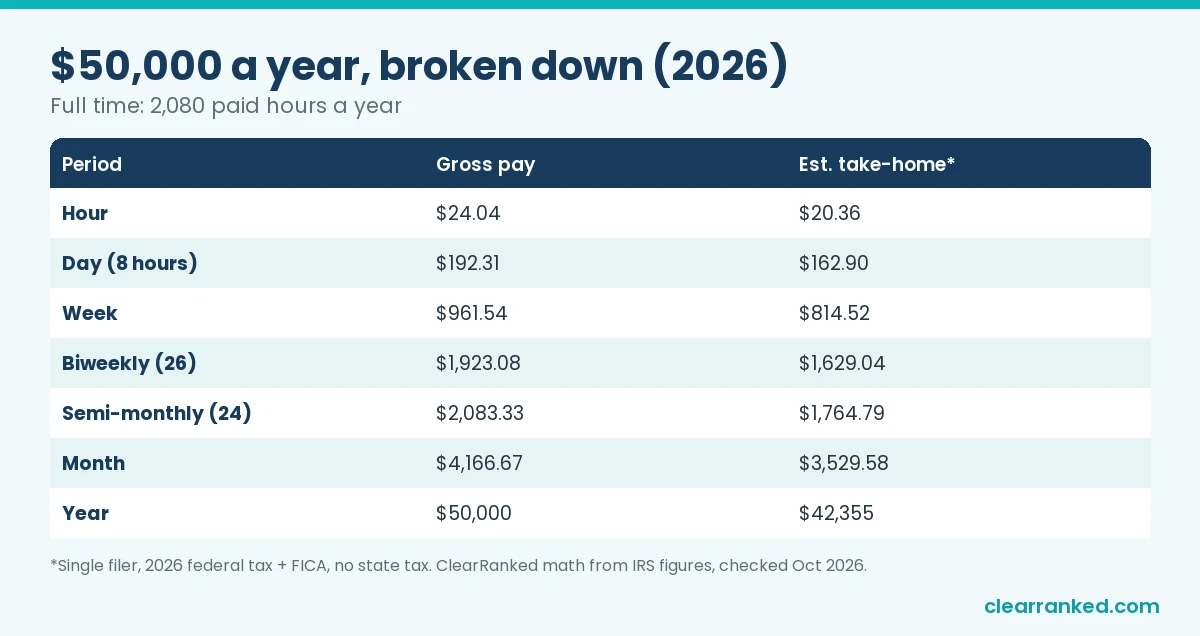
$50,000 a year works out to $24.04 an hour, assuming a standard 40-hour week and 52 paid weeks ($50,000 divided by 2,080). Weekly, that’s $961.54. Monthly, $4,166.67. Once 2026 federal tax and FICA come out, a single filer keeps around $42,355, or about $20.36 per paid hour.
That’s the textbook answer, and payroll software will agree with it. Real salaried life is messier. Plenty of $50k jobs expect 45 or 50 hours, and if you’re exempt, those extra hours are free labor.
Say you’re an office coordinator offered $50,000, and a warehouse lead role pays $22 an hour plus overtime. Which pays better for your time? Keep reading, because the answer depends almost entirely on the hours.
How we researched this: we pulled 2026 tax figures from the IRS, the salary-level overtime test from the federal regulation at 29 CFR 541.600, and pay benchmarks from the BLS wage survey and the BLS usual weekly earnings release. Checked October 2026.
Key takeaways
- Standard conversion: $24.04 an hour, $961.54 a week.
- Single-filer net pay in 2026: around $42,355, or $3,530 a month in a no-tax state.
- Working 50-hour weeks drops your effective rate to $19.23.
- The salary clears the federal $684-a-week exemption floor, but duties decide whether you get overtime.
- It trails the full-time median of about $64,064 by roughly 22%.
50k a year is how much an hour?
$24.04. Divide $50,000 by 52 and you get $961.54 a week; divide that by 40 and you’re at $24.04 an hour. For a fast guess, cut the salary in half and swap thousands for dollars. That says $25, which overshoots by about 4%.
Why does the shortcut overshoot? It pretends a year has 2,000 work hours. The real full-time count is 2,080, so the true rate is a bit lower. Good enough for skimming job ads, not for a budget.
Your paycheck size depends on the schedule. Weekly checks are $961.54, biweekly ones $1,923.08, semi-monthly ones $2,083.33. Semi-monthly checks are bigger because there are only 24 of them, not 26. We cover the difference in our piece on how often employers run payroll.
What’s $50,000 per hour when the week runs long?
It falls fast. At 45 hours a week, $50,000 equals $21.37 an hour. Push it to 50 hours and you’re at $19.23. Work 55, and it drops to just $17.48. Divide the salary by your actual weekly hours times 52 to find yours.

Back to that coordinator-versus-warehouse choice. The $22 hourly job pays $45,760 for a plain 40-hour year, so the salary looks $4,240 better. Now suppose both jobs really run 50 hours a week.
The hourly worker gets $33 for each of those 10 extra hours, so the week pays $1,210 and the year $62,920. The salaried coordinator still gets $50,000, or $19.23 an hour. That’s a $12,920 swing toward the ‘lower-paying’ job. Ask about real hours before you sign anything.
Not sure how many hours you actually put in? Log them for a month. Our shift hours calculator subtracts breaks and totals the week.
What do you earn per hour actually worked?
More than $24.04, if your job includes paid time off. With 10 vacation days and 10 paid holidays, you’re on the clock about 1,920 hours a year. Spread $50,000 over those hours and you’re earning $26.04 for every hour you actually work.
| Paid days off a year | Hours on the job | Pay per hour worked |
|---|---|---|
| 0 | 2,080 | $24.04 |
| 10 | 2,000 | $25.00 |
| 15 | 1,960 | $25.51 |
| 20 | 1,920 | $26.04 |
| 25 | 1,880 | $26.60 |
This is how I’d compare a salaried offer with good PTO against an hourly job with none. Two offers with equal yearly pay can differ by $2 an hour once you count the days you don’t have to show up.
Unpaid leave flips the math, of course. Take two unpaid weeks and you’re paid for 50 weeks, so the salary shrinks to about $48,077. See our PTO accrual math for how employers track earned days.
Is a $50,000 salary owed overtime?
Sometimes. Being salaried doesn’t make you exempt by itself. Federal rules require exempt white-collar staff to earn at least $684 a week and to perform qualifying duties. At $961.54 a week, $50,000 passes the pay test easily, so your duties settle it.
That $684 floor, equal to $35,568 a year, is written into the Department of Labor regulation. The duties side asks whether you truly manage, exercise independent judgment on business matters, or do learned professional work. Your title doesn’t count. What you do all day does.
If you turn out to be non-exempt, the employer owes time and a half for every hour past 40 in a workweek. On a salary meant to cover 40 hours, your regular rate is about $24.04, so overtime runs roughly $36.06 an hour. Some states set a higher salary floor than the federal one, so check yours.
Our guide on how exemption is decided walks through each duties test with examples.
How much is $50,000 a year after taxes?
About $42,355 for a single filer in 2026. Federal income tax takes $3,820 and FICA takes $3,825. Spread across 26 paychecks, that’s $1,629.04 each. State and local taxes would come out on top of that.
Here’s how each biweekly check breaks down, which is the version you’ll actually see on a pay stub:
| Per biweekly check | Amount |
|---|---|
| Gross pay | $1,923.08 |
| Federal income tax withheld (approx.) | $146.92 |
| Social Security, 6.2% | $119.23 |
| Medicare, 1.45% | $27.88 |
| Net pay | $1,629.04 |
Where does $3,820 come from? Subtract the $16,100 single standard deduction, leaving $33,900 taxable. The first $12,400 is taxed at 10% and the remaining $21,500 at 12%. You never touch the 22% bracket, which starts above $50,400 of taxable income.
If you live somewhere with no income tax on wages, that’s your number. The Tax Foundation lists eight such states, and Washington only taxes capital gains. A 4.95% flat-tax state like Illinois would cost about $2,475 more. A CPA can confirm what applies to you.
For monthly planning, picture roughly $3,530 landing in your account. A common renter’s guideline caps housing at 30% of gross, which is $1,250 a month at this salary. If local rents run higher, you’ll feel it in savings first, so build the budget around the net figure rather than the offer letter.
Is $50,000 a year good pay?
It’s middle-of-the-road for all jobs and below the middle for full-time ones. The BLS all-jobs median was $24.51 an hour in May 2025, close to $24.04. But the median full-time worker made $1,232 a week in Q3 2026, around $64,064 a year.
The gap exists because the all-jobs figure includes part-timers. So $50,000 is a fair wage, not a high one. In cheaper metros it covers a single person comfortably; in expensive ones, it’s tight.
Who earns about this much? In the BLS data, bookkeeping and accounting clerks had a $24.36 median, automotive service technicians $24.34, and human resources assistants $24.33. Each of those converts to roughly $50,600 a year on a full-time schedule.
What should you ask before accepting a $50,000 offer?
Ask five things: the usual weekly hours, whether the role is exempt, how many paid days off you get, what benefits cost you, and how often payroll runs. Those answers can move the real value of a $50,000 offer by several dollars an hour in either direction.
- Typical hours. If the honest answer is 50 a week, you’re really being offered about $19 an hour.
- Exempt or not. A non-exempt salaried role still pays time and a half past 40 hours, which can add thousands.
- Paid time off. Fifteen paid days is worth roughly $2,900 at this salary, since one day equals about $192.
- Your share of health premiums. A plan costing you $150 a month eats $1,800 of the salary each year.
- Pay frequency. It won’t change the total, but biweekly versus monthly checks changes how you budget.
Honestly, I’d treat the hours question as the big one. Benefits and schedules matter, but nothing erodes a salary like unpaid evenings. If a recruiter dodges it or says the hours vary, take that as your answer and plan for long weeks.
Related guides
- What $40 an hour adds up to
- Exempt or non-exempt? The tests
- Weekly, biweekly or monthly pay
- Track your weekly hours
- Florida and state income tax
- Work out overtime pay
FAQ
About $24.04, using the standard 2,080-hour full-time year.
$1,923.08 gross per paycheck. After 2026 federal tax and FICA, a single filer nets about $1,629.04.
Close to $3,530 a month if you’re single and live in a state with no wage tax.
No. $25 an hour is $52,000 a year. $50,000 equals $24.04 an hour.
The 12% bracket for a single filer in 2026. Taxable income is $33,900 after the standard deduction.
Yes, when the job is non-exempt. The salary passes the federal $684-a-week floor, but the job duties must also qualify before overtime can be skipped.
Roughly $21.37, since 45 hours times 52 weeks is 2,340 hours.
About the author
I’m Ali Hassan, the founder of ClearRanked. Also, I run small businesses myself, and I know how much time goes into payroll, pay math and HR rules. ClearRanked is where I share plain-English guides and honest comparisons, so small business owners can make decisions with confidence instead of guesswork.
How we work: this guide is research-based, and every source in it was checked in October 2026. We don’t take payment for rankings, and we update guides when laws or prices change. Finally, read more on our About page.