1099 vs W2 Calculator: Contract Rate vs Salary in 2026
This 1099 vs W-2 calculator compares a salaried job with a contract offer after 2026 federal taxes, so you can see which one leaves more money in your pocket. It returns take-home pay both ways, the value of benefits, and the break-even 1099 hourly rate that would match the W-2 job.
1099 vs W-2 calculator
1099 vs W-2 Calculator
Compare a salaried W-2 job with a 1099 contract after 2026 federal taxes, benefits and unbilled time.
Estimate only, not tax advice. Federal taxes only, standard deduction, no other household income or credits. The QBI deduction assumes a business that is not a specified service business. State taxes are not included.
Contract offers often look generous. Then the first quarterly tax bill arrives. So the trick is comparing like for like: the W-2 salary pays you for 52 weeks including vacation, while a 1099 rate only pays for hours you bill. The calculator handles that, plus the extra payroll tax a contractor carries.
How we researched this: the 15.3% rate and the half-SE deduction come from the IRS self-employment tax page, and the 92.35% factor from Schedule SE. The $184,500 wage base comes from IRS Publication 15, the QBI rules from the IRS QBI page, and the 2026 thresholds and brackets from Rev. Proc. 2025-32. We checked it all in October 2026.
Key takeaways
- Employees pay 7.65% in Social Security and Medicare; contractors pay 15.3% self-employment tax on 92.35% of profit.
- Contractors deduct half of that SE tax, and many can take a 20% QBI deduction on top.
- The QBI limits start at $201,750 of taxable income ($403,500 joint) for 2026.
- Unbilled hours matter most: 30 billable hours for 48 weeks is 1,440 hours, not 2,080.
- A $75,000 W-2 job with $8,000 of benefits breaks even with a 1099 rate of about $69.13 an hour in our example.
How do you use the 1099 vs W-2 calculator?
Enter the W-2 salary and the yearly value of its benefits, leaving health insurance out. Then enter the 1099 hourly rate, your realistic billable hours and weeks, business costs and what you'd pay for health coverage. The result shows which side wins, by how much, and the break-even rate.
- Filing status. The married option assumes your spouse has no income, so the full joint brackets apply.
- Benefits value. Count 401(k) match dollars, HSA contributions and any guaranteed bonus. PTO is already inside the salary.
- Billable hours. Be honest here. Admin, sales and invoicing eat into every solo contractor's week, and none of it is billable.
- Billable weeks. 52 minus vacation, holidays, sick days and the gap between contracts.
- Health insurance. Enter the extra premium you'd pay on your own compared with your share as an employee.
Not sure which one you're being offered? The IRS uses common-law control tests. If the company directs what you do and how you do it, you're generally an employee, as the IRS worker classification page explains.
How is self-employment tax calculated in 2026?
Self-employment tax is 15.3% of 92.35% of your net profit: 12.4% for Social Security on earnings up to $184,500 in 2026, and 2.9% for Medicare with no cap. You can deduct half of the 15.3% part when figuring income tax. It kicks in once net earnings reach $400.
Why 92.35%? It's 100% minus 7.65%. That mimics the fact that an employer's share of FICA isn't counted as wages for an employee. Here's the math on $68,000 of profit:
- Net earnings: $68,000 x 0.9235 = $62,798
- SE tax: $62,798 x 15.3% = $9,608.09
- Half-SE deduction: $9,608.09 / 2 = $4,804.05
- Compare a W-2 worker on $75,000: $75,000 x 7.65% = $5,737.50
High earners also owe the 0.9% additional Medicare tax above $200,000 ($250,000 joint), on both sides. That extra 0.9% isn't part of the half-SE deduction. The calculator includes it.
| Tax item, 2026 | W-2 employee | 1099 contractor |
|---|---|---|
| Social Security | 6.2% of wages to $184,500 | 12.4% of net earnings to $184,500 |
| Medicare | 1.45% of all wages | 2.9% of all net earnings |
| Base used | Gross wages | 92.35% of net profit |
| Deduction for payroll tax | None | Half of SE tax |
| QBI deduction | Not available | Up to 20% of business income |
| How tax is paid | Withheld each paycheck | Quarterly estimated payments |
How does the QBI deduction change the comparison?
The qualified business income deduction lets many sole proprietors deduct up to 20% of business profit, after subtracting the deductible part of SE tax and self-employed health insurance. It's capped at 20% of taxable income. For 2026, extra limits start above $201,750 of taxable income, or $403,500 on a joint return.
In our example, QBI is $68,000 - $4,804.05 - $6,000 = $57,195.95, and 20% of that is $11,439.19. However, taxable income before QBI is only $41,095.95, so the cap of 20% x $41,095.95 = $8,219.19 applies. That drops the contractor's federal income tax to about $3,697, roughly half the W-2 worker's $7,670.
Above the threshold, the deduction phases out over the next $75,000 of taxable income ($150,000 joint) for a solo business with no employees. Specified service businesses, such as health, law, accounting and consulting, lose it faster, so the calculator's figure is a best case for them. Also new for 2026, the IRS QBI page describes a minimum deduction for active businesses, set by the 2025 law at $400 for those with at least $1,000 of QBI.
When does a 1099 contract pay more than a W-2 job?
A 1099 contract pays more only when its hourly rate clears your break-even rate. That rate covers the extra 7.65% of payroll tax, your unbilled hours and weeks, benefits you give up, health coverage and business costs. In our $75,000 example, that's about $69.13 an hour, nearly double the salary's $36.06 hourly equivalent.
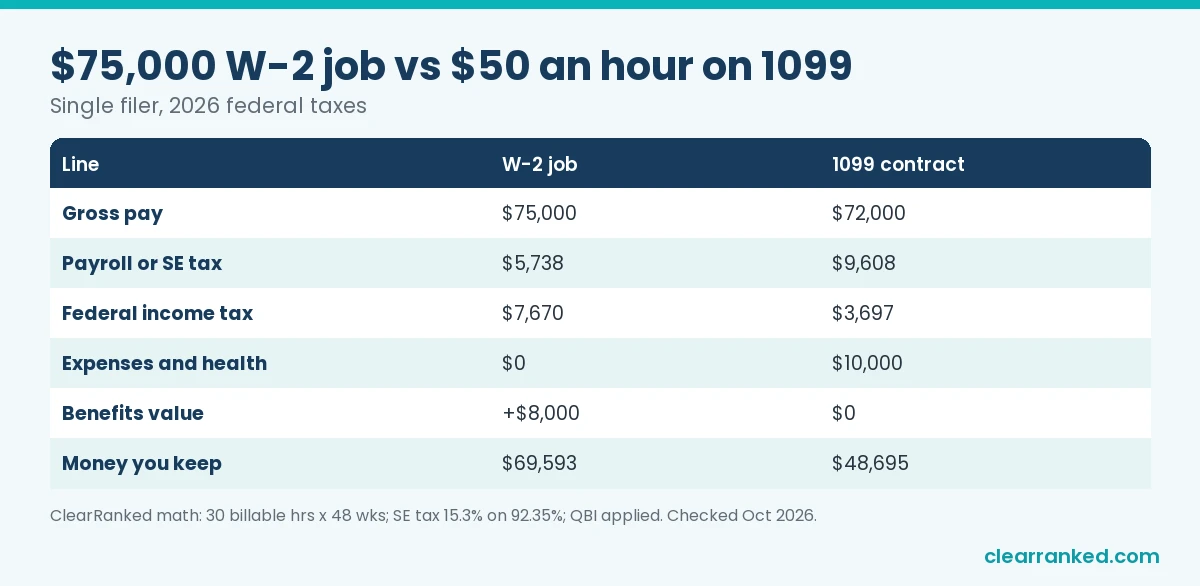
Let's run the full example. Jordan, single, is choosing between a $75,000 W-2 job with $8,000 of benefits and a $50-an-hour contract. Jordan expects 30 billable hours a week for 48 weeks, $4,000 of expenses and $6,000 of health insurance.
- W-2: $75,000 - $5,737.50 FICA - $7,670 income tax = $61,592.50, plus $8,000 benefits = $69,592.50
- 1099: $50 x 30 x 48 = $72,000 - $4,000 - $6,000 - $9,608.09 SE tax - $3,697.21 income tax = $48,694.69
- Gap: the W-2 job wins by about $20,898 a year
Notice that $50 an hour sounds like $104,000 a year if you multiply by 2,080. That's the trap. At 1,440 billable hours, the same rate is $72,000 before any costs. So when you quote a client, start from your break-even rate and add a margin for slow months.

What else should you weigh besides take-home pay?
Beyond the math, weigh stability, control and paperwork. W-2 jobs bring unemployment insurance, workers' comp and employer retirement plans. Contracting brings flexible hours, multiple clients, business deductions and a solo 401(k), but also quarterly estimated taxes and the risk of gaps between projects.
- Taxes don't come out for you. The IRS self-employed tax center says you'll generally pay estimated tax quarterly. The calculator shows a rough quarterly set-aside.
- Retirement savings can be bigger. A contractor can open a solo plan with both employee and employer contributions. See our solo 401(k) guide.
- Paperwork changes. Clients report your pay on a 1099-NEC instead of a W-2. Our Form 1099 guide covers what to expect.
- Overtime disappears. Nonexempt employees earn time and a half past 40 hours. Contractors don't. Our exempt vs non-exempt guide explains who qualifies.
If you're the business owner on the other side of this choice, the cost math flips. Hiring a W-2 employee adds the employer's 7.65% FICA, unemployment taxes and benefits, so compare our contractor payroll services with payroll for one employee. Check with a CPA for your situation, since state taxes and local rules can move the result.
Related calculators
- All ClearRanked calculators
- Overtime calculator
- $40 an hour is how much a year
- Form 1099 guide
- Solo 401(k) guide
- Contractor payroll services
FAQ
W-2 is usually better at the same headline pay, because your employer pays half of Social Security and Medicare and often adds benefits. A 1099 contract wins only when the rate is high enough to cover self-employment tax, unpaid time off, health insurance and business costs.
Work out your break-even rate with your own numbers. In our example, a $75,000 W-2 job with $8,000 of benefits equals about $69.13 an hour on a 1099 at 30 billable hours a week for 48 weeks, almost double the $36.06 hourly equivalent of the salary.
Multiply net profit by 92.35% to get net earnings, then apply 15.3%: 12.4% for Social Security on up to $184,500 and 2.9% for Medicare on all of it. You owe it once net earnings reach $400, and you can deduct half of the Social Security and Medicare part.
The qualified business income deduction lets many sole proprietors deduct up to 20% of their business profit, after subtracting the deductible part of SE tax and self-employed health insurance. For 2026, limits start once taxable income passes $201,750, or $403,500 on a joint return.
More questions about 1099 vs W-2 pay
On payroll taxes, yes. A contractor pays both halves of Social Security and Medicare, about 15.3% versus 7.65% for an employee. On income tax, contractors often pay less because of the half-SE deduction, business expenses and the QBI deduction.
Not just by choice. The IRS looks at whether the business has the right to control what you do and how you do it. If it does, you're generally an employee under the common-law rules, whatever the contract calls you.
Generally, yes. The IRS says self-employed people usually pay estimated taxes quarterly, because no employer is withholding for them. The calculator shows a rough quarterly set-aside based on your SE tax and income tax.
About the author
I'm Ali Hassan, the founder of ClearRanked. Also, I run small businesses myself, and I know how much time goes into payroll, contractor pay and tax math. ClearRanked is where I share plain-English guides and honest comparisons, so small business owners can make decisions with confidence instead of guesswork.
How we work: this guide is research-based, and every source in it was checked in October 2026. We don't take payment for rankings, and we update guides when laws or prices change. Finally, read more on our About page.