$24 an Hour Is How Much a Year? 2026 Pay, Overtime and Taxes
At $24 an hour, a full-time year pays $49,920 before taxes ($24 x 2,080 hours). Monthly, you’re looking at $4,160; biweekly, $1,920; weekly, $960. Subtract 2026 federal income tax and FICA and a single filer keeps about $42,291, close to $3,524 a month.
Picture a warehouse worker weighing a $24-an-hour forklift job against a $50,000 salaried supervisor slot. On paper they’re nearly tied, just $80 apart. In practice, the hourly job often wins, because $24-an-hour work usually comes with overtime at $36.
That’s the focus here. You’ll see the 2026 tax math, exactly what 5 or 10 overtime hours a week add, how the new federal overtime deduction cuts your tax bill, and how $24 stacks up nationally. Spoiler: it’s almost dead center, since the BLS all-jobs median was $24.51.
How we researched this: our sources are the IRS tax year 2026 adjustments, the IRS explainer on the overtime deduction, overtime law in 29 U.S.C. 207 and wage data from the BLS OEWS program. All were reviewed in October 2026.
Key takeaways
- Straight time: $49,920 a year, $960 a week.
- Estimated net for a single filer in 2026: $42,291, with $3,810 going to federal income tax.
- Overtime pays $36 an hour. Five extra hours weekly is worth $9,360 a year; ten is worth $18,720.
- The overtime deduction (tax years 2025 to 2028) saves about $374 a year at five overtime hours a week.
- Your rate sits within about 50 cents of the national all-jobs median.

$24 an hour is how much a year?
$49,920. Multiply $24 by 40 hours for a $960 week, then by 52 weeks. If two of those weeks are unpaid, the year drops to $48,000. Paid vacation and holidays don’t change the total.
Your check depends on the payroll schedule. A biweekly worker sees $1,920 gross per check. Semi-monthly pay gives $2,080 per check, since there are only 24. Monthly pay, rare for hourly jobs, would be $4,160.
Since $24 an hour lands $80 short of $50,000, comparing it with a $50k salary really comes down to hours and overtime. Our guide to who qualifies for overtime spells out the rules.
How much does $24 an hour pay after taxes?
About $42,291 a year for a single filer in 2026, or $1,626.57 per biweekly check. Federal income tax runs $3,810 and FICA $3,819, so roughly 15.3% of your gross goes to federal taxes. Add state tax if your state has one.
Thinking in weekly terms makes it concrete. Here’s where a $960 paycheck goes:
| Out of each $960 week | Amount |
|---|---|
| Federal income tax (annual tax / 52) | $73.28 |
| Social Security | $59.52 |
| Medicare | $13.92 |
| What you keep | $813.28 |
The annual tax figure comes from $49,920 minus the $16,100 single standard deduction, which leaves $33,820 taxable. You pay 10% on the first $12,400 and 12% on the rest. You won’t touch 22% until gross pay passes about $66,500, which only happens here with heavy overtime.
In the eight states with no individual income tax, plus Washington, that’s the whole story, per the Tax Foundation. Pennsylvania’s flat 3.07% would take about $1,533 more; Illinois at 4.95% about $2,471.
On a biweekly schedule, two checks of about $1,626.57 cover most months. A sensible split for one person: keep rent under $1,150, set $350 aside for savings on each payday, and let the rest handle groceries, gas and bills. Overtime months then become a bonus instead of something you depend on.
How much does overtime add at $24 an hour?
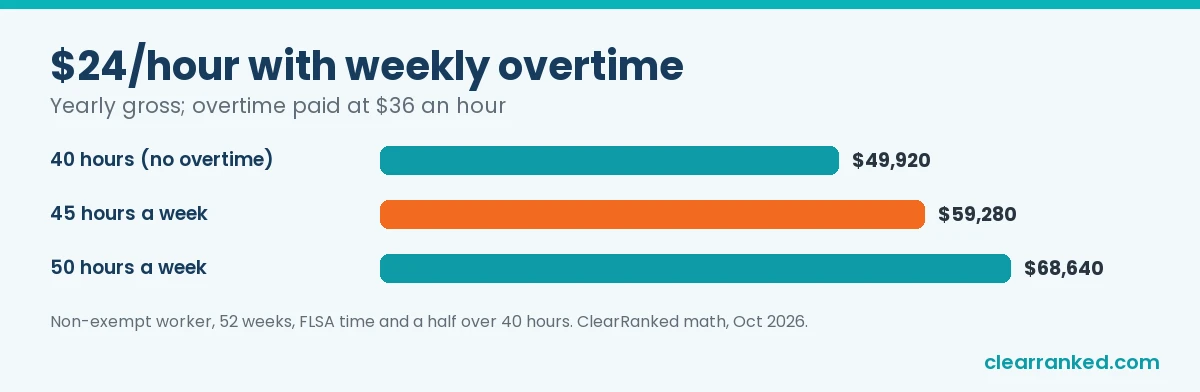
A lot. Overtime pays at least $36 an hour, so five extra hours a week turns $49,920 into $59,280. Ten extra hours makes it $68,640. Federal law requires that premium for non-exempt employees once they pass 40 hours in a workweek.
| Typical week | Weekly gross | Yearly gross | Net before deduction* |
|---|---|---|---|
| 40 hours | $960 | $49,920 | $42,291 |
| 45 hours | $1,140 | $59,280 | $49,811 |
| 50 hours | $1,320 | $68,640 | $57,118 |
*Single filer, no state tax. A 45-hour week is $24 x 40 plus $36 x 5, which equals $1,140. Overtime is often seasonal, so don’t budget as if peak weeks last all year. Our overtime pay tool handles uneven schedules.
Some states layer their own overtime rules on top of the federal one, so it’s worth a look at your state labor department’s site.
Does the no tax on overtime deduction help at $24 an hour?
Yes, if you’re non-exempt. From 2025 through 2028 you can deduct the premium portion of FLSA overtime, the extra $12 in each $36 hour. Five overtime hours a week means a $3,120 deduction and roughly $374 less federal income tax in 2026.
The IRS caps the deduction at $12,500 for single filers ($25,000 joint) and phases it out above $150,000 of modified AGI. Only overtime the FLSA actually requires counts. A bonus your boss calls overtime doesn’t.
| Overtime hours weekly | Deductible premium | Federal tax saved | Net with deduction* |
|---|---|---|---|
| 5 | $3,120 | $374 | $50,186 |
| 10 | $6,240 | $963 | $58,081 |
Why does the 10-hour row save more than double? Ten overtime hours push part of your income into the 22% bracket, and the deduction removes those high-taxed dollars first. Social Security and Medicare still apply in full, so FICA stays at $5,251 on $68,640.
Most people claim the deduction when they file, so paychecks won’t show the savings unless you adjust your W-4. Run your own numbers past a tax pro before you count on the savings.
Should you take $24 an hour or a $50,000 salary?
If the work regularly runs past 40 hours, the $24 hourly job almost always pays more, because every extra hour earns $36. If hours are a steady 40 and the salaried job carries better benefits or more paid leave, the salary can come out ahead. Ask both employers about typical weekly hours.
| Typical week | $24/hour, non-exempt | $50,000 salary, exempt | Better deal |
|---|---|---|---|
| 40 hours | $49,920 | $50,000 | Salary, by $80 |
| 43 hours | $55,536 | $50,000 | Hourly |
| 45 hours | $59,280 | $50,000 | Hourly, by $9,280 |
| 50 hours | $68,640 | $50,000 | Hourly, by $18,640 |
Back to our forklift driver. Peak season in a warehouse can mean 50-hour weeks for months, and every one of those hours is paid. The supervisor on a salary works the same weeks for the same $50,000. I’d take the hourly role in that setup unless the salaried job is a clear step toward a better title.
Benefits can tip it, though. A salaried role that covers your health premium, say $200 a month, is quietly worth $2,400 more a year. Put both offers on paper, total wages and benefits, then decide. Don’t forget the commute, either, since an extra 30 minutes each way is unpaid time too.
What about part time or unpaid weeks at $24?
Pay scales straight down with hours. Twenty hours a week at $24 is $24,960 a year, and 30 hours is $37,440. On a full-time schedule, each unpaid week costs you $960, so four unpaid weeks leaves $46,080.
- 20 hours weekly: $24 x 20 x 52 = $24,960
- 30 hours weekly: $24 x 30 x 52 = $37,440
- 32 hours weekly: $24 x 32 x 52 = $39,936
- Full time with two weeks unpaid: $48,000
Flip that around and paid time off is real money. Ten paid days at $24 an hour equal $1,920. If your hours bounce around, our clock-in calculator keeps the tally honest.
Is $24 an hour good pay?
It’s right around average. The BLS put the median across all jobs at $24.51 an hour in May 2025, so $24 is a hair below it. Compared with full-time workers only, it’s lower: their median weekly paycheck was $1,232 in Q3 2026, versus your $960.
Jobs in this range include medical records specialists (median $24.59) and general maintenance and repair workers ($23.84) in the same BLS survey. Both often come with overtime, which is how many workers at this rate close the gap to the full-time median.
Is it enough? For a single adult in a mid-cost area, I’d say yes, with room to save if rent stays under about $1,150. In a big coastal city, it’s a squeeze, and you’d likely need a roommate, regular overtime or a second income to save anything meaningful each month.
Related guides
- Breaking down $40 an hour
- Overtime calculator
- Exempt vs non-exempt explained
- Hours worked calculator
- Paychecks per year by schedule
- Florida paycheck estimator
FAQ
$49,920 gross, for 40-hour weeks all year.
About $42,291 a year once federal income tax and FICA are paid, assuming single filing status in 2026 and no state tax.
$1,920 before tax, or roughly $1,626.57 take-home once a single filer pays federal tax and FICA.
$36 an hour, paid for non-exempt hours past 40 in a workweek.
Nearly. It’s $49,920, which is $80 under $50,000.
Partly. Through 2028, single filers can deduct up to $12,500 of the premium half of FLSA overtime. FICA and most state taxes still apply.
$1,140 a week, or $59,280 a year before taxes, with five hours paid at $36.
About the author
I’m Ali Hassan, the founder of ClearRanked. Also, I run small businesses myself, and I know how much time goes into payroll, overtime and pay math. ClearRanked is where I share plain-English guides and honest comparisons, so small business owners can make decisions with confidence instead of guesswork.
How we work: this guide is research-based, and every source in it was checked in October 2026. We don’t take payment for rankings, and we update guides when laws or prices change. Finally, read more on our About page.