$22 an Hour Is How Much a Year? 2026 Pay, Taxes and Part-Time Math
Working full time at $22 an hour earns you $45,760 a year before taxes ($22 x 40 hours x 52 weeks). Broken down, that’s $880 weekly, $1,760.00 biweekly and $3,813.33 monthly. After 2026 federal income tax and FICA, expect to keep around $38,948 if you file single and your state doesn’t tax wages.
Lots of jobs land right at $22: pharmacy techs, medical assistants, dispatch and receiving clerks. It’s triple the federal minimum wage. Yet it’s a bit under the national median, so whether it feels like enough depends on your hours and your zip code.
Think of a pharmacy tech offered $22 an hour, or a college student picking up 20 hours a week at the same rate. Their yearly pay is wildly different. This guide works through both cases, plus taxes, minimum-wage comparisons and a realistic budget.
How we researched this: federal tax inputs come from the IRS 2026 adjustment notice, occupational pay from the May 2025 OEWS release, and minimum wages straight from Washington L&I, the New York labor department and the U.S. Code. Each was checked in October 2026.
Key takeaways
- Full-time gross: $45,760. Weekly: $880. Monthly: $3,813.33.
- Likely 2026 net pay, single filer, no state tax: about $38,948 ($3,311 federal income tax, $3,501 FICA).
- At 30 hours a week the annual figure becomes $34,320.
- You’d earn $4.87 an hour more than Washington’s 2026 minimum and about 3x the $7.25 federal floor.
- Pharmacy technicians’ median pay was exactly $22.00 in May 2025, per the BLS.

$22 an hour is how much a year?
$45,760 on a full-time schedule. The formula is hourly rate times weekly hours times 52, so $22 x 40 x 52. That only holds if your holidays and vacation are paid. Two unpaid weeks shave it to $44,000.
Want the figure in other units? Here’s the quick list:
- Per day (8 hours): $176
- Per week: $880
- Every two weeks: $1,760.00
- Twice a month: $1,906.67
- Per month on average: $3,813.33
One catch with biweekly pay: two months each year contain three paydays, not two. So a month of income usually looks like two checks of $1,760.00, and you’ll get a small bonus month twice a year. Our article on the number of paychecks in a year explains the calendar quirk.
How much do you keep from $22 an hour after taxes?
Roughly $38,948 a year, or about $3,246 a month, for a single filer in 2026. That works out to about $1,498.01 per biweekly check and $18.73 per hour worked. Combined federal income tax and FICA take only about 14.9% of your gross.
Here’s the federal math, step by step:
- Start with $45,760 in wages.
- Subtract the $16,100 standard deduction for single filers. Taxable income: $29,660.
- The first $12,400 of that is taxed at 10%, which is $1,240.
- The other $17,260 is taxed at 12%, which is $2,071.20.
- Federal income tax totals $3,311.20. Then Social Security (6.2%) takes $2,837.12 and Medicare (1.45%) takes $663.52.
Notice you never reach the 22% bracket. That’s good news for raises: each extra dollar you earn loses only about 20 cents to federal income tax and FICA combined.
State tax is the wild card. According to the Tax Foundation, nine states don’t tax wages at all (Washington taxes only capital gains). Elsewhere, set aside another 3% to 5% as a rough estimate. Check with a CPA for your situation.
How does $22 an hour compare with minimum wage?
It’s about three times the $7.25 federal minimum and comfortably above the state rates we checked. Washington pays the highest of those, $17.13 in 2026 and $17.73 starting January 1, 2027. New York’s downstate rate is $17.00, and the rest of the state is $16.00.
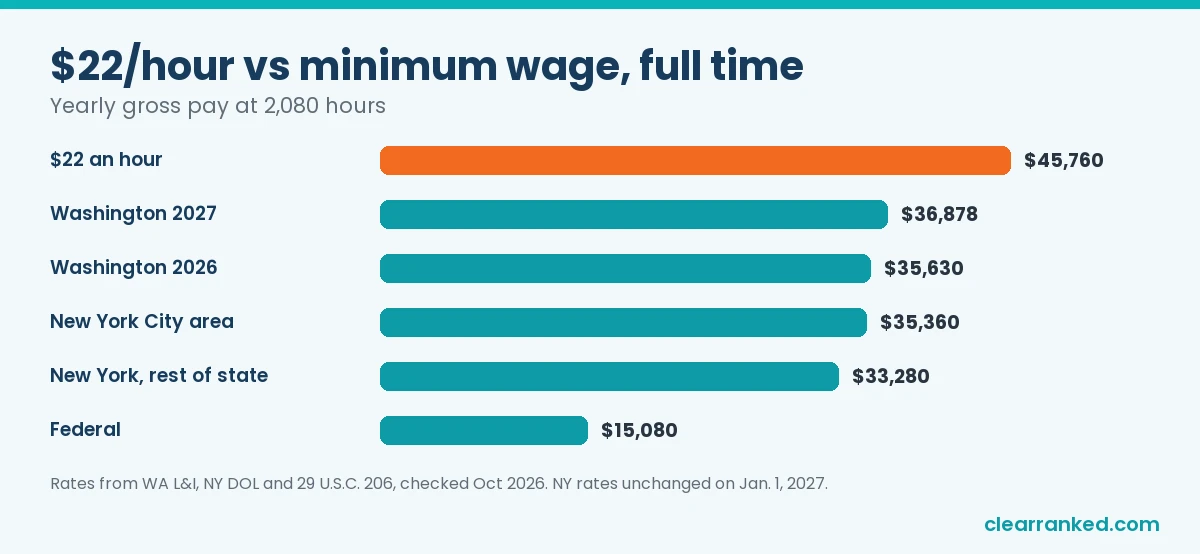
Annualized, a federal minimum-wage job pays $7.25 x 2,080, or $15,080. At $22 an hour you clear $30,680 more than that. Against Washington’s 2026 minimum, your edge is $4.87 an hour, about $10,130 a year.
New York’s rates won’t rise on January 1, 2027, per the state labor department, while Washington already announced its increase. The $7.25 federal figure is set in section 206 of the FLSA. Cities can go higher than their states, so check local rules too, or see our page on Virginia minimum wage rules.
Hiring at $22 yourself? In Washington or New York, that rate is roughly $5 to $6 over the state floor, which still gives you room to stand out with applicants. In a federal-minimum state, it’s a premium wage. Either way, list the hourly rate in the job post. Candidates skip ads that hide pay.
What does $22 an hour pay part time?
Part-time pay at $22 adds up to $22,880 a year at 20 hours a week and $34,320 at 30 hours. Your tax share also drops, because the $16,100 standard deduction covers a bigger slice of a smaller income.
| Weekly hours | Gross a year | Net a year (est.) | Net a month |
|---|---|---|---|
| 20 | $22,880 | $20,452 | $1,704 |
| 25 | $28,600 | $25,160 | $2,097 |
| 30 | $34,320 | $29,756 | $2,480 |
| 32 | $36,608 | $31,595 | $2,633 |
| 40 | $45,760 | $38,948 | $3,246 |
Take that college student at 20 hours a week. After the standard deduction, only $6,780 of their pay is taxable, so federal income tax is around $678. FICA still takes 7.65% of every dollar, though, and there’s no deduction for that.
If your shifts change week to week, track them. Our weekly hours tracker adds up clock-in and clock-out times for you.
How many hours at $22 does it take to hit an income goal?
Divide the goal by $22, then by 52 weeks. To gross $30,000 you’d need about 26.2 hours a week. Reaching $50,000 takes about 43.7 hours, which only works if some of those hours pay overtime or you add a side job.
| Yearly goal (gross) | Hours a week at $22 | Realistic? |
|---|---|---|
| $30,000 | 26.2 | Yes, part time |
| $40,000 | 35.0 | Yes, about 35 hours |
| $45,760 | 40.0 | Exactly full time |
| $50,000 | 43.7 | Needs overtime |
| $60,000 | 52.4 | Only with overtime |
That table uses the flat $22 rate, so it overstates the hours once overtime kicks in. Take the $60,000 goal. Forty regular hours pay $880 a week, leaving about $274 a week to find. At $33 an overtime hour, that’s roughly 8.3 extra hours, so a 48-hour week gets you there, not 54.5. Overtime-eligible jobs stretch your time further than any salary at the same base rate.
Which jobs pay about $22 an hour?
Health support and office roles cluster here. In the BLS May 2025 numbers, pharmacy technicians earned a median $22.00, medical assistants $21.97, shipping and receiving clerks $21.76 and general office clerks $21.64.
| Job | Middle pay per hour | Full-time equivalent |
|---|---|---|
| Pharmacy technicians | $22.00 | $45,760 |
| Medical assistants | $21.97 | $45,698 |
| Shipping, receiving and inventory clerks | $21.76 | $45,261 |
| Office clerks, general | $21.64 | $45,011 |
| Light truck drivers | $21.57 | $44,866 |
| Customer service representatives | $21.53 | $44,782 |
For perspective, the all-occupations median in that survey was $24.51. So $22 sits roughly 10% under the overall middle. Several of these jobs offer overtime, though, which can lift a year well past $45,760.
Can you live on $22 an hour?
In much of the country, yes, for a single person on a modest budget. You’d take home about $3,246 a month. Keeping rent near $1,100 holds housing to roughly a third of that. In expensive cities, $22 an hour gets tight fast.
I like the 50/30/20 rule as a starting point here. Half your take-home, about $1,623, goes to needs. Then $974 for wants and $649 for savings or paying down debt. If rent alone eats the 50%, trim wants before you trim savings.
Small raises punch above their weight at this level. Going from $22 to $24 adds $4,160 a year before tax, and you’d keep about $3,343 of it in a no-tax state. That’s worth asking for.
Retirement saving costs less than it looks, too. In the 12% bracket, $100 a month into a traditional 401(k) reduces your federal tax by roughly $12, so your check only falls by about $88.
- Ask if overtime is offered. At this rate, non-exempt overtime pays at least $33 an hour.
- Price the benefits. A strong health plan or 401(k) match can be worth more than a $1 raise.
- In Florida? Our Florida net pay calculator gives an instant estimate.
Related guides
- $40 an hour, per year and per month
- Minimum wage in Virginia
- Pay frequency basics
- Hours worked calculator
- Is there income tax in Florida?
- Time and a half calculator
FAQ
$45,760 before taxes, assuming 40 paid hours in each of 52 weeks.
Around $38,948 a year, or $3,246 a month, for a single filer in 2026 with no state income tax.
$1,760.00 gross per check, which nets roughly $1,498.01 after federal tax and FICA for a single filer.
$3,813.33 before tax on average.
Above every statewide minimum we checked. It’s about triple the $7.25 federal rate and higher than Washington’s $17.73 for 2027.
$34,320 a year, or $660 a week, before taxes.
$33 an hour, which is 1.5 times $22, for non-exempt hours beyond 40 in a week.
About the author
I’m Ali Hassan, the founder of ClearRanked. Also, I run small businesses myself, and I know how much time goes into payroll, pay math and HR rules. ClearRanked is where I share plain-English guides and honest comparisons, so small business owners can make decisions with confidence instead of guesswork.
How we work: this guide is research-based, and every source in it was checked in October 2026. We don’t take payment for rankings, and we update guides when laws or prices change. Finally, read more on our About page.