30k a Year Is How Much an Hour? $14.42, and Below Many State Minimums
A $30,000 salary works out to $14.42 an hour if you’re paid for 40 hours a week, 52 weeks a year (30,000 divided by 2,080). That’s $576.92 a week, $1,153.85 per biweekly paycheck and $2,500 a month. After 2026 federal income tax and FICA, a single filer keeps about $26,285, or $12.64 per paid hour.
Here’s the twist most converters skip. In 2026, $14.42 an hour is below the minimum wage in 18 states and Washington, DC. So the real question at this pay level isn’t only what you’ll take home. It’s whether the offer is even legal where you live, and whether you’re owed overtime.
We’ll follow one offer through all of it. Tasha, 23, has been offered a $30,000 salaried front-desk job at a small dental office in Tampa. She’s single, no kids, and wants to know if it’s a fair deal.
How we researched this: wage floors come from the U.S. Department of Labor state minimum wage table, the salary test from DOL Fact Sheet 17A, tax figures from the IRS 2026 inflation adjustments, and pay rankings from the BLS weekly earnings tables. Everything was checked in November 2026.
Key takeaways
- $30,000 a year = $14.42 an hour, $576.92 a week, $2,500 a month.
- Take-home is about $26,285 for a single filer with no state income tax.
- Full time at the minimum wage pays more than $30,000 in 18 states plus DC, including Florida, California and New York.
- At $576.92 a week, the job is below the $684 federal salary test, so overtime is owed after 40 hours.
- Putting $3,750 into a 401(k) can earn a $400 Saver’s Credit and costs only about $2,945 of take-home.

30k a year is how much an hour?
It’s $14.42. Divide $30,000 by 52 weeks to get $576.92, then divide that by 40 hours. The quick mental shortcut (halve the salary, drop the thousands) says $15, which overstates the true rate by 58 cents an hour.
The paycheck size depends on your employer’s schedule, but the yearly total doesn’t change. Weekly payroll means $576.92 checks. Biweekly gives you 26 checks of $1,153.85, while semi-monthly gives 24 checks of $1,250. Our guide to how many pay periods are in a year explains why two months a year have three biweekly paydays.
What if the week is shorter? At 35 paid hours, $30,000 is $16.48 an hour, since 35 x 52 = 1,820 hours. At 30 hours it’s $19.23. So a part-time role at $30,000 isn’t bad money. A full-time one is a different story, as you’ll see next.
Is a $30,000 salary legal in your state?
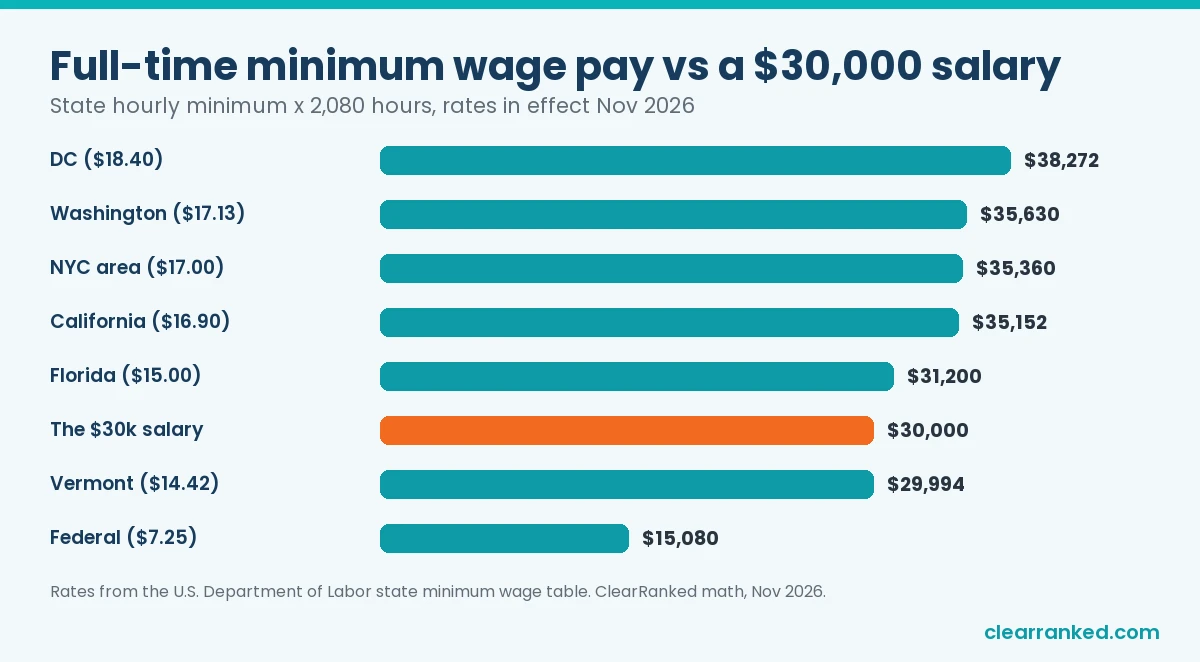
Not everywhere. A salary has to cover at least the state minimum wage for every hour worked. Spread over 40 hours, $30,000 pays $14.42 an hour, which is below the 2026 minimum in Florida, California, New York, Washington, Illinois and 13 other states, plus DC.
Run Tasha’s offer through Florida’s rules. The DOL lists Florida’s minimum at $15.00 an hour. Forty hours at $15 is $600 a week, or $31,200 a year. Her $576.92 weekly salary falls $23.08 short every single week. If she really works 40 hours, the office would have to raise the salary to at least $31,200 or pay her the difference.
| Where you work | Minimum wage | Full-time yearly pay | vs $30,000 |
|---|---|---|---|
| District of Columbia | $18.40 | $38,272 | +$8,272 |
| Washington | $17.13 | $35,630 | +$5,630 |
| New York City area | $17.00 | $35,360 | +$5,360 |
| California | $16.90 | $35,152 | +$5,152 |
| New Jersey | $15.92 | $33,114 | +$3,114 |
| Florida, Illinois, Maryland | $15.00 | $31,200 | +$1,200 |
| Vermont | $14.42 | $29,994 | About even |
| Texas, Pennsylvania (federal) | $7.25 | $15,080 | -$14,920 |
The full list of states above $14.42 also includes Arizona, Colorado, Connecticut, Delaware, Hawaii, Maine, Massachusetts, Missouri, Nebraska, Oregon and Rhode Island. A few states only cover employers above a certain size, and some cities set higher local rates. Michigan is scheduled to move to $15.00 on January 1, 2027, which would put a full-time job there at $31,200 too.
Where the federal $7.25 still applies, $30,000 is about double the legal floor. In Texas, for example, it’s a legal offer with room to spare. That’s why the same salary can be fine in Houston and a wage violation in Tampa.
Does a $30,000 salary qualify for overtime?
Yes, in almost every case. To be exempt from overtime, a white-collar employee must earn at least $684 a week under federal rules. A $30,000 salary is $576.92 a week, so the worker is nonexempt and earns time and a half after 40 hours, whatever the job title says.
The DOL is direct about this: job titles don’t decide exempt status. A salaried “office manager” earning $30,000 still gets overtime. To clear the federal test, a salary needs to be at least $684 x 52 = $35,568 a year. Several states set their own, higher test as well.
Say Tasha’s office expects 45 hours a week during busy season, and her salary is meant to cover a 40-hour week. Her regular rate is $14.42, so overtime is $21.63 an hour. Five extra hours add $108.17 to that week’s check. Over a 10-week busy stretch, that’s $1,081.73 she’s owed.
| Usual week | Extra pay per week | Yearly gross if it lasts all year |
|---|---|---|
| 40 hours | $0 | $30,000 |
| 42 hours | $43.27 | $32,250 |
| 45 hours | $108.17 | $35,625 |
| 50 hours | $216.35 | $41,250 |
One caution. Some employers use a “fluctuating workweek” setup, where the salary covers all hours and overtime is paid at half the regular rate instead. That needs a clear agreement up front, and the salary still has to meet the minimum wage. If the paperwork is vague, ask HR in writing. Our exempt vs non-exempt guide covers the duties tests too.
How much is $30,000 a year after taxes?
A single filer keeps roughly $26,285 in 2026. Federal income tax is about $1,420, Social Security takes $1,860 and Medicare $435. That’s around $2,190 a month or $1,011 per biweekly check, before any state income tax or benefit deductions.
The 2026 standard deduction for a single filer is $16,100, so only $13,900 of the salary is taxable. The first $12,400 is taxed at 10% and the last $1,500 at 12%. As a result, federal income tax is just 4.7% of gross pay, and FICA is a flat 7.65% on top.
| Line | Amount | Share of $30,000 |
|---|---|---|
| Gross salary | $30,000 | 100% |
| Standard deduction | -$16,100 | |
| Federal income tax | $1,420 | 4.7% |
| Social Security (6.2%) | $1,860 | 6.2% |
| Medicare (1.45%) | $435 | 1.45% |
| Take-home, no state tax | $26,285 | 87.6% |
Florida has no state income tax, so Tasha’s number stays at $26,285. In a flat-tax state the hit is easy to estimate: multiply taxable income by the state rate. And if you’re a single parent filing as head of household, the picture changes a lot, because the child tax credit and earned income credit can add several thousand dollars. Our $45,000 salary guide walks through those credits.
Can the Saver’s Credit stretch a $30,000 salary?
Yes, and it’s one of the most overlooked perks at this income. For 2026, a single filer with AGI of $26,250 or less gets a credit of 20% of up to $2,000 saved for retirement. Below $24,250 the rate jumps to 50%. Up to $40,250, it’s 10%.
Here’s the move. If Tasha puts $3,750 into a traditional 401(k), her AGI drops from $30,000 to exactly $26,250. That lands her in the 20% tier, so she gets a $400 credit on top of the normal tax savings from deferring pay.
| No 401(k) | $3,750 into a 401(k) | |
|---|---|---|
| Adjusted gross income | $30,000 | $26,250 |
| Federal tax before credit | $1,420 | $1,015 |
| Saver’s Credit | $0 | -$400 |
| Federal income tax owed | $1,420 | $615 |
| Take-home pay | $26,285 | $23,340 |
| Money in retirement account | $0 | $3,750 |
So $3,750 of savings costs her only $2,945 of spending money. Put another way, the government covers about 21% of the deposit. If her office doesn’t offer a plan, the same math works with a traditional IRA. The credit isn’t refundable, though, so it can’t push her tax below zero. Details and income tiers are on the IRS Saver’s Credit page.
How does $30,000 compare with what other workers earn?
It sits near the bottom of full-time pay. In the third quarter of 2026, the BLS found that 10% of full-time wage and salary workers earned $634 a week or less, about $32,968 a year. A $30,000 salary is $576.92 a week, so it falls inside that lowest tenth.
The middle of the pack is much higher. The median full-time worker made $1,232 a week, roughly $64,064 a year, more than twice Tasha’s offer. Even the first quartile, at $849 a week, works out to about $44,148.
Still, $30,000 is close to the typical pay in several large service jobs. Here’s what the BLS occupational survey shows for May 2025 national medians:
| Occupation | Median annual pay | Gap vs $30,000 |
|---|---|---|
| Fast food and counter workers | $31,200 | +$1,200 |
| Cashiers | $32,880 | +$2,880 |
| Dishwashers | $34,810 | +$4,810 |
| Childcare workers | $34,980 | +$4,980 |
| Retail salespersons | $35,410 | +$5,410 |
| Receptionists | $38,010 | +$8,010 |
Notice the receptionist line. Tasha’s role is basically reception work, and the national median for receptionists is $38,010. Her offer is $8,010 below that midpoint, before you even factor in Florida’s wage floor. That’s a solid, data-backed reason to negotiate.
What should you ask before accepting a $30,000 offer?
Ask about expected hours, how overtime is paid, and what benefits come with the salary. At this level, a health plan or a retirement match can be worth thousands, and the hours question tells you whether the offer meets your state’s minimum wage.
- How many hours a week will I actually work? Is the salary based on 40?
- Am I classified as non-exempt, and how is overtime calculated?
- What do I pay toward health insurance each paycheck?
- Is there a 401(k) or IRA option, and does the company match?
- How much paid time off do I get, and does it roll over?
- When is the first pay review, and what would a raise look like?
Tasha’s best counter is simple: ask for $31,200 to meet Florida’s minimum for 40 hours, then point to the $38,010 receptionist median to push higher. Every $1,000 raise adds about $804 to her yearly take-home, since only 12% income tax and 7.65% FICA come out of it. This isn’t legal advice; a state labor office can confirm the rules where you work.
Related guides
- Hourly to salary conversion chart
- $19 an hour is how much a year
- Florida minimum wage
- Overtime pay laws by state
- Paycheck calculator
- 2026 401(k) contribution limits
FAQ
$14.42 an hour, based on 40 hours a week for 52 weeks, or 2,080 hours. It’s $576.92 a week and $2,500 a month before taxes.
About $26,285 for a single filer in 2026 with no state income tax. That’s roughly $2,190 a month or $1,011 per biweekly paycheck.
In 18 states and DC it is, for a 40-hour week. Florida’s $15.00 minimum, for example, works out to $31,200 a year full time. Where only the federal $7.25 applies, $30,000 is well above the floor.
Usually yes. The federal salary test for exempt white-collar workers is $684 a week, or $35,568 a year. At $576.92 a week, a $30,000 employee is nonexempt and earns time and a half after 40 hours.
Yes. A single filer can claim 10% of up to $2,000 saved if AGI is $40,250 or less. Saving enough in a traditional 401(k) to bring AGI down to $26,250 lifts the credit to 20%, or $400.
It’s on the low end. BLS data for Q3 2026 puts the bottom 10% of full-time earners at $634 a week or less, and $30,000 falls below that. It can work as a part-time salary or in a low-cost area with few expenses.
About the author
I’m Ali Hassan, the founder of ClearRanked. Also, I run small businesses myself, and I know how much time goes into payroll, pay math and wage rules. ClearRanked is where I share plain-English guides and honest comparisons, so small business owners can make decisions with confidence instead of guesswork.
How we work: this guide is research-based, and every source in it was checked in November 2026. We don’t take payment for rankings, and we update guides when laws or prices change. Finally, read more on our About page.