
Texas Paycheck Calculator: 2026 Take-Home Pay With No State Income Tax
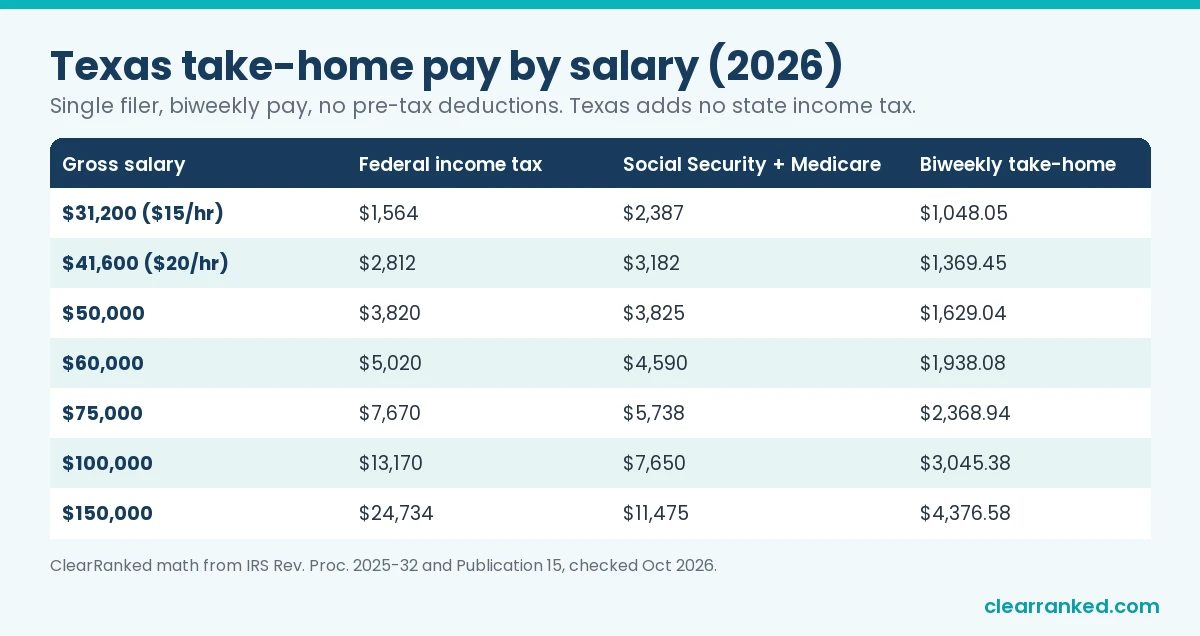
A Texas paycheck calculator only has to subtract federal income tax, Social Security and Medicare, because Texas has no state or local income tax on wages. For a single worker earning $50,000 in 2026, that leaves about $42,355 a year, or $1,629.04 every two weeks. Texas collects its money through sales and property taxes instead.
That’s the headline everyone knows. What people moving here often miss is the second half of the deal. Your paycheck is bigger than it would be in Georgia or Illinois, but your property tax bill and your receipts at the register are where Texas catches up. So this guide covers both: the take-home math, and what a Texas budget actually has to absorb after payday.
How we researched this: federal brackets and the $16,100 standard deduction came from IRS Rev. Proc. 2025-32, and the $184,500 Social Security wage base from IRS Publication 15. Sales tax rates came from the Texas Comptroller sales tax page, and homestead rules from the Comptroller property tax exemptions page. We checked everything in October 2026.
Key takeaways
- Texas has no personal income tax, so no state tax line appears on a Texas pay stub.
- A single filer on $50,000 keeps about $42,355 a year after federal tax and FICA.
- Texas workers don’t pay state unemployment tax either. Employers pay it, and it can’t be deducted from wages.
- The state sales tax is 6.25%, and local add-ons can push the combined rate to 8.25%.
- School districts must exempt $140,000 of a homestead’s value, plus another $60,000 for owners 65 or older or disabled.
Texas take-home pay calculator (2026)
Federal income tax, Social Security and Medicare. Texas has no state or city income tax on wages.
Planning estimate, not tax advice. Federal tax uses 2026 IRS brackets and the standard deduction with a W-4 that has no extra entries.
How does a Texas paycheck calculator work?
It starts with gross pay, takes out pre-tax benefits such as a 401(k), and then figures three things: federal income tax from your W-4, Social Security at 6.2% up to $184,500 of wages, and Medicare at 1.45%. There’s no state step, so what’s left is your take-home pay.
Here’s the federal piece in plain terms. Your employer annualizes each check, subtracts the standard deduction for your filing status ($16,100 single, $32,200 married filing jointly, $24,150 head of household) and runs the rest through the 2026 brackets. The result is split across your pay periods.
| 2026 federal bracket | Single taxable income | Married filing jointly |
|---|---|---|
| 10% | $0 to $12,400 | $0 to $24,800 |
| 12% | $12,400 to $50,400 | $24,800 to $100,800 |
| 22% | $50,400 to $105,700 | $100,800 to $211,400 |
| 24% | $105,700 to $201,775 | $211,400 to $403,550 |
| 32% | $201,775 to $256,225 | $403,550 to $512,450 |
| 35% | $256,225 to $640,600 | $512,450 to $768,700 |
| 37% | Over $640,600 | Over $768,700 |
Medicare has one twist. Once your wages pass $200,000 in a year, your employer adds an Additional Medicare Tax of 0.9% on the excess. The calculator applies that automatically, so a $250,000 earner sees it on the Medicare line.
How much is $50,000 a year after taxes in Texas?
About $42,355 for a single filer in 2026 with no pre-tax deductions. That’s $1,629.04 biweekly, $3,529.58 a month or $814.52 a week. Federal income tax takes $3,820, and FICA takes $3,825.
- Taxable income: $50,000 – $16,100 standard deduction = $33,900
- Federal income tax: 10% x $12,400 + 12% x ($33,900 – $12,400) = $1,240 + $2,580 = $3,820
- Social Security: $50,000 x 6.2% = $3,100
- Medicare: $50,000 x 1.45% = $725
- Take-home: $50,000 – $3,820 – $3,100 – $725 = $42,355
Put another way, a Texan on $50,000 keeps about 84.7 cents of every gross dollar. The same worker in a flat-tax state like Illinois would hand over roughly another $2,300 to the state. That gap is real money, about $90 per biweekly check.
Why are Texas paychecks bigger than in most states?
Because Texas doesn’t levy a personal income tax, there’s nothing to withhold for the state. Most other states take 2% to 5% of wages. On a $60,000 salary that missing line is worth roughly $1,900 to $2,800 a year compared with the neighbors in the chart below.
We ran a $60,000 single filer through each state’s 2026 employer withholding formula. Those are the same formulas that power our other state calculators, so the numbers line up with what a pay stub in those states would show, give or take rounding.

Also, there’s no city income tax anywhere in Texas. A worker in Houston, Austin or El Paso gets the same check as one in a small town, assuming the same pay and W-4. Compare that with states like Pennsylvania or Ohio, where moving across a city line can change your local withholding.
However, a bigger check doesn’t mean lower total taxes for every household. Texas funds schools mostly through local property taxes, and it leans on sales tax for state revenue. Whether you come out ahead depends on whether you own a home, how expensive it is and how much you spend on taxable goods.
What does Texas sales tax cost a typical household?
The state rate is 6.25%, and cities, counties, transit authorities and special districts can add up to 2% more, for a maximum combined rate of 8.25%. It applies to retail sales, leases and rentals of most goods plus a list of taxable services, so it touches a big share of what a household buys.
Let’s put numbers on it. Suppose a household spends $1,500 a month on taxable items in a city at the full 8.25% rate. That’s $1,500 x 12 = $18,000 a year, and $18,000 x 8.25% = $1,485 in sales tax. In a spot with only the state rate, the same spending costs $1,125.
| Taxable spending per year | At 6.25% (state only) | At 8.25% (max combined) |
|---|---|---|
| $10,000 | $625 | $825 |
| $18,000 | $1,125 | $1,485 |
| $25,000 | $1,563 | $2,063 |
| $40,000 | $2,500 | $3,300 |
For a renter on $50,000, that’s often far less than an income tax would cost. For a family buying a car this year, it’s a different story, though that purchase falls under the separate motor vehicle tax rules. Either way, it helps to budget sales tax as a percentage of spending, not of income.
How do Texas property taxes fit into take-home pay?
Property tax never shows up on your pay stub, but it’s the biggest Texas tax for most homeowners. School districts must exempt $140,000 of a residence homestead’s appraised value, and owners 65 or older or disabled get an extra $60,000 off for school taxes. Cities and counties can add their own optional exemptions.
Here’s the Comptroller’s own logic with real numbers. A home appraised at $300,000 with the $140,000 school homestead exemption is taxed by the school district as if it were worth $160,000. If your school district rate were, say, 1% (rates vary widely, so check your appraisal district), the school bill would be $1,600 instead of $3,000.
Counties, cities and special districts then tax the home at their own rates, with smaller or no homestead exemptions. That’s why Texas homeowners often escrow several hundred dollars a month on top of the mortgage payment. If you’re comparing a Texas job offer with one in a state that has an income tax, add your likely property tax and escrow to the Texas side of the budget before you celebrate the bigger check.
Renters pay property tax too, just indirectly through rent. Still, renters usually feel the no-income-tax benefit most clearly, since they keep the full paycheck advantage and only pay the property tax baked into their lease.
What changes when you’re married or contribute to a 401(k)?
Filing jointly doubles the federal standard deduction and widens every bracket, and pre-tax 401(k) deferrals cut federal income tax but not FICA. A married Fort Worth electrician on $85,000 with 6% to a 401(k) and $4,800 of pre-tax health premiums takes home about $64,313 a year.
The math: the 401(k) is $85,000 x 6% = $5,100, and health premiums are $4,800, so federal taxable wages are $75,100. After the $32,200 joint standard deduction, taxable income is $42,900. Federal tax is $2,480 + 12% x $18,100 = $4,652.00. FICA applies to $85,000 – $4,800 = $80,200 (health premiums under a cafeteria plan escape FICA, but 401(k) deferrals don’t), so it’s $6,135.30.
Take-home after all of that is about $64,313, or $2,473.57 biweekly. In a state with an income tax, that 401(k) would also trim state tax. In Texas it can only save federal tax, so the take-home cost of saving is a bit higher here than in, say, Georgia.
Dependents work through Step 3 of the federal W-4, which this calculator leaves blank. If you claim kids there, your federal withholding will drop below what’s shown. Our 2026 W-4 guide walks through each step.
What is the minimum wage in Texas?
The Texas minimum wage is $7.25 an hour in 2026, the same as the federal rate. The Texas Minimum Wage Act ties the state rate to the federal one, and cities such as Austin or Houston cannot set a higher minimum for private employers.
At $7.25 for 40 hours a week, a full-time year pays $15,080 before taxes. Because Texas has no state income tax, the only standard deductions from that check are FICA and any federal withholding your W-4 calls for. Tipped workers can be paid a cash wage of $2.13 an hour, as long as tips bring them up to $7.25. The full rules, including teen and overtime pay, are in our Texas minimum wage guide.
What do Texas employers withhold and pay?
Texas employers withhold only federal income tax and the employee’s share of FICA. They also pay their own matching FICA, federal unemployment tax and Texas unemployment tax. Texas unemployment tax is an employer cost, and Texas Workforce Commission rules don’t allow it to be deducted from paychecks.
- No state withholding account is needed, because there’s nothing to withhold for the state.
- New hires still go to the Texas new hire registry, and each worker fills out a federal W-4.
- The employer pays 7.65% FICA on top of wages, plus state and federal unemployment tax.
- Final paychecks, overtime and pay frequency still follow state and federal wage laws, even without an income tax.
Take a 4-person HVAC shop in San Antonio. Payroll is simpler than in most states, but it isn’t zero work: federal deposits, quarterly Form 941s, the Texas unemployment report and W-2s in January. Our guides on how to set up payroll and Texas unemployment cover the state side. Check with a CPA for your situation.
Related guides
- States with no income tax
- Florida paycheck calculator
- Washington paycheck calculator
- Paycheck calculator for every state
- Federal tax estimator
- How to read a pay stub
FAQ
No. Texas has no personal income tax, so employers withhold only federal income tax, Social Security and Medicare. There’s no city income tax in Texas either.
For a single filer in 2026 with no pre-tax deductions, about $42,355 a year, or $1,629.04 every two weeks. Federal income tax is $3,820 and FICA is $3,825.
The state rate is 6.25%. Local jurisdictions can add up to 2%, so the maximum combined rate is 8.25%.
No. Texas employers pay state unemployment tax, and it can’t be taken out of employee paychecks.
School districts must exempt $140,000 of a residence homestead’s value. Owners who are 65 or older or disabled get an extra $60,000 exemption for school taxes.
No. It’s an estimate built on 2026 IRS brackets and a W-4 with no extra entries. Your employer’s payroll software, your W-4 choices and benefits can change the result.
About the author
I’m Ali Hassan, the founder of ClearRanked. Also, I run small businesses myself, and I know how much time goes into payroll, paycheck math and Texas tax rules. ClearRanked is where I share plain-English guides and honest comparisons, so small business owners can make decisions with confidence instead of guesswork.
How we work: this guide is research-based, and every source in it was checked in October 2026. We don’t take payment for rankings, and we update guides when laws or prices change. Finally, read more on our About page.