
SALT Deduction 2026: The $40,400 Cap, Phase-Down and Examples
The SALT deduction lets you write off state and local income or sales tax plus property tax on your federal return if you itemize. For 2026 the cap is $40,400 ($20,200 if married filing separately). It shrinks once modified AGI passes $505,000, but it can’t drop below $10,000.
For years the limit sat at a flat $10,000, and lots of homeowners in high-tax states simply stopped itemizing. The 2025 tax law changed that. It quadrupled the cap for 2025, set a slightly higher figure for 2026, and added a phase-down for big earners.
Here’s why that matters for you. A couple who quit itemizing in 2018 might come out ahead by itemizing again. This guide shows the 2026 numbers, the phase-down math and a few real examples, so you can see which side of the line you’re on.
How we researched this: the cap amounts come straight from section 70120 of Public Law 119-21, the 2025 reconciliation law. We matched the phase-down steps to the worksheet in the IRS Schedule A instructions and to the 2026 Form 1040-ES. Standard deduction figures are from the IRS 2026 inflation release. Checked in October 2026.
Key takeaways
- For 2026 the SALT cap is $40,400 for most filers and $20,200 for married people filing separately.
- Above $505,000 of MAGI, you lose 30 cents of cap for every extra dollar, down to a $10,000 floor.
- You only get the SALT deduction if you itemize, and the 2026 standard deduction is $32,200 for married couples filing jointly.
- The cap rises 1% a year through 2029. In 2030 it snaps back to $10,000 unless Congress acts.
- Taxes your business pays, like property tax on a shop building, go on the business schedule and don’t count toward the personal cap.
What is the SALT deduction limit for 2026?
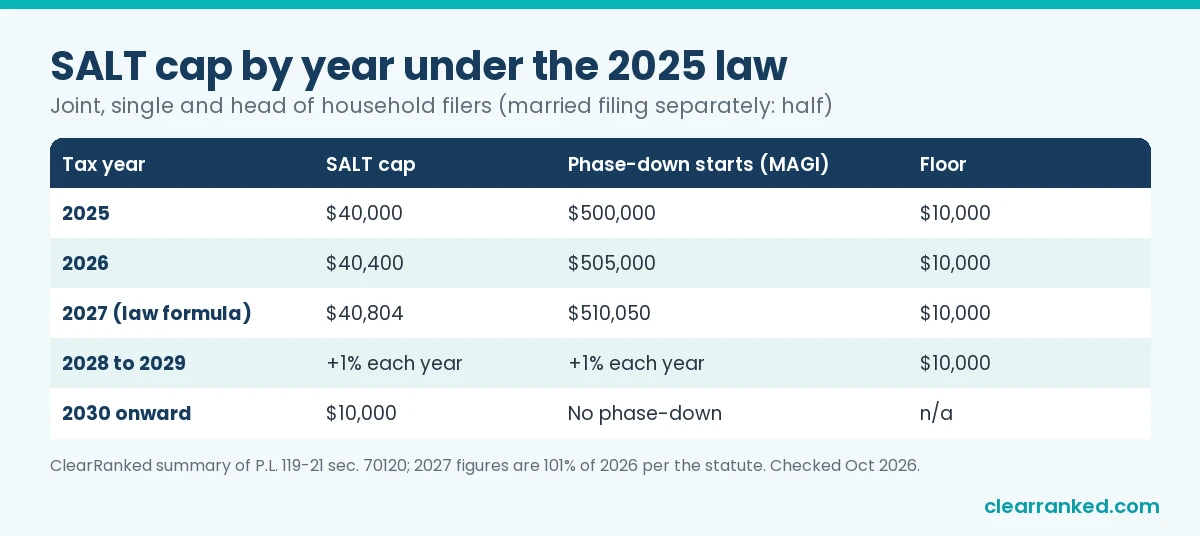
The 2026 SALT deduction limit is $40,400 for single, joint and head of household filers, and $20,200 for married filing separately. That’s up from $40,000 in 2025. The limit covers state and local income or sales taxes plus real estate and personal property taxes combined.
Notice the word combined. You don’t get $40,400 for property tax and another $40,400 for state income tax. Everything you pay in those categories goes into one bucket, and the bucket holds $40,400 at most.
Also, the cap is the same for a single person and a married couple filing jointly. Many tax figures double for couples. This one doesn’t, which is a sore spot for two-earner households in places like New Jersey or California.
Looking ahead, the law spells out a formula rather than a list of numbers. For 2027 it’s 101% of the 2026 amount. That works out to $40,804 for the cap and $510,050 for the phase-down threshold. The IRS will publish the official figures in its 2027 forms.
How does the SALT cap phase down for high earners?
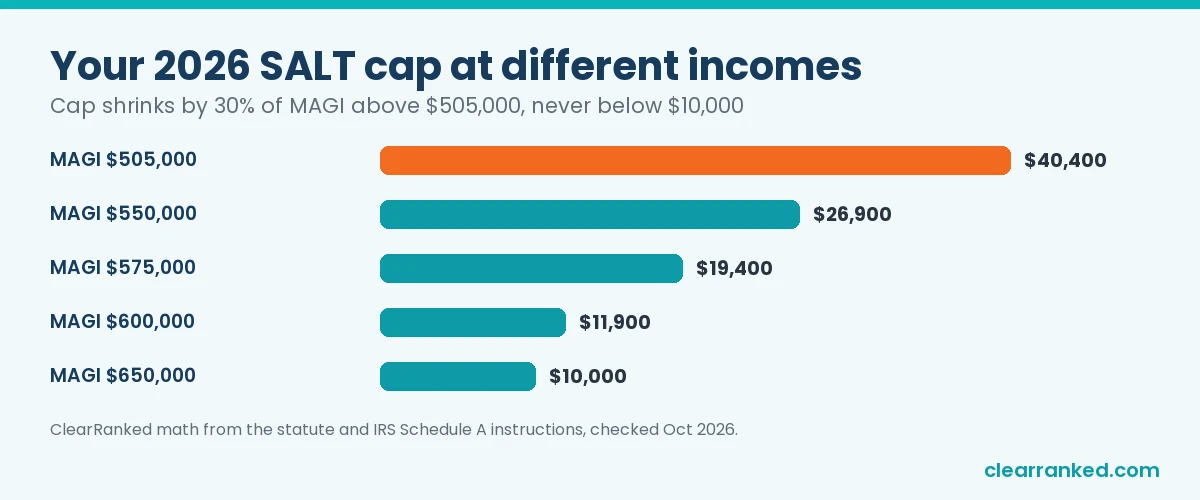
If your modified AGI is above $505,000 in 2026, subtract 30% of the excess from $40,400. The result is your cap, but it never goes below $10,000. So the bigger SALT cap fades out completely at about $606,333 of MAGI.
Let’s work it through for a dentist in Westchester with $550,000 of MAGI.
- Income over the threshold: $550,000 – $505,000 = $45,000
- Reduction: $45,000 x 30% = $13,500
- Her 2026 cap: $40,400 – $13,500 = $26,900
Push her income to $600,000 and the reduction becomes $28,500, leaving an $11,900 cap. At $650,000 the math would go below $10,000, so the floor kicks in and she keeps $10,000.
| 2026 MAGI | Reduction (30% of excess) | SALT cap |
|---|---|---|
| $450,000 | $0 | $40,400 |
| $505,000 | $0 | $40,400 |
| $525,000 | $6,000 | $34,400 |
| $550,000 | $13,500 | $26,900 |
| $575,000 | $21,000 | $19,400 |
| $600,000 | $28,500 | $11,900 |
| $650,000 | $43,500 | $10,000 |
For most people, modified AGI here is just the AGI line on Form 1040. It’s increased only if you excluded foreign earned income or certain income from US territories. One more wrinkle for married couples who file separately: the threshold is halved to $252,500 and the floor is $5,000.
Who benefits from the SALT deduction now?
The winners are itemizers in high-tax states with income below the phase-down range. Think homeowners paying $15,000 to $40,000 a year in combined state income and property taxes. People who take the standard deduction get nothing extra from the new cap.
Here’s a concrete case. Marco and Jen own a small landscaping business in New Jersey and file jointly with $300,000 of AGI. In 2026 they pay $18,000 in state income tax and $14,000 in property tax on their home. They also pay $15,000 of mortgage interest and give $4,000 to charity.
| Item | Old $10,000 cap | 2026 rules |
|---|---|---|
| SALT deduction | $10,000 | $32,000 |
| Mortgage interest | $15,000 | $15,000 |
| Charity | $4,000 | $4,000 |
| Total itemized | $29,000 | $51,000 |
| Standard deduction (joint) | $32,200 | $32,200 |
| Better choice | Standard deduction | Itemize |
Under the old $10,000 cap, their itemized total would trail the $32,200 standard deduction, so they’d skip itemizing. Under the 2026 rules they deduct $51,000, which is $18,800 more. At their 24% bracket, that’s roughly $18,800 x 24% = $4,512 less federal tax. Not bad for filling out Schedule A.
On the other hand, a renter in Texas with no state income tax won’t see much change. She could deduct sales tax instead, but unless she bought something big, like a car or a boat, it’s unlikely to beat a $16,100 standard deduction.
Which taxes count toward the SALT deduction?
Three kinds of state and local taxes count: income tax or general sales tax (you pick one), real estate tax, and personal property tax based on value, such as some car registration fees. Federal taxes, utility fees and HOA dues don’t count.
- State and local income tax withheld from your paychecks, plus estimated payments you made during the year.
- General sales tax, as an alternative to income tax. You can total your receipts or use the IRS optional tables.
- Real estate tax on your home or land, as long as it’s assessed by a local government.
- Personal property tax that’s charged yearly and based on the item’s value.
Sales tax is the smart pick in states without an income tax, like Florida or Washington. If you live in one of those states, see our guide to Florida take-home pay for how the missing state tax shows up in each paycheck.
Also, timing counts. Generally, you deduct the tax in the year you actually pay it. Prepaying next year’s property tax before the bill is assessed usually doesn’t work, so don’t count on that trick.
Does the SALT cap apply to small business taxes?
Not to taxes the business itself pays as an expense. Property tax on a bakery’s building, or sales tax on a contractor’s equipment, goes on Schedule C, E or F as a business cost. The personal SALT cap only limits the taxes you claim as an itemized deduction on Schedule A.
That split matters if you run a business from home. Say a solo bookkeeper uses 15% of her house as a qualifying home office. Part of her property tax can go on her business return, and the rest stays on Schedule A, where the cap applies.
Owners of pass-through businesses still pay state income tax on their profit personally, and that personal tax counts toward the cap. Some states offer workarounds that shift the tax to the entity level. Those rules vary a lot, so ask a CPA who knows your state.
If you’re hiring, the employer side of payroll doesn’t touch this at all. Payroll taxes are business expenses. Our guide to payroll for one employee covers that side.
Should you itemize or take the standard deduction in 2026?
Itemize only if your SALT, mortgage interest, charity and other itemized deductions add up to more than your standard deduction. The 2026 amounts are single $16,100, head of household $24,150 and married filing jointly $32,200.
A quick way to check: add your capped SALT amount to your mortgage interest. If that alone tops your standard deduction, itemizing almost always wins. If it’s close, add charity and large medical bills to see where you land.
A few more things to keep in mind:
- Itemizing doesn’t cost you the new deductions for tips, overtime or seniors. Those are available either way.
- If you don’t itemize, you can still deduct up to $1,000 of cash gifts to charity ($2,000 for joint filers) starting in 2026.
- People in the 37% bracket face a new limit on the tax benefit of itemized deductions, so their savings per dollar are a bit smaller.
Honestly, tax software handles this comparison for you. The real value of knowing the rules is planning. If you’re close to the line, bunching two years of charity gifts into one year can tip you over. Check with a CPA for your situation.
Related guides
- Florida paycheck calculator
- Pay periods in a year, explained
- Payroll services for one employee
- Contractor payroll services
- How bonuses are taxed: calculator
FAQ
It’s $40,400 for most filers and $20,200 for married filing separately. It drops by 30% of MAGI over $505,000 but stays at least $10,000.
Per return. Single filers and married couples filing jointly share the same $40,400 cap for 2026.
The higher cap runs from 2025 through 2029, rising 1% a year after 2026. Starting in 2030, the law sets it back to $10,000.
No. You choose one or the other. People in states without an income tax usually pick sales tax.
Yes. The SALT deduction is only available on Schedule A, so it helps only if your itemized total beats your standard deduction.
No. Taxes your business pays as a business expense go on Schedule C, E or F and aren’t limited by the personal SALT cap.
The law sets it at 101% of the 2026 cap, which works out to $40,804, with a phase-down threshold of $510,050. Watch for the official IRS figures.
About the author
I’m Ali Hassan, the founder of ClearRanked. Also, I run small businesses myself, and I know how much time goes into payroll, pay math and HR rules. ClearRanked is where I share plain-English guides and honest comparisons, so small business owners can make decisions with confidence instead of guesswork.
How we work: this guide is research-based, and every source in it was checked in October 2026. We don’t take payment for rankings, and we update guides when laws or prices change. Finally, read more on our About page.