80k a Year Is How Much an Hour? $80,000 Salary in 2026
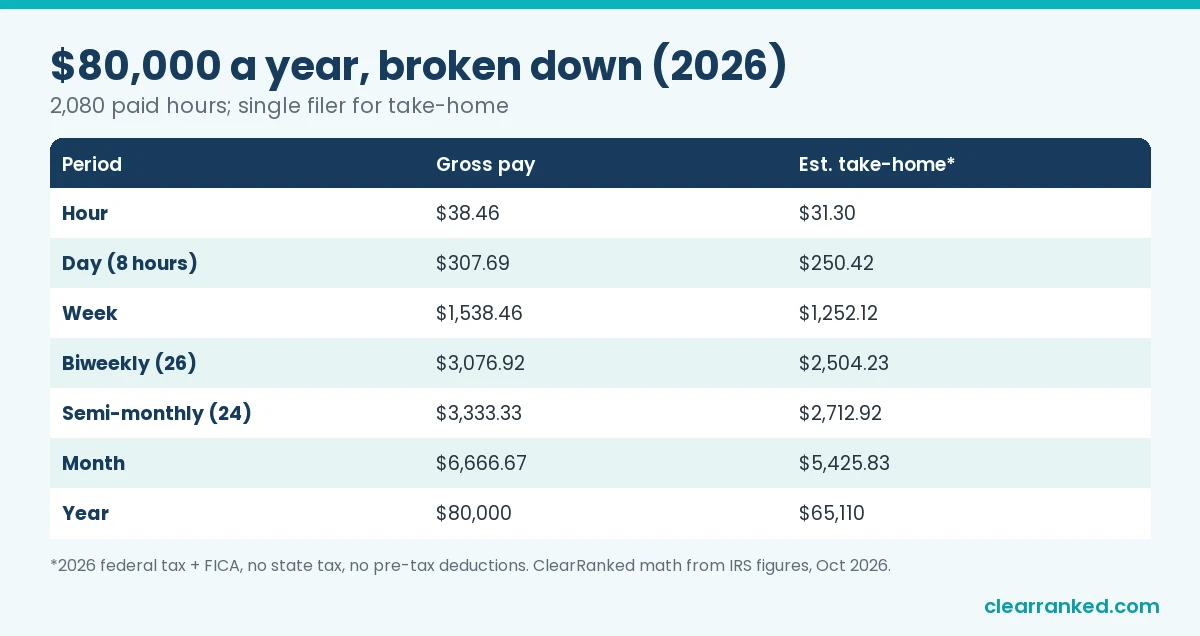
An $80,000 salary equals about $38.46 an hour, assuming 40-hour weeks all year (80,000 divided by 2,080). It also works out to $1,538.46 weekly, $3,076.92 per biweekly check and $6,666.67 monthly. A single filer clears roughly $65,110 after 2026 federal income tax and FICA, or $5,425.83 a month.
Eighty thousand is where tax planning starts to pay off. A slice of your income now sits in the 22% bracket, which makes every pre-tax dollar more valuable. It’s also a pay level where most jobs are salaried and exempt, so the clock doesn’t stop at 40 hours.
Let’s use a real-world example. Marcus is a construction project supervisor offered $80,000. He’s single, rents in a mid-size city and wants to know three things: his true hourly rate, his actual paycheck, and how much a 401(k) will cost him. We’ll answer all three.
How we researched this: Marcus’s tax math uses the official 2026 IRS tax tables and deduction amounts, the 2026 401(k) deferral limit, and pay comparisons from the BLS occupational wage survey and the BLS earnings release. Everything was rechecked in October 2026.
Key takeaways
- Hourly equivalent: $38.46. Weekly: $1,538.46.
- Federal income tax $8,770 plus FICA $6,120 leaves about $65,110 (single, no state tax).
- Only the top $13,500 of taxable income is taxed at 22%; the effective federal rate is about 11.0%.
- The first $13,500 of 401(k) savings each cut federal tax by 22 cents per dollar.
- That salary beats the typical full-time paycheck by about 25%.
80k a year is how much an hour?
Roughly $38.46. Divide $80,000 by 52 weeks to get $1,538.46, then by 40 hours. A rough check is to halve the salary and read it as dollars per hour: $40. That’s close, but it overstates the real rate by about $1.54.
Marcus’s pay schedule changes the check size, not the total. Biweekly, he’ll see $3,076.92 gross. If his company pays twice a month, each check is $3,333.33. Weekly payroll would mean $1,538.46.
What if he’d been offered $40 an hour instead? Full time, that’s $83,200, which beats $80,000 by $3,200 a year before overtime even enters the picture. Our walkthrough of the $40-an-hour salary runs those numbers in detail.
How much is $80,000 a year after taxes?
A single filer keeps about $65,110 in 2026. Federal income tax is about $8,770, Social Security $4,960 and Medicare $1,160. That’s close to $5,426 a month, before any state or local income tax.
The bracket question confuses a lot of people, so here it is laid out by marginal and effective rate:
| Portion of taxable income | Marginal rate | Tax on that portion | Running total |
|---|---|---|---|
| First $12,400 | 10% | $1,240 | $1,240 |
| Next $38,000 | 12% | $4,560 | $5,800 |
| Last $13,500 | 22% | $2,970 | $8,770 |
Taxable income here is $63,900, because the 2026 single standard deduction of $16,100 comes off first. So Marcus’s top rate is 22%, yet his whole federal income tax bill is only 11.0% of salary. With FICA included, the federal share is about 18.6%.
What about a raise to $85,000? Every extra dollar is taxed at 22% plus 7.65% FICA, so he’d keep about $3,518 of the $5,000. Raises never shrink your take-home; that’s a myth.
State taxes vary widely. A flat 3.07% in Pennsylvania would leave about $62,654; Illinois’s 4.95% about $61,150. The Tax Foundation lists the states with none. A CPA can confirm the numbers for you.
How much does a 401(k) cost you at $80,000?
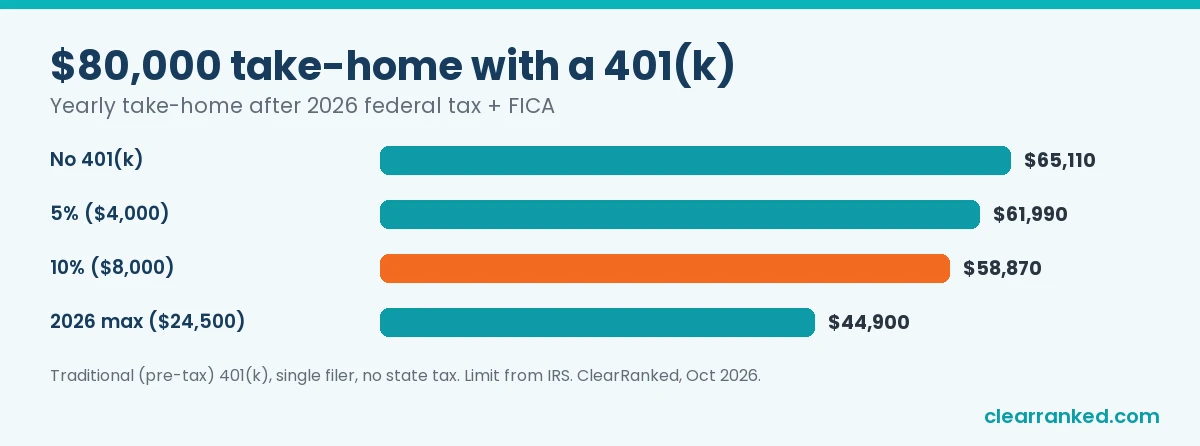
Less than the amount you save. Since your top dollars are taxed at 22%, the first $13,500 you put into a traditional 401(k) costs you only about 78 cents per dollar in take-home. A 10% contribution ($8,000) reduces yearly take-home by about $6,240.
| You contribute | Federal income tax | Yearly take-home | Biweekly net |
|---|---|---|---|
| Nothing | $8,770 | $65,110 | $2,504.23 |
| $4,000 (5%) | $7,890 | $61,990 | $2,384.23 |
| $8,000 (10%) | $7,010 | $58,870 | $2,264.23 |
| $13,500 (fills the 22% slice) | $5,800 | $54,580 | $2,099.23 |
| $24,500 (2026 maximum) | $4,480 | $44,900 | $1,726.92 |
After $13,500, the tax break shrinks, because further deferrals come out of the 12% bracket. At the full $24,500, federal tax drops from $8,770 to $4,480. FICA isn’t affected either way.
If Marcus asked me, I’d say aim for at least $13,500 if the budget allows. That’s the sweet spot where each dollar saved gets the full 22% break. A Roth 401(k) flips the deal, with tax now and tax-free withdrawals later; see our Roth versus traditional comparison and the full 2026 limits.
Got an employer 401(k) match? That’s the first money to claim. A 4% match on $80,000 is $3,200 a year added to your account for doing nothing more than contributing 4% yourself. Skipping it is like turning down a raise.
What’s $80,000 per hour if you work 50-hour weeks?
About $30.77. Salaried pay doesn’t grow with your hours, so the longer the week, the lower your real rate. At 45 hours it’s $34.19, and at 55 hours just $27.97. Divide $80,000 by your weekly hours times 52 to get yours.
| Usual week | Hours worked a year | Effective hourly pay |
|---|---|---|
| 40 hours | 2,080 | $38.46 |
| 45 hours | 2,340 | $34.19 |
| 50 hours | 2,600 | $30.77 |
| 55 hours | 2,860 | $27.97 |
Construction supervisors often log long weeks in peak season. If Marcus averages 50, he’s earning about $30.77 an hour. A non-exempt foreman at $36 an hour working 45 hours would pull in $36 x 40 + $54 x 5 = $1,710 a week, or $88,920 a year. Food for thought.
Most $80,000 roles are exempt, as long as the duties qualify and pay clears $684 a week. Our explainer on overtime exemption tests has the details.
Is it worth negotiating $80,000 up to $85,000 or $90,000?
Usually, yes. At this level each extra dollar keeps about 70 cents after the 22% federal rate and 7.65% FICA. Bumping $80,000 to $85,000 adds about $3,518 of take-home a year, roughly $135 per biweekly check.
| Offer | Hourly equivalent | Take-home (single, no state tax) | Gain vs $80,000 |
|---|---|---|---|
| $80,000 | $38.46 | $65,110 | – |
| $82,000 | $39.42 | $66,517 | $1,407 |
| $85,000 | $40.87 | $68,628 | $3,518 |
| $90,000 | $43.27 | $72,145 | $7,035 |
Marcus asked for $85,000, citing the BLS median for his role and his crane certification. He got $83,000 plus an extra week of PTO. Was that a win? The $3,000 raise is worth about $2,110 after federal taxes, and the extra week is worth roughly $1,600 of paid time. Together, that’s a solid outcome for one email.
A tip if you’re in his shoes: anchor with a specific number backed by data, not a range. Ranges invite the employer to pick the bottom, and you will rarely get more than you ask for. Put the request in writing so the final number is on record.
Is $80,000 a good salary?
Yes, by national numbers. Full-time workers had a median of $1,232 a week in Q3 2026, about $64,064 a year, so $80,000 is around 25% higher. It’s also far above the $24.51 all-jobs hourly median from May 2025.
Whether it feels good depends on rent and debt. In Kansas City it’s comfortable. In Boston, a single earner at $80k can still feel stretched once housing takes 40% of take-home.
Here’s a quick gut check I like. If you can save 15% of gross, about $1,000 a month, while still covering rent and a car, $80,000 is working for you. If you can’t save anything, the problem is usually housing or debt, not the salary. On $5,426 of monthly take-home, a $2,000 apartment is manageable; a $2,800 one starts crowding out everything else.
Jobs with medians near this level, according to the May 2025 BLS survey:
- Radiologic technologists, $38.52 an hour (about $80,122 a year)
- First-line supervisors of construction trades, $38.42 (about $79,914)
- Market research analysts, $37.87 (about $78,770)
- Compensation, benefits and job analysis specialists, $37.60 (about $78,208)
- Loan officers, $36.87 (about $76,690)
Marcus is right on target, then. Construction supervisors’ median sits just $86 a year under $80,000. If you hire for roles like his, our payroll setup walkthrough covers the employer taxes on top of salary.
How much house can you afford on $80,000 a year?
On $80,000 a year, gross income is $6,666.67 a month. At Fannie Mae’s 36% debt-to-income limit for manually underwritten loans, all your monthly debts, mortgage included, could total about $2,400. Loans approved through its automated system can go up to 50%, or about $3,333.
Lenders use gross pay, not take-home, and they subtract your other debts first. The CFPB defines DTI as all monthly debt payments divided by gross monthly income. The caps below come from the Fannie Mae Selling Guide; the 45% level needs a qualifying credit score and cash reserves.
| DTI limit | Total monthly debts allowed | Left for housing with a $400 car loan |
|---|---|---|
| 36% | $2,400 | $2,000 |
| 45% | $3,000 | $2,600 |
| 50% | $3,333 | $2,933 |
That housing figure has to cover principal, interest, property tax, insurance and any HOA dues. Keep in mind that a single filer nets roughly $5,426 a month on $80,000, so a $3,000 payment would eat more than half of it. Lenders approve the maximum, but you live on the net.
Related guides
- $40 an hour per year
- Converting a $50k salary to hourly
- 401(k) contribution limits
- Roth vs traditional 401(k)
- Estimate your 2026 federal tax
- Who’s exempt from overtime
FAQ
About $38.46, based on 2,080 working hours in a full-time year.
Roughly $65,110 if you file single in 2026 and live where the state doesn’t tax wages.
$3,076.92 gross, or about $2,504.23 net for a single filer.
22% at the top for a single filer in 2026, but only on the last $13,500 of taxable income. Your effective federal income tax rate comes to about 11.0%.
No. $80,000 is $38.46 an hour. Full-time pay at $40 an hour is $83,200.
At least enough for any employer match. Saving about $13,500 captures the full 22% tax break; the 2026 cap is $24,500.
About $30.77 an hour, because 50 hours times 52 weeks is 2,600 hours.
About the author
I’m Ali Hassan, the founder of ClearRanked. Also, I run small businesses myself, and I know how much time goes into payroll, pay math and HR rules. ClearRanked is where I share plain-English guides and honest comparisons, so small business owners can make decisions with confidence instead of guesswork.
How we work: this guide is research-based, and every source in it was checked in October 2026. We don’t take payment for rankings, and we update guides when laws or prices change. Finally, read more on our About page.