55 an Hour Is How Much a Year? $114,400, and What to Bill for It
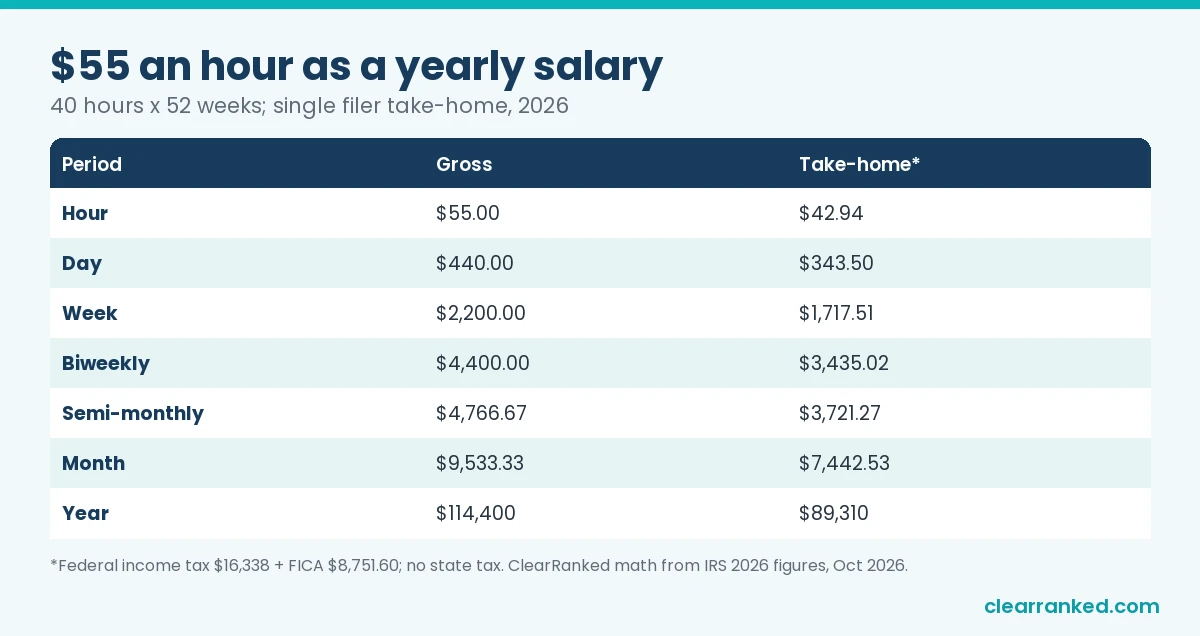
$55 an hour works out to $114,400 a year on a full-time schedule ($55 x 40 hours x 52 weeks). That’s $2,200 a week, $4,400 every two weeks and $9,533.33 a month. A single filer keeps about $89,310 after 2026 federal income tax and FICA, before state tax.
This guide covers both sides of that number. If you earn $55 an hour, you’ll find your take-home pay and how it compares with similar jobs. If you’re a business owner paying someone $55 an hour, you’ll see what that person really costs and what you need to bill clients to cover it.
Our example is a small general contractor, Hollis Build, that pays its project manager, Nadia, $55 an hour. The owner bills Nadia’s time to clients and wants a rate that covers her wage, taxes, benefits and the company’s overhead, with some profit left over.
How we researched this: tax and payroll math uses the IRS 2026 inflation adjustments and IRS Publication 15, which sets the 2026 Social Security wage base and the federal unemployment tax rules. Job pay comes from the BLS wage survey. Benefit and overhead amounts are example inputs, not national averages. Checked October 2026.
Key takeaways
- $55 an hour = $114,400 a year, $9,533.33 a month, $4,400 every two weeks.
- Single filer: about $16,338 federal income tax and $8,751.60 FICA, leaving roughly $89,310.
- The employer adds another $8,751.60 of FICA plus $42 of federal unemployment tax.
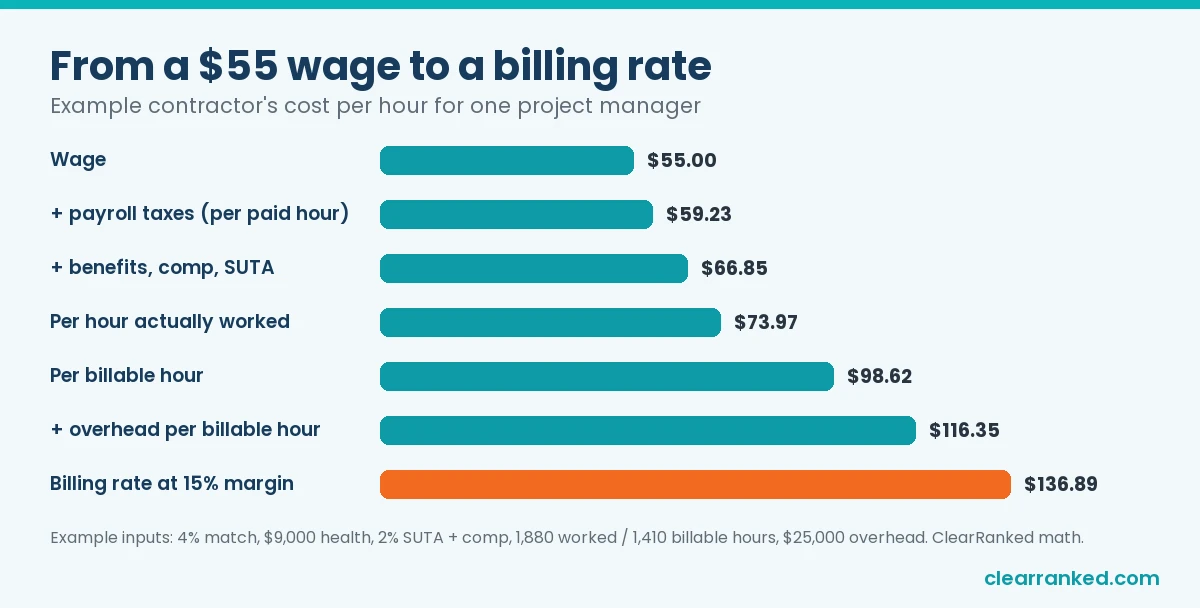
- In our example, a $55 wage costs about $98.62 per billable hour before overhead.
- With $25,000 of overhead and a 15% profit margin, the billing rate comes to about $137 an hour.
55 an hour is how much a year?
$114,400 before taxes, assuming 2,080 paid hours. The formula is $55 x 40 = $2,200 a week, and $2,200 x 52 = $114,400 a year. Monthly gross averages $9,533.33, an eight-hour day is $440, and a semi-monthly check is $4,766.67.
If Nadia is non-exempt, overtime pays $82.50 an hour. Most project managers at this level are paid as exempt salaried staff, though, since $2,200 a week is far above the $684 weekly floor in 29 CFR 541.600. Either way, the yearly base is the same $114,400.
Fewer paid hours lower it quickly. At 36 hours a week, $55 comes to $102,960. With four unpaid weeks a year, a 40-hour schedule pays $105,600.
How much is $55 an hour after taxes?
About $89,310 a year for a single filer, or roughly $7,443 a month. Federal income tax is $16,338 on $98,300 of taxable income. Social Security takes $7,092.80 and Medicare $1,658.80. Nadia keeps about $42.94 of each $55 hour, before state tax.
| Taxable income slice | Rate | Tax |
|---|---|---|
| $0 to $12,400 | 10% | $1,240 |
| $12,400 to $50,400 | 12% | $4,560 |
| $50,400 to $98,300 | 22% | $10,538 |
| Total on $98,300 | 14.3% of gross | $16,338 |
She’s $7,400 short of the 24% bracket, which starts at $105,700 of taxable income for single filers in 2026. So a raise to $60 an hour would push a small slice into 24%. Also, her pay is well under the $184,500 Social Security wage base, so the 6.2% applies to every dollar she earns.
If she’s married filing jointly and her spouse doesn’t work, the $32,200 joint standard deduction and wider brackets would drop her federal income tax to about $9,368. Our federal tax estimator runs other situations.
What does a $55-an-hour employee cost the business?
Far more than $114,400. Hollis Build pays a matching $8,751.60 of FICA and $42 of federal unemployment tax. In our example it also pays a 4% 401(k) match ($4,576), $9,000 toward health insurance and about 2% of wages for state unemployment and workers’ comp. That totals about $139,058.
| Cost item | Yearly amount | How it’s figured |
|---|---|---|
| Wages | $114,400 | $55 x 2,080 paid hours |
| Employer Social Security + Medicare | $8,751.60 | 7.65% of wages |
| Federal unemployment (FUTA) | $42 | 0.6% of first $7,000 |
| 401(k) match (example) | $4,576 | 4% of wages |
| Health insurance share (example) | $9,000 | Employer premium |
| State unemployment + workers’ comp (example) | $2,288 | 2% of wages |
| Total cost | $139,057.60 | About $66.85 per paid hour |
The FICA and FUTA lines are set by federal law. The FUTA figure assumes the business gets the full 5.4% state credit, which leaves 0.6% on the first $7,000. State unemployment rates, workers’ comp premiums and benefit costs vary widely, so swap in your own numbers.
Our guides to setting up payroll and small business health insurance cover those costs in more detail.
How many hours can a $55-an-hour employee actually bill?
Far fewer than 2,080. Nadia is paid for holidays, vacation and sick days, so she works about 1,880 hours in our example. And not every working hour is billable; meetings, estimating and admin take time. At 75% of worked hours, she bills about 1,410 a year.
| Hours | Count | Cost per hour at $139,058 |
|---|---|---|
| Paid hours | 2,080 | $66.85 |
| Minus 10 holidays, 2 weeks PTO, 5 sick days | 1,880 worked | $73.97 |
| Billable share (75%) | 1,410 billed | $98.62 |
This is the step most new contractors skip. They take the $55 wage, add 20% and call it a rate. But spreading the full cost over billable hours shows Nadia’s time costs the company nearly $99 an hour before a single dollar of rent, trucks or software.
The PTO numbers here are just one company’s policy. Our guide to PTO policy for small businesses shows other common setups, and how each one changes worked hours.
What should a contractor bill for a $55-an-hour employee?
In our example, about $137 an hour. Add $25,000 of overhead spread over 1,410 billable hours ($17.73 an hour) to get a full cost of $116.35. Then divide by 0.85 to keep a 15% profit margin. A 20% margin would push the rate to about $145.
Watch the difference between markup and margin here. Adding 15% to $116.35 gives $133.81, which is only a 13% margin. Dividing by 0.85 instead gives $136.89, a true 15% margin. On 1,410 hours, that gap is worth about $4,300 a year.
| Pricing method | Billing rate | Profit per billable hour | Real margin |
|---|---|---|---|
| Cost + 15% markup | $133.81 | $17.45 | 13.0% |
| Cost / 0.85 (15% margin) | $136.89 | $20.54 | 15.0% |
| Cost / 0.80 (20% margin) | $145.44 | $29.09 | 20.0% |
Our markup calculator converts between the two, and the guide on calculating profit margin explains why it matters. Check with your accountant before setting rates.
Could the business pay $55 an hour to a 1099 contractor instead?
Only if the worker truly is independent. Paying Nadia as a contractor would skip the $8,751.60 employer FICA, the $42 FUTA and the benefits. But the IRS looks at who controls the work, not the label, and a project manager who keeps company hours under the owner’s direction usually looks like an employee.
The IRS sorts the facts into three groups: behavioral control, financial control and the relationship between the parties. Someone who sets her own methods, uses her own tools, works for several clients and invoices by the project points toward contractor status. Someone with a set schedule, a company truck and a desk in the office points the other way.
Also, a real contractor would rarely accept $55. She’d need to cover her own self-employment tax, insurance and unpaid time, so her rate would likely land somewhere around $75 to $85 an hour, using the same math as our $60 example. In other words, the saving often shrinks once the contractor prices in her own costs. See our guides to Form 1099 and paying contractors, and ask a CPA before reclassifying anyone.
Which jobs pay about $55 an hour?
Construction managers had a national median of $55.28 an hour in the BLS May 2025 wage survey, almost exactly Nadia’s pay. Electrical engineers were a bit higher at $58.00, and industrial production managers at $60.61. General and operations managers came in lower, at $50.85.
So $55 an hour is typical for experienced construction managers nationwide, not exceptional. In big metros, that role often pays more, while smaller markets may run lower.
For workers, $2,200 a week is about 79% more than the $1,232 median weekly earnings of full-time workers in the third quarter of 2026. If you’re thinking of going independent at a similar rate, our look at $60 an hour as a W-2 vs a 1099 contractor shows what self-employment tax and unpaid time off do to the math.
Related guides
- $60 an hour: W-2 vs 1099
- How to calculate profit margin
- Markup calculator
- How to set up payroll
- Small business health insurance
- Hourly to salary conversion
FAQ
$114,400 a year for 40 hours a week over 52 weeks, or about $9,533 a month before taxes.
About $89,310 a year for a single filer in 2026 with no state income tax, which is about $42.94 per hour.
$4,400 gross every two weeks, or about $3,435 after federal income tax and FICA for a single filer.
At least $123,193.60 a year with employer FICA and federal unemployment tax. With a 4% match, health coverage and state costs, our example reaches about $139,058.
In our example, about $137 an hour, based on 1,410 billable hours, $25,000 of overhead and a 15% profit margin. Your numbers will differ.
Yes. At 40 hours a week for 52 weeks, $55 an hour is $114,400, and even 36 hours a week pays $102,960.
About the author
I’m Ali Hassan, the founder of ClearRanked. Also, I run small businesses myself, and I know how much time goes into payroll, pay math and HR rules. ClearRanked is where I share plain-English guides and honest comparisons, so small business owners can make decisions with confidence instead of guesswork.
How we work: this guide is research-based, and every source in it was checked in October 2026. We don’t take payment for rankings, and we update guides when laws or prices change. Finally, read more on our About page.